

Texas McCombs MBA Guide 2026–27: Admissions, Class Profile, Curriculum, Employment, Fees & Scholarships
A complete guide to the Texas McCombs Full-Time MBA, covering academics, class profile, admissions, Austin and Southwest recruiting, career outcomes, costs, and scholarships.
The Texas McCombs Full-Time MBA sits at an interesting intersection.
It is a two-year MBA at a major public research university, in one of the most commercially active cities in the United States, with a curriculum that becomes highly customizable after a relatively compact core.
That combination makes Austin an obvious part of the McCombs story.
But location alone is not a career strategy.
The useful question is not:
"Do I want to get an MBA in Austin?"
It is:
"Can McCombs give me the academic preparation, practical experience, recruiting access, network, and geographic reach needed for the specific career transition I want?"
The latest employment data makes that distinction especially important.
McCombs placed 72% of reported U.S. locations in the Southwest for the Class of 2025, and the employment report highlights Austin as the dominant individual destination.
At the same time, the school's three largest industries were consulting, technology, and financial services.
That means McCombs should not be reduced to either:
- an "Austin tech MBA";
- or a "Texas energy MBA."
Its recent career outcomes are broader than either stereotype.
Academically, more than 70% of coursework is self-selected, students begin electives during the first year, and McCombs layers its core with Custom Core courses, concentrations, McCombs+ projects, Fellows programs, investment funds, leadership development, and global experiences.
This guide focuses on the two-year Full-Time MBA at The University of Texas at Austin, not McCombs's Evening, Executive, Dallas, or Houston MBA formats.
It uses the latest official Class of 2027 profile, the 2026–27 admissions cycle, the Class of 2025 employment report, and McCombs's currently published tuition, cost, and scholarship information.
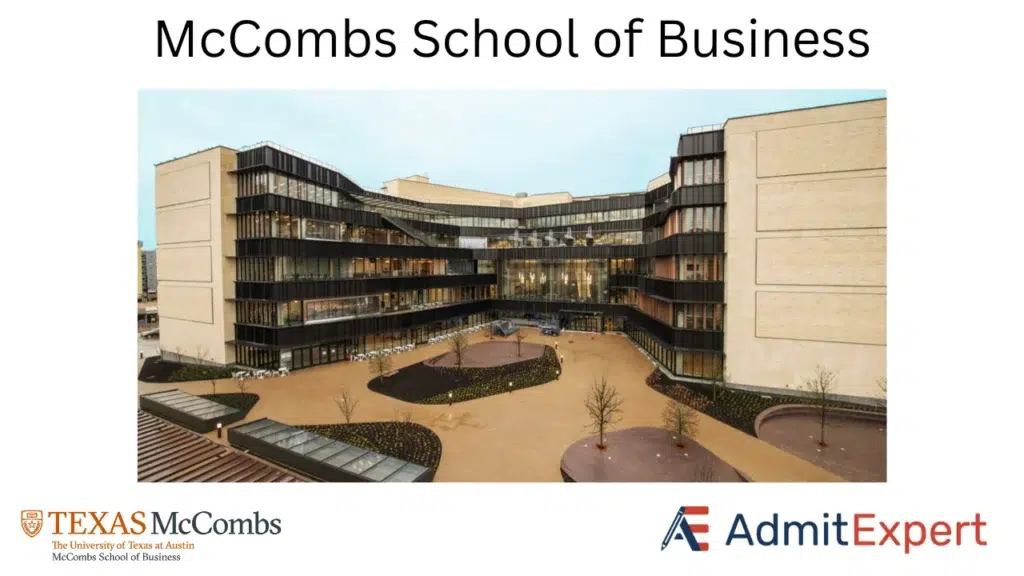
Texas McCombs MBA at a Glance
| Metric | Latest official figure |
|---|---|
| Latest published Full-Time MBA class profile | Class of 2027 |
| Students enrolled | 235 |
| Average age | 29 |
| Average work experience | 6 years |
| International students | 31% |
| Median undergraduate GPA | 3.53 |
| Median GMAT Focus score | 655 |
| Median GRE total | 319 |
| Median Executive Assessment score | 155 |
| Coursework that is self-selected | More than 70% |
| Electives | 100+ |
| STEM structure | Two STEM-designated academic paths |
| Class of 2025 median base salary | $150,000 |
| Class of 2025 mean base salary | $154,053 |
| Job seekers receiving an offer within 3 months | 74.6% |
| Job seekers accepting an offer within 3 months | 72.1% |
| Job seekers receiving an offer within 6 months | 80.2% |
| Job seekers accepting an offer within 6 months | 78.2% |
| Current two-year program-cost estimate, Texas resident | $110,392 |
| Current two-year program-cost estimate, nonresident | $122,428 |
| 2026–27 nine-month budget, Texas resident | $79,871 |
| 2026–27 nine-month budget, nonresident | $85,889 |
| Next Full-Time MBA deadline | Round 1 — October 15, 2026 |
The latest Full-Time MBA class profile remains the Class of 2027.
McCombs does not publish the admission-offer count needed to calculate a current acceptance rate from that page.
Dividing the 235 enrolled students by any application total would produce an enrollment-to-application ratio, not an acceptance rate.
What Makes the Texas McCombs MBA Distinctive?
Five parts of the Full-Time MBA reinforce one another:
- Austin and a heavily Southwest-oriented recruiting footprint;
- a 235-student entering class organized into cohorts and study teams;
- unusually high academic customization;
- a large applied-learning ecosystem through McCombs+, Fellows programs, funds, and leadership development;
- access to the wider resources of The University of Texas at Austin.
The important point is interaction.
A technology candidate may use Austin very differently from an energy candidate.
A consultant moving into corporate strategy may use the Custom Core differently from a banker pursuing private equity.
A military applicant may get more value from leadership development and a functional career switch than from adding another broad management credential.
The school becomes easier to evaluate once those elements are connected to an actual post-MBA role.
Austin Is an Advantage Only If You Know How to Use It
McCombs is based in Rowling Hall on the UT Austin campus, close to downtown Austin.
That places students inside a market with employers and networks spanning:
- technology;
- consulting;
- financial services;
- energy;
- healthcare;
- consumer businesses;
- real estate;
- startups;
- professional services.
But an Austin address does not automatically produce access to every role in those sectors.
A candidate targeting product management might need:
- relevant product or analytics coursework;
- the MBA Tech Club;
- a McCombs+ project;
- conversations with product managers and alumni;
- a summer internship;
- evidence of customer and technical judgment.
A candidate targeting energy finance might instead need:
- finance and valuation coursework;
- the Energy Finance Group;
- energy-specific electives;
- industry relationships;
- transaction or project-finance exposure.
The location becomes valuable through repeated interaction.
It is not valuable merely because Austin appears on the resume.
McCombs's Employment Geography Is Heavily Southwest-Oriented
The Class of 2025 employment report places 72% of reported U.S. locations in the Southwest.
The report also highlights 56.4% of post-MBA geographic placements in Austin.
That is one of the clearest facts an applicant should understand about McCombs.
For someone targeting:
- Austin;
- Texas;
- the broader Southwest;
the concentration can be a major advantage.
For someone committed to:
- New York;
- San Francisco;
- Chicago;
- another U.S. region;
- an international market;
the same number should trigger more research.
The question becomes:
How strong is the McCombs recruiting and alumni pathway in the exact geography I want?
A nationally recognized MBA can still have a regional center of gravity.
A 235-Student Entering Class Creates a Relatively Compact MBA Community
The Class of 2027 contains 235 students.
McCombs reinforces that class structure through a cohort model.
Its student-experience page says students are placed into a cohort before classes begin and then assigned to a study team of four to six people during the first year.
That creates two layers of repeated interaction:
- the broader cohort;
- the smaller study team.
For an applicant, the useful question is not whether a smaller or larger MBA is universally better.
It is whether you want an environment where you repeatedly work with a relatively compact group of classmates.
A smaller class can make relationships feel denser.
It can also mean fewer classmates in a very narrow industry or function than you might find in a much larger MBA program.
That is a trade-off, not a flaw.
More Than 40 Student Organizations Expand the Community Beyond the Cohort
McCombs currently lists 40+ Full-Time MBA student organizations across professional development, affinity, leadership, social, and sports categories.
Career-oriented groups include organizations focused on:
- consulting;
- finance;
- technology;
- energy;
- clean technology;
- marketing;
- operations;
- real estate;
- healthcare;
- entrepreneurship;
- sports, entertainment, and media.
That matters because clubs can perform several different functions.
They can provide:
- peer-led recruiting preparation;
- technical training;
- employer relationships;
- alumni access;
- leadership roles;
- social community.
The useful distinction is between joining a club and using it.
Membership by itself adds little.
A club becomes valuable when it changes the applicant's preparation, network, knowledge, or leadership evidence.
More Than 70% of the McCombs Curriculum Is Self-Selected
McCombs's current Full-Time MBA curriculum says more than 70% of coursework is self-selected.
Students can choose from 100+ electives.
That is one of the program's defining academic features.
The degree begins with a common management foundation, but customization starts during the first year and dominates the second.
The First Fall Builds the Management Foundation
The fall curriculum includes:
- Financial Accounting;
- Financial Management;
- Statistics;
- Microeconomics;
- Marketing Management;
- Operations Management;
- Strategic Career Planning;
- one Custom Core course.
The purpose is breadth.
A finance professional may need operations and marketing.
An engineer may need accounting and customer economics.
A military officer may need formal finance or marketing frameworks.
A consultant may need deeper operating or functional knowledge.
The core becomes useful when it fills gaps rather than simply repeating the applicant's strongest subjects.
The Custom Core Adds Choice Before the Curriculum Becomes Mostly Elective
McCombs does not use a completely fixed first-year sequence.
Students select four Custom Core courses.
One is taken in the fall.
Three more are taken in the spring alongside Strategic Management.
That gives students some ability to begin shaping the degree before the fully elective second year.
The timing matters.
Internship recruiting happens during the first year.
A candidate should therefore ask:
What do I need to know before I interview—not merely before I graduate?
A course taken after the relevant recruiting process may still be educationally useful.
It may be less useful for the immediate career transition.
Electives Begin in the First Year
In the spring of year one, students take their first two electives.
The second year is then built entirely from elective coursework.
This makes academic sequencing especially important.
A candidate targeting investment banking may want valuation and finance depth early.
A product candidate may want analytics, technology, marketing, and product-oriented coursework before internship recruiting.
An energy candidate may need a mix of finance, operations, regulation, and sector-specific classes.
The best McCombs academic plan is not:
"I want to take many interesting courses."
It is:
career goal → missing capabilities → courses → timing
McCombs Offers 20+ Concentrations
The Full-Time MBA overview describes 20+ concentrations.
The concentration directory organizes options across areas including:
- accounting;
- finance;
- business, government, and society;
- management;
- marketing;
- operations and analytics;
- interdisciplinary fields.
Students can pursue more than one concentration.
Concentrations are optional.
That distinction matters.
A concentration can create coherence in course selection.
It is not required to prove that you are qualified for a career.
Recruiters will still care about:
- prior experience;
- skills;
- internship performance;
- projects;
- interview preparation;
- evidence of judgment.
McCombs Has Two STEM-Designated Academic Paths
The program's STEM structure can be confusing because McCombs also discusses STEM-linked concentrations.
The underlying MBA has two STEM-designated paths:
- Financial Mathematics
- Management Science / Quantitative Methods
Students qualify by completing the MBA core plus the required combination of Custom Core and approved courses.
Many concentrations can be organized within those two paths.
That is more precise than saying every possible McCombs MBA course plan is automatically STEM-designated.
International students should plan the academic path deliberately if STEM classification is important to them.
STEM Designation Does Not Guarantee Sponsorship
For eligible international graduates, a STEM-designated degree can be relevant to U.S. work-authorization planning.
It does not guarantee:
- an internship;
- a full-time job;
- employer sponsorship;
- H-1B selection;
- long-term U.S. work authorization.
That distinction is particularly important because the Class of 2025 employment report shows different three-month outcomes for graduates with permanent and non-permanent work authorization.
The academic designation is one part of the plan.
Employer behavior is another.
McCombs+ Turns Part of the MBA Into Applied Work
Through McCombs+, students can work on 8–10-week micro-consulting projects for organizations ranging from startups to large companies.
Teams present recommendations directly to the project sponsor.
The format matters because it can generate evidence.
A career changer may need to show that they can:
- frame an ambiguous problem;
- analyze unfamiliar information;
- work across functions;
- communicate with a client;
- make a recommendation;
- defend that recommendation.
A project can create that evidence more credibly than merely saying you are interested in a new field.
The Best McCombs+ Project Is Not Necessarily the Most Famous Company
Applicants often overvalue brand names.
A recognizable client can be useful.
But the better project is usually the one that creates the most relevant experience for your goal.
If you want product strategy, a smaller company's product-market problem may be more useful than a famous company's unrelated process project.
If you want operations, implementation exposure may be more useful than another high-level strategy deck.
A strong project question is:
"What will I be able to say I have actually done after this project?"
McCombs+ Also Includes Coaching and Skills Development
McCombs's tuition page says the Full-Time MBA program includes access to McCombs+ workshops and up to eight hours of personal executive coaching per year.
The broader experiential-learning platform also includes training in areas such as:
- leadership;
- communication;
- financial modeling;
- product management;
- data skills.
This matters because career transitions usually contain both a knowledge gap and a presentation gap.
A candidate may know enough finance but struggle to communicate executive judgment.
Another may be highly persuasive but need stronger analytical evidence.
Coaching and technical training solve different problems.
Leadership Development Is Organized Around Character and Credibility
McCombs's current leadership and coaching framework organizes leadership around two pillars:
Character
The school connects character with:
- authenticity;
- integrity;
- purpose-driven impact.
Credibility
McCombs connects credibility with:
- strategic agility;
- communication;
- collaboration and teamwork.
That framework is useful because it separates internal intent from external effectiveness.
A person may have strong values but communicate poorly.
Another may be highly polished but inconsistent in behavior.
Leadership development becomes more concrete when applicants can identify which part of that gap they actually need to work on.
Hildebrand Leadership Fellows Is Open Beyond the Scholarship Program
McCombs now offers Hildebrand Leadership Fellows as a flexible leadership-development program available across its MBA formats.
That should not be confused with Hildebrand Scholars, the selective Full-Time MBA scholarship program discussed later in this guide.
The names are similar.
The functions are different.
Leadership Fellows is a development framework.
Hildebrand Scholars is a competitive scholarship and leadership program for selected Full-Time MBA admits.
Fellows Programs Go Deeper Into Specific Functions and Industries
McCombs's Fellows Programs and Investment Funds are selective experiences designed for students who want deeper exposure to a particular field.
Current offerings span areas such as:
- marketing;
- operations;
- nonprofit boards;
- healthcare;
- investing;
- other specialized functions and industries.
These programs can become especially useful when the candidate needs more than classroom knowledge.
A marketing switcher may need actual client work.
An aspiring investor may need security or company analysis.
A nonprofit leader may need governance exposure.
The program name matters less than the evidence it allows the student to build.
McCombs Gives Students Access to the Wider UT Austin Ecosystem
The MBA sits inside The University of Texas at Austin rather than operating as an isolated professional school.
McCombs offers more than 10 dual-degree options, connecting the MBA with other graduate fields across UT.
Even students who do not pursue a dual degree benefit from being part of a large research university with technical, scientific, policy, legal, and entrepreneurial resources.
That can matter for careers at the intersection of business and another discipline.
Examples include:
- energy;
- healthcare;
- technology;
- public policy;
- entrepreneurship;
- engineering.
The useful question is whether the wider university adds something the MBA alone cannot provide.
Global Learning Extends Beyond Austin
McCombs's experiential-learning platform includes:
- faculty-led global programs;
- short-term international programs;
- semester-long exchanges;
- double-degree opportunities.
International exposure should not be treated as a decorative trip.
It becomes more useful when tied to a concrete question:
- entering a new market;
- managing across cultures;
- global supply chains;
- international investing;
- cross-border regulation;
- multinational strategy.
The strongest global experience is the one connected to an actual capability gap.
Texas McCombs MBA Class Profile 2027
The latest official profile contains 235 students who entered in fall 2025.
Class Composition
| Metric | Class of 2027 |
|---|---|
| Students enrolled | 235 |
| Average age | 29 |
| Middle 80% age range | 26–34 |
| Average work experience | 6 years |
| Middle 80% work-experience range | 3–10 years |
| International students | 31% |
| Countries represented | 36 |
| First-generation college students | 17% |
| Active U.S. military / veterans | 15% |
| Out-of-state students | 24% |
| Undergraduate institutions represented | 155 |
| Dual-degree students | 6 |
The six dual-degree students figure is a headcount.
It is not 6%.
That type of distinction matters when class profiles mix percentages and counts.
Six Years of Average Work Experience Is a Benchmark, Not a Cutoff
The average is six years.
The middle 80% range is three to ten years.
That range is more useful than the average by itself.
It shows that the class includes both relatively early-career students and people with substantially more experience.
Applicants should not interpret six years as:
- a minimum;
- an ideal target;
- a requirement to delay applying.
McCombs generally expects meaningful post-undergraduate professional experience and recommends roughly two years or more by enrollment.
The better questions are:
- How much responsibility have you earned?
- Has your scope increased?
- What decisions have you owned?
- What impact can you demonstrate?
- Why is the MBA useful now?
Undergraduate Backgrounds Are Split Between Business and Non-Business Majors
| Undergraduate field | Share |
|---|---|
| Business / economics / accounting | 44% |
| STEM | 34% |
| Humanities | 9% |
| Other | 13% |
Business-related fields are the largest category.
But 56% of the class studied something else.
That matters for applicants who assume they need a business undergraduate degree.
They do not.
The more important question is whether the complete application demonstrates readiness for:
- accounting;
- economics;
- statistics;
- finance;
- analytical decision-making.
A humanities applicant may need stronger quantitative evidence.
An engineer may need stronger commercial and interpersonal evidence.
A business graduate still needs to show leadership, progression, and impact.
The Largest Pre-MBA Industries Are Finance, Technology, and Consulting
McCombs highlights the following leading incoming industries:
| Pre-MBA industry | Share of class |
|---|---|
| Finance | 17% |
| Technology | 16% |
| Consulting | 15% |
| Military | 11% |
| Energy | 6% |
These are the top industries published on the class-profile page, not a complete distribution.
Finance, technology, and consulting together account for 48% of the class.
That creates a differentiation problem for applicants from those sectors.
A recognizable employer establishes context.
It does not establish:
- individual impact;
- progression;
- leadership;
- judgment;
- contribution.
Applicants from less common sectors face the opposite challenge.
They need to translate specialized work into language the admissions committee can understand.
Military Representation Is Material at McCombs
The Class of 2027 reports 15% active U.S. military or veterans.
That is large enough to be a meaningful part of the class composition rather than a peripheral category.
Military applicants should still avoid assuming that leadership is self-evident from rank or responsibility.
A strong application translates military experience into:
- team size;
- decision complexity;
- operational stakes;
- resource constraints;
- measurable outcomes;
- lessons relevant to civilian business leadership.
The same principle applies to applicants from any specialized profession.
Context must be translated.
Texas McCombs GMAT, GRE, EA, and GPA
McCombs reports medians for the current academic profile.
| Measure | Median | Middle 80% range |
|---|---|---|
| Undergraduate GPA | 3.53 | Not published on the profile page |
| GMAT Focus | 655 | 615–695 |
| GRE total | 319 | 310–332 |
| Executive Assessment | 155 | Not published on the profile page |
Median and average are not interchangeable.
The median is the midpoint of the reported distribution.
An article calling 655 the "average McCombs GMAT" would therefore be inaccurate.
A Middle-80% Range Is Not an Admissions Cutoff
The current GMAT Focus middle 80% is 615–695.
The GRE middle 80% is 310–332.
That means approximately 80% of the relevant enrolled scores fall inside those intervals.
It does not mean:
- 615 is a minimum GMAT score;
- 310 is a minimum GRE score;
- a score above the upper bound guarantees admission.
McCombs explicitly states that it has no minimum standardized-test score.
The useful question is:
Does the complete academic record give the admissions committee enough evidence that I can handle the quantitative MBA curriculum?
Current GMAT Scores Should Not Be Compared Mechanically With Legacy GMAT Scores
The Class of 2027 profile uses the GMAT Focus scale.
Older McCombs articles often quote scores from the legacy GMAT.
Those raw scores use different scales.
A lower-looking numerical score on the current exam should not be described as a decline simply because the number is smaller.
Applicants should compare themselves with:
- current-format scores;
- current percentiles;
- the school's current class profile;
- the rest of their academic evidence.
McCombs Accepts GMAT, GRE, and Executive Assessment
The current application process accepts:
- GMAT / GMAT Focus;
- GRE;
- Executive Assessment.
McCombs says it has no preference among the accepted tests.
That gives applicants flexibility.
The right test is the one that most credibly demonstrates readiness for the applicant's profile.
McCombs Is Not Universally Test-Optional
The standard Full-Time MBA application requires a standardized-test route.
The requirement can be satisfied through several paths:
- a current GMAT, GRE, or EA score;
- qualifying proof of an expired score taken more than five years ago;
- an approved merit-based test waiver;
- participation in an eligible dual-degree program.
That is different from a blanket test-optional policy.
Applicants should not assume they can simply omit a score without an approved route.
The Merit-Based Test Waiver Is an Evidence Question
Applicants can request a merit-based waiver before submitting the MBA application.
McCombs evaluates whether the applicant has demonstrated strong quantitative or analytical ability through:
- academic work;
- professional experience;
- other relevant evidence.
The school says waiver requests are generally reviewed within 10 business days.
The practical question is not:
"Can I avoid taking a test?"
It is:
"Does my existing record already prove the academic readiness the test would otherwise demonstrate?"
Applicants Admitted Without a Valid Current Score Take Accelerated Foundations
McCombs requires Full-Time MBA students admitted without a valid current GMAT, GRE, or EA score to enroll in the Accelerated Foundations Program.
It is a one-week quantitative-preparation series taught by McCombs faculty.
That detail reinforces an important point.
The waiver removes the testing requirement.
It does not remove the school's concern with quantitative preparation.
Dual-Degree Applicants Follow a Different Test Rule
McCombs currently says applicants to participating MBA dual-degree programs do not need to submit GMAT, GRE, or EA scores for the MBA component.
That is a program-specific exception.
It should not be generalized to the standard Full-Time MBA application.
Applicants considering a dual degree should evaluate the separate admissions requirements of both programs.
Texas McCombs MBA Application Requirements 2026–27
The current Full-Time MBA application includes:
- academic transcripts;
- professional resume;
- standardized test or qualifying exception/waiver;
- one professional recommendation;
- two required essays;
- optional statement;
- required video assessment;
- optional but encouraged MBA interview;
- English-proficiency evidence where required;
- post-admission employment and recommendation verification.
McCombs also says applicants should generally have meaningful post-undergraduate professional experience before enrollment.
Essay 1 Asks You to Look Back From the End of the MBA
The first current essay asks applicants to imagine themselves at the completion of the McCombs MBA and explain why attending was the right decision for their personal and professional growth.
It asks them to reflect on how they used:
- academics;
- hands-on learning;
- the McCombs community.
The limit is 250 words.
The unusual feature is the future-looking structure.
The applicant is writing from an imagined point after the MBA.
That forces the response to answer:
What exactly will I have done at McCombs that makes the degree worth pursuing?
A strong response usually connects:
current gap → McCombs resource → action during the MBA → capability or outcome
For detailed essay strategy, see Admit Expert's Texas McCombs MBA essay analysis.
Essay 1 Should Not Become a Catalogue of McCombs Resources
The biggest risk is listing:
- courses;
- clubs;
- Fellows programs;
- Austin;
- alumni;
- projects
without showing how they fit together.
The essay becomes stronger when each resource solves a specific problem.
For example:
- finance coursework closes an analytical gap;
- McCombs+ creates applied evidence;
- a club supports recruiting preparation;
- an internship tests the transition;
- a leadership role builds contribution to the community.
The resource list is not the argument.
The development path is.
Essay 2 Uses a Core Value to Examine Behavior
The second required essay asks applicants to identify a core value, describe a specific example of how it guided decisions and actions, and explain how it will shape contribution and growth at McCombs.
The limit is also 250 words.
The key word is not "value."
It is guided.
A value becomes credible when it affected a real decision.
"Integrity matters to me" is an assertion.
Choosing the harder course of action because of integrity—and explaining the consequences—is evidence.
The Best Value Essay Shows a Trade-Off
Values become most visible when they cost something.
That could mean:
- disagreeing with a popular decision;
- protecting a team member;
- admitting a mistake;
- prioritizing a customer over a short-term metric;
- changing course after new evidence;
- taking responsibility for an outcome.
The story should show how the value operated in practice.
The McCombs contribution then follows from the same behavior.
The Optional Statement Is for Context, Not Another Achievement Story
The optional statement is limited to 250 words.
McCombs specifically identifies issues such as:
- gaps in work experience;
- recommender choice;
- academic-performance concerns.
That makes the purpose relatively clear.
It is a place for useful context.
It is not a third required essay.
An applicant with nothing material to explain does not need to invent a problem or use the space for another accomplishment.
McCombs Requires One Recommendation
McCombs requires one letter of recommendation.
The school prefers a professional recommender who has supervised the applicant's work or directly assessed performance.
The recommender is asked about:
- the relationship with the applicant;
- comparative performance;
- principal strengths;
- constructive feedback;
- the applicant's response to that feedback.
That structure makes direct observation more useful than seniority.
A chief executive who barely knows the applicant may be less valuable than a manager who can describe:
- specific work;
- difficult decisions;
- growth;
- feedback;
- interpersonal behavior.
The Required Video Assessment Comes After Application Submission
All Full-Time MBA applicants complete a video assessment after submitting the application.
Applicants receive seven days after gaining platform access to complete it.
The current format contains:
- six question prompts;
- 90 seconds to answer each prompt;
- two prompts that are viewed by the admissions committee but are not scored.
This is not the same as the optional MBA interview.
Every applicant completes the video assessment.
The Video Assessment Tests More Than Prepared Talking Points
The structured format gives applicants limited time to respond.
That makes over-rehearsed scripts less useful.
Preparation should focus on having a bank of flexible stories around:
- leadership;
- teamwork;
- conflict;
- values;
- setbacks;
- decision-making;
- motivation;
- contribution.
The goal is not memorization.
It is being able to select and explain the right example quickly.
The McCombs MBA Interview Is Optional but Encouraged
McCombs encourages Full-Time MBA applicants to complete a virtual interview with a member of the McCombs Ambassador Committee.
It is not required.
The interview is behavioral and generally lasts 20–30 minutes, including time for the applicant's questions.
That differs from schools where the interview is:
- invitation-only;
- mandatory before admission;
- conducted by an admissions officer who has reviewed the full application.
Applicants should not confuse the McCombs interview with the required video assessment.
The Interview Is an Additional Opportunity to Show Fit
Because the interview is optional, the useful question is whether you have a reason not to take advantage of another structured interaction with the school.
The format gives applicants an opportunity to demonstrate:
- communication;
- collaboration;
- motivation;
- self-awareness;
- knowledge of McCombs.
Behavioral preparation should focus on real examples rather than school slogans.
Texas McCombs MBA Application Deadlines 2026–27
| Round | Application deadline | Decision delivered |
|---|---|---|
| Round 1 | October 15, 2026 | December 17, 2026 |
| Round 2 | January 15, 2027 | March 25, 2027 |
| Round 3 | April 1, 2027 | May 6, 2027 |
Applications are due by 11:59 p.m. Central Time.
As of September 28, 2026, the next Full-Time MBA deadline is:
Round 1 — October 15, 2026
Only the online application itself must be submitted by the deadline.
McCombs says the video assessment and interview can be completed after submission, including after the application deadline.
Applicants should still complete every post-submission requirement within the school's stated window.
Round 1 Matters for Hildebrand Scholars
The Round 1 date has an additional consequence.
Applicants must apply to the Full-Time MBA in Round 1 to be eligible for the Hildebrand Scholars program.
That makes October 15 more than an admissions deadline for candidates interested in the scholarship.
Missing Round 1 means losing access to that particular funding opportunity for the cycle.
Employment and Recommendation Verification Happens After Admission
McCombs uses Re Vera Services to verify employment and recommendation information for admitted applicants.
The school currently lists a base verification fee of $85 paid directly to Re Vera.
This is separate from the application itself.
Applicants should therefore make sure that:
- job titles;
- dates;
- employers;
- recommender relationships;
- other professional details
are consistent and accurate across the application.
Texas McCombs Employment Report: Class of 2025
The latest detailed Full-Time MBA employment report covers 245 graduates.
Employment Status
| Outcome | Class of 2025 |
|---|---|
| Total graduates | 245 |
| Seeking employment | 201 |
| Not seeking employment | 38 |
| No recent information available | 6 |
| Job offer by graduation | 63.2% of seekers |
| Job offer within 3 months | 74.6% of seekers |
| Job acceptance by graduation | 60.2% of seekers |
| Job acceptance within 3 months | 72.1% of seekers |
| Job offer within 6 months | 80.2% of seekers |
| Job acceptance within 6 months | 78.2% of seekers |
The denominator matters.
The three- and six-month percentages apply to the 201 graduates seeking employment.
They do not mean 80.2% of all 245 graduates had received a job offer.
The non-seeking group includes people pursuing paths such as:
- continuing education;
- their own ventures;
- returning to sponsoring employers;
- other non-search outcomes.
The Six-Month Data Changes the Employment Picture
At graduation:
- 63.2% of job seekers had received an offer;
- 60.2% had accepted one.
Within three months:
- 74.6% had received an offer;
- 72.1% had accepted.
Within six months:
- 80.2% had received an offer;
- 78.2% had accepted.
The progression is decision-useful.
It shows that a meaningful share of successful searches continued after graduation.
That matters for:
- financial reserves;
- loan planning;
- lease commitments;
- international work-authorization timing;
- expectations about immediate post-MBA income.
The six-month outcome is useful context.
It should not be relabeled as a three-month result.
International and Domestic Job Seekers Had Different Three-Month Outcomes
The report separates graduates by work authorization.
Offer within three months
- permanent work authorization: 76.7%
- non-permanent work authorization: 68.6%
Acceptance within three months
- permanent work authorization: 74.0%
- non-permanent work authorization: 66.7%
These figures describe one graduating class.
They do not predict what will happen to every future international student.
But they are materially relevant.
International applicants should evaluate:
- STEM eligibility;
- target employers;
- sponsorship policies;
- industry;
- geography;
- recruiting timelines.
A school's overall employment rate can hide important differences between candidate groups.
Texas McCombs MBA Salary
| Compensation metric | Class of 2025 |
|---|---|
| Salary reports | 128 |
| Mean base salary | $154,053 |
| Median base salary | $150,000 |
| Base salary range | $65,000–$225,000 |
| Signing-bonus reports | 94 |
| Mean signing bonus | $34,279 |
| Median signing bonus | $30,000 |
| Signing-bonus range | $5,000–$140,000 |
The median and mean measure different things.
The $150,000 median is the midpoint of reported base salaries.
The $154,053 mean is the arithmetic average.
Neither represents every graduate.
The salary statistics are based on 128 salary reports, not the full 245-person graduating class.
Do Not Add the Median Salary and Median Signing Bonus
The report lists:
- $150,000 median base salary;
- $30,000 median signing bonus.
It would be incorrect to conclude that the median total compensation was $180,000.
The salary and bonus medians come from different reporting populations.
The person at the midpoint of one distribution is not necessarily the person at the midpoint of the other.
Base salary and total compensation should stay separate unless the school publishes a valid combined measure.
Employment by Industry
The report provides industry data for 145 graduates accepting new employment.
| Industry | Share | Median base salary |
|---|---|---|
| Consulting | 28% | $190,000 |
| Technology | 22% | $140,000 |
| Financial Services | 19% | $171,000 |
| Energy | 6% | $135,000 |
| Consumer Packaged Goods | 6% | $127,500 |
| Healthcare | 6% | $140,000 |
| Retail | 5% | $130,000 |
| Other | 5% | $142,000 |
| Real Estate | 3% | $130,000 |
Consulting, technology, and financial services together account for 69% of accepted positions in this table.
That is the clearest description of McCombs's current employment mix.
The program supports other sectors.
Its largest current pipelines are still concentrated in those three.
Consulting Is the Largest McCombs Industry Destination
Consulting accounts for 28% of accepted new-employment positions.
It also reports the highest median base salary among the large industry groups:
$190,000
For career changers, consulting can be attractive because the recruiting process is comparatively structured around:
- internships;
- case interviews;
- major employers;
- office-specific recruiting;
- repeat MBA hiring.
The salary figure should not be interpreted as proof that consulting is the "best" McCombs career.
Compensation is only one variable.
Applicants should also consider:
- work content;
- travel;
- hours;
- office geography;
- long-term exit options;
- fit with prior experience.
Technology Is Large—but "Technology" Is Not a Job
Technology represents 22% of accepted positions.
Its median base salary is $140,000.
That makes technology the second-largest industry destination.
But the industry percentage does not tell you which function those graduates perform.
A technology employer can hire MBAs into:
- product management;
- product marketing;
- finance;
- strategy;
- operations;
- sales;
- business development.
That is why "I want to work in tech" is not a sufficiently specific post-MBA goal.
The applicant needs to define the function.
Product Management Is Smaller Than the Technology Headline Suggests
McCombs reports 5% of accepted positions in product management.
The median base salary for those roles is $178,500.
That creates an important distinction.
Technology is 22% of industry placements.
Product management is 5% of functions.
Those numbers are not inconsistent.
They measure different things.
A graduate can join a technology company without becoming a product manager.
Applicants should therefore avoid using the broad technology percentage as evidence that a specific product role is equally common.
Financial Services Is the Third-Largest Industry
Financial services accounts for 19% of accepted positions.
Its median base salary is $171,000.
The functional table reveals that the finance market is not one career.
Reported finance roles include:
- investment banking;
- corporate finance;
- asset management;
- corporate development;
- other finance functions.
Those paths have different recruiting structures.
Investment Banking Is the Largest Clearly Reported Finance Function
Investment banking represents 10% of accepted positions.
The median base salary is $175,000.
That makes banking a meaningful structured pathway at McCombs.
Candidates still need:
- accounting and valuation preparation;
- technical interview readiness;
- networking;
- internship recruiting;
- clear motivation for the role.
Private equity and venture capital should not automatically be treated as equally structured simply because they sit inside a broad finance ecosystem.
Energy Is Visible but Does Not Dominate Current Outcomes
Texas and McCombs are often associated with energy.
The Class of 2025 data places 6% of accepted positions in energy.
That is meaningful.
It is not the largest career destination.
Consulting, technology, and financial services are substantially larger.
This is a useful correction to a common stereotype.
McCombs can be especially interesting for an energy applicant because Texas offers:
- corporate energy employers;
- traditional energy;
- power and utilities;
- clean technology;
- energy finance;
- energy-transition activity.
But the school should not be described as primarily an energy MBA based on the current employment mix.
Employment by Function
| Function | Share of accepted positions | Median base salary |
|---|---|---|
| Consulting | 30% | $189,000 |
| Investment Banking | 10% | $175,000 |
| Operations & Logistics | 9% | $140,000 |
| Other Marketing | 9% | $140,000 |
| Other Finance | 6% | $130,000 |
| Corporate Finance | 5% | $130,000 |
| Asset Management | 5% | $150,000 |
| Product Management | 5% | $178,500 |
| Product Marketing | 4% | $145,950 |
| Corporate Development | 3% | $126,250 |
| Other Management | 3% | $130,000 |
| General Management | 3% | $110,000 |
| Brand Management | 3% | $128,000 |
| Marketing / Merchandising | 2% | $130,000 |
| All Other Functions | 3% | $144,975 |
Function and industry answer different questions.
A post-MBA goal should ideally specify:
Function + industry + geography
rather than only:
- consulting;
- finance;
- technology.
The more precise the target, the easier it becomes to evaluate whether McCombs has the relevant coursework, employers, alumni, and internship routes.
Internship Conversion Is a Major Part of the Full-Time Employment Pipeline
Among 133 graduates reporting how they sourced their full-time offer, McCombs reports:
| Offer source | Share |
|---|---|
| Internship sourced through Texas McCombs | 47% |
| Individual networked search / personal network | 25% |
| Recruiting through the Texas McCombs corporate-partner ecosystem | 19% |
| Internship sourced through an individual search | 9% |
Combining the two internship categories means 56% of reported offer sources were internship-derived.
That is one of the most important career facts in the report.
For many students, the MBA job path is not:
classes → graduation → job search
It is closer to:
classes → first-year recruiting → internship → conversion → full-time role
That makes the first year strategically important.
The Class of 2026 Internship Data Shows Where Students Recruit Before Graduation
The same employment report includes internship outcomes for the Class of 2026.
Among reported internship acceptances, the largest industries were:
| Internship industry | Share |
|---|---|
| Financial Services | 24% |
| Consulting | 23% |
| Technology | 19% |
| Consumer Packaged Goods | 5% |
| Real Estate | 5% |
| Healthcare | 4% |
| Manufacturing | 4% |
| Transportation / Logistics | 3% |
| Energy | 3% |
| Nonprofit / Education | 3% |
The order differs from the Class of 2025 full-time industry table.
That is another reminder that internship and full-time distributions should not be treated as the same dataset.
Internship hiring can shift with employer demand, student preferences, and conversion patterns.
The Southwest Dominates Geography
Among 126 graduates reporting U.S. locations, the regional distribution is:
| U.S. region | Share | Median base salary |
|---|---|---|
| Southwest | 72% | $150,000 |
| West | 8% | $143,900 |
| Northeast | 7% | $175,000 |
| Midwest | 6% | $175,000 |
| South | 4% | $131,000 |
| Mid-Atlantic | 3% | $147,500 |
The geographic concentration is unusually important for evaluating McCombs.
A candidate targeting Texas can view the density as a potential advantage.
A candidate targeting another market should investigate:
- target-office recruiting;
- alumni concentration;
- internship availability;
- employer sponsorship;
- geographic mobility.
A national employer may recruit at McCombs.
That does not mean every office hires at the same level.
Austin Is More Than a Lifestyle Point in the Employment Data
McCombs's employment report highlights 56.4% of post-MBA geographic placements in Austin.
That gives the Austin story actual career substance.
The city is not merely where students spend two years.
For a large share of reported placements, it is also where graduates work afterward.
That can be particularly relevant for applicants who want to build a long-term network in Central Texas.
It can be less useful for someone whose plan requires deep recruiting access elsewhere.
Career Services Should Be Evaluated as Infrastructure, Not Placement
McCombs provides career advising, employer access, recruiting resources, and a corporate-partner ecosystem.
The employment report shows that those channels matter.
But career services do not remove the student's responsibility to:
- choose a target;
- prepare for interviews;
- network;
- build relevant skills;
- perform during the internship;
- manage a changing hiring market.
A useful way to evaluate career support is:
Does the school provide the infrastructure I need to execute my specific search?
That is more precise than asking whether the career center is "good."
Texas McCombs MBA Program Cost
McCombs currently publishes the following program-cost estimates for the Full-Time MBA:
| Program cost | Texas resident | Non-Texas resident |
|---|---|---|
| Year 1 | $55,196 | $61,214 |
| Year 2 | $55,196 | $61,214 |
| Current two-year estimate | $110,392 | $122,428 |
These figures represent the school's current tuition and registration-fee estimates based on its expected semester credit load.
Actual tuition is billed according to enrolled credit hours.
Future rates can change.
An applicant entering in fall 2027 should therefore treat these as the currently published reference amounts, not a guaranteed bill for their entire two-year MBA.
The $2,000 Enrollment Deposit Is Credited Toward Program Cost
After accepting admission, students pay a $2,000 nonrefundable deposit to secure their seat.
The deposit is credited toward first-semester program costs.
That means it should not be calculated as:
tuition + another $2,000 of permanent additional cost.
It changes the timing of the payment.
It does not add another $2,000 on top of the final tuition bill.
The $1,500 MBA Student Fee Is Different
All Full-Time MBA students are also required to pay a $1,500 nonrefundable student fee during the summer before enrollment.
McCombs says the fee supports program and co-curricular resources.
Unlike the enrollment deposit, this is a separate fee.
It should therefore be included in a realistic cash-flow plan.
Texas Residency Changes the Tuition Rate
The current two-year program-cost difference between:
- Texas resident: $110,392
- nonresident: $122,428
is:
$12,036
That difference comes from residency-based tuition treatment.
Moving to Austin for the MBA does not automatically establish Texas residency for tuition purposes.
The university determines residency under state rules.
Applicants should use the classification they actually qualify for rather than assuming they will later receive the lower rate.
The 2026–27 Cost of Attendance Is a Nine-Month Budget
For fall 2026 and spring 2027, McCombs publishes the following estimated cost of attendance:
| Expense | Texas resident | Non-Texas resident |
|---|---|---|
| Tuition and fees | $55,196 | $61,214 |
| Housing and food | $17,355 | $17,355 |
| Transportation | $1,785 | $1,785 |
| Books and supplies | $775 | $775 |
| Personal expenses | $4,760 | $4,760 |
| Estimated nine-month budget | $79,871 | $85,889 |
The distinction between program cost and cost of attendance matters.
The $55,196 / $61,214 figures are tuition and fees.
The $79,871 / $85,889 figures add standard living and academic allowances.
They are not interchangeable.
The Standard Budget Does Not Include Every Expense
McCombs explicitly notes that some costs may sit outside the standard cost-of-attendance estimate.
Examples include:
- MBA student fee;
- some health-insurance costs;
- international-student charges;
- computer or technology needs;
- professional clothing;
- other individual educational expenses.
That means the standard budget is a financial-aid planning figure.
It is not a guarantee that every student's actual spending will fit inside it.
Health Insurance Can Materially Change an International Student's Budget
International students are generally charged nonresident tuition and can face additional international and health-insurance fees.
Those amounts are not automatically included in the standard McCombs estimate shown above.
International applicants should therefore avoid using $85,889 as a complete all-in number without reviewing the additional university charges that apply to their status.
Opportunity Cost Belongs in the MBA Price
The published budget excludes the salary and benefits a student gives up while studying full time.
For someone leaving:
- technology;
- consulting;
- finance;
- energy;
- military service;
- another professional career;
foregone income can be a substantial part of the economic cost.
A more realistic comparison is:
net direct cost + financing cost + foregone compensation
versus
the career access, skills, network, and long-term trajectory created by the MBA.
The Job-Search Timeline Should Affect Financial Planning
The Class of 2025 employment data shows that:
- 60.2% of seekers had accepted an offer by graduation;
- 72.1% had accepted within three months;
- 78.2% had accepted within six months.
That means some graduates were still searching months after commencement.
An applicant building a financial plan should therefore avoid assuming:
graduation date = first post-MBA paycheck
A reserve for the transition period can be as important as the tuition calculation.
Texas McCombs Merit Scholarships
McCombs says all Full-Time MBA applicants are considered for merit-based scholarships.
That includes international applicants.
Current recruiting scholarships can take the form of:
- cash awards;
- out-of-state tuition waivers.
McCombs says awards currently range from:
$2,000 to full tuition
The school evaluates scholarships through a holistic merit review.
A Tuition Waiver and a Cash Scholarship Are Not Economically Identical
This matters particularly at a public university with different resident and nonresident tuition rates.
A tuition waiver can change what a nonresident student pays.
A cash scholarship is a direct award.
Applicants comparing offers should therefore focus on:
final net amount payable
rather than only the name or face value of the scholarship.
International Applicants Are Eligible for McCombs Merit Scholarships
McCombs explicitly states that Full-Time MBA applicants are considered for merit scholarships regardless of country of origin or citizenship.
That is important because scholarship eligibility and U.S. federal-loan eligibility are different questions.
An international applicant may be eligible for merit aid while having a very different borrowing environment from a U.S. citizen or permanent resident.
Hildebrand Scholars Provides Full Tuition Coverage
The Hildebrand Scholars program provides full tuition coverage for selected Full-Time MBA students.
The program also includes:
- 360-degree leadership assessment;
- dedicated coaching;
- individualized development planning;
- leadership workshops;
- executive networks;
- co-curricular programming.
That makes it more than a tuition award.
It is a selective leadership-development program attached to full tuition funding.
Hildebrand Scholars Requires Round 1
Eligibility starts with one non-negotiable timing requirement:
Apply to the Full-Time MBA in Round 1.
McCombs then identifies exceptional admitted candidates and invites selected students into the additional scholar process.
That process includes:
- invitation to apply;
- application review;
- invitation to interview;
- final selection.
Applicants who care materially about this scholarship should therefore work backward from October 15, 2026.
Second-Year Scholarships Exist—but Should Not Be Assumed
Current Full-Time MBA students can apply during the first year for McCombs scholarships covering the second year.
McCombs says those awards consider both:
- merit;
- need.
The application typically becomes available around March.
These awards can improve the economics of the MBA.
They should not be counted as guaranteed funding before the student actually receives one.
Teaching and Research Assistantships Are Limited
McCombs also notes that teaching and research assistantships may be available through academic departments.
But the school explicitly says:
- positions are limited;
- obtaining one in the first semester is difficult;
- MBA students cannot hold an assistantship for more than 15 hours per week;
- an assistantship does not automatically create in-state tuition status.
That makes assistantships a possible supplement.
They are not a reliable base-case funding assumption.
Is Texas McCombs a Good MBA for Consulting?
Consulting is the largest current industry destination at 28%.
It is also the largest functional category at 30%.
The median consulting base salary is approximately $189,000–$190,000, depending on whether the table is viewed by function or industry.
McCombs can therefore support a substantial consulting pathway.
Applicants should still investigate:
- target firms;
- target offices;
- internship recruiting;
- case preparation;
- visa policies;
- office geography.
The 72% Southwest placement concentration makes office-level research especially useful.
Is Texas McCombs a Good MBA for Technology?
Technology accounts for 22% of Class of 2025 accepted positions by industry.
That is a meaningful share.
Austin also provides proximity to a large technology ecosystem.
But "technology" should always be broken into function.
The current report shows product management at 5% of accepted positions.
Other graduates at technology companies may work in:
- finance;
- strategy;
- marketing;
- operations;
- sales;
- other roles.
A technology applicant should therefore define the job before using the industry percentage as evidence of fit.
Is Texas McCombs a Good MBA for Finance?
Financial services represents 19% of accepted positions.
Investment banking is the largest clearly reported finance function at 10%.
Other finance outcomes include:
- corporate finance;
- asset management;
- corporate development;
- other finance roles.
The Financial Mathematics STEM path, finance concentrations, student groups, and Austin/Texas employer network can all support finance preparation.
But finance is not one recruiting market.
Investment banking, asset management, corporate finance, private equity, and venture capital have very different access requirements.
Is Texas McCombs a Good MBA for Energy?
Energy represents 6% of accepted Class of 2025 positions.
That is smaller than:
- consulting;
- technology;
- financial services.
McCombs nevertheless has a meaningful energy ecosystem through:
- Texas geography;
- energy employers;
- energy finance coursework;
- CleanTech activities;
- energy-focused student groups;
- UT's wider technical and research environment.
The right candidate should therefore distinguish between:
- traditional energy;
- power and utilities;
- clean technology;
- energy finance;
- climate-related investing;
- corporate strategy.
"Energy" is too broad to serve as a complete career goal.
Is Texas McCombs a Good MBA for Product Management?
Product management represents 5% of accepted positions in the Class of 2025 functional table.
The reported median base salary is $178,500.
McCombs can support product candidates through:
- Austin technology access;
- analytics coursework;
- marketing;
- technology electives;
- product-management training;
- McCombs+;
- MBA Tech Club;
- internships.
But the 22% technology industry share should not be mistaken for a 22% product-management share.
The function is much narrower.
Is Texas McCombs a Good MBA for Entrepreneurship?
McCombs supports entrepreneurship through:
- Austin's startup ecosystem;
- student organizations;
- electives;
- experiential projects;
- Fellows and fund opportunities;
- the wider UT Austin ecosystem.
The Class of 2025 employment report also identifies graduates pursuing their own ventures among those not seeking traditional employment.
Entrepreneurship applicants should distinguish among:
- founding a company;
- joining a startup;
- working in venture capital;
- building entrepreneurial skills for a larger company.
Those are different goals.
They require different evidence and different uses of the MBA.
Who Should Consider Texas McCombs Most Seriously?
McCombs deserves close consideration if you value:
- Austin;
- Texas and Southwest career access;
- consulting;
- technology;
- financial services;
- energy;
- a relatively compact MBA class;
- 70%+ self-selected coursework;
- 100+ electives;
- first-year customization;
- applied consulting projects;
- Fellows programs and funds;
- leadership coaching;
- the wider UT Austin ecosystem.
Applicants should think more carefully if they strongly prefer:
- a highly prescribed MBA curriculum;
- recruiting concentrated primarily in New York or another non-Southwest market;
- a much larger MBA class;
- a school where geography plays a smaller role in post-MBA outcomes.
The strongest McCombs fit is specific.
Austin should be part of how the career plan works, not the entire career plan.
How to Decide Whether McCombs Fits Your MBA Goals
1. Define the post-MBA role
Specify:
- function;
- industry;
- geography;
- employer type.
"Technology" is not enough.
"Product manager at a B2B technology company in Austin or the broader Southwest" is much more useful.
2. Identify what is missing today
Is the gap:
- finance?
- analytics?
- product experience?
- leadership?
- employer access?
- industry credibility?
- communication?
- network?
The MBA should solve something.
3. Build a McCombs development path
Map those gaps to:
- core;
- Custom Core;
- concentration;
- STEM path where relevant;
- electives;
- McCombs+;
- Fellows programs;
- student organizations;
- coaching;
- internship;
- Austin and Texas network.
4. Test the career data at the correct level
Do not use the 22% technology figure to justify an unspecified product goal.
Do not use the 19% financial-services figure to justify private equity.
Do not use the 72% Southwest figure to assume equal access to every Texas employer.
Research the actual route.
5. Model the full financial commitment
Include:
- resident or nonresident tuition;
- $1,500 student fee;
- living expenses;
- health insurance where applicable;
- confirmed scholarship;
- financing;
- foregone salary;
- realistic job-search timing.
Do not count unconfirmed second-year awards or assistantships as guaranteed funding.
Texas McCombs MBA FAQs
What is the latest Texas McCombs Full-Time MBA class profile?
The latest official profile currently published is the Class of 2027, with 235 enrolled students.
What is the median GMAT at Texas McCombs?
McCombs reports a 655 median GMAT Focus score, with a 615–695 middle-80% range.
What is the median GRE at Texas McCombs?
The Class of 2027 reports a 319 median GRE total, with a 310–332 middle-80% range.
What is the median Executive Assessment score at McCombs?
The current class profile reports a 155 median EA score.
What is the median undergraduate GPA at McCombs?
The Class of 2027 reports a 3.53 median undergraduate GPA.
How much work experience do McCombs MBA students have?
The class averages six years of work experience.
The middle 80% range is three to ten years.
Does Texas McCombs require the GMAT or GRE?
The standard Full-Time MBA application requires an accepted testing route.
Applicants may submit the GMAT, GRE, or Executive Assessment, use qualifying proof of an expired score, receive an approved merit-based test waiver, or qualify through an eligible dual-degree exception.
Does McCombs offer a test waiver?
Yes.
Applicants can request a merit-based standardized-test waiver before submitting the MBA application.
Approval is based on evidence of quantitative or analytical readiness.
What happens if I am admitted to McCombs without a current test score?
Full-Time MBA students admitted without a valid current GMAT, GRE, or EA score are required to complete the Accelerated Foundations Program, a one-week quantitative preparation series.
How many recommendations does Texas McCombs require?
The Full-Time MBA requires one recommendation.
A professional recommender who has supervised or directly assessed the applicant is strongly preferred.
What are the Texas McCombs MBA essays?
The current application contains two required 250-word essays:
- a future-looking reflection on why McCombs was the right MBA and how the applicant used the program;
- a values essay asking how a core value shaped decisions, leadership, and future contribution.
There is also an optional 250-word statement for relevant context.
Is the Texas McCombs video assessment required?
Yes.
All Full-Time MBA applicants complete a video assessment after application submission.
The current format contains six prompts with 90 seconds to answer each.
Is the Texas McCombs MBA interview required?
No.
The Full-Time MBA interview is optional but encouraged.
It is a behavioral virtual interview lasting approximately 20–30 minutes.
What is the next Texas McCombs MBA deadline?
As of September 28, 2026, the next Full-Time MBA deadline is:
Round 1 — October 15, 2026 at 11:59 p.m. Central Time
What is the Texas McCombs MBA median salary?
The Class of 2025 reports a $150,000 median base salary.
The mean base salary is $154,053.
What percentage of McCombs MBA job seekers receive offers?
Among the 201 Class of 2025 graduates seeking employment:
- 74.6% had received an offer within three months;
- 80.2% had received an offer within six months.
Where do Texas McCombs MBA graduates work?
Among 126 graduates reporting U.S. locations, 72% were in the Southwest.
McCombs's employment report also highlights Austin as the largest individual geographic destination.
Which industries hire the most McCombs MBAs?
For the Class of 2025, the three largest industries were:
- consulting — 28%;
- technology — 22%;
- financial services — 19%.
Together they represent 69% of accepted positions in the industry table.
How much does the Texas McCombs MBA cost?
McCombs currently lists two-year program-cost estimates of:
- $110,392 for Texas residents;
- $122,428 for nonresidents.
Those are current tuition and registration-fee estimates and can change.
What is the McCombs cost of attendance?
For fall 2026 and spring 2027, the published nine-month budget is:
- $79,871 for Texas residents;
- $85,889 for nonresidents.
Those figures include estimated housing, food, transportation, books, and personal expenses in addition to tuition and fees.
Are international students eligible for McCombs scholarships?
Yes.
McCombs says all Full-Time MBA applicants are considered for merit-based scholarships regardless of citizenship or country of origin.
How large are Texas McCombs merit scholarships?
The school currently says recruiting scholarships range from $2,000 to full tuition.
Awards can include cash scholarships and out-of-state tuition waivers.
What is Hildebrand Scholars?
Hildebrand Scholars is a selective Full-Time MBA program providing full tuition coverage plus individualized leadership development, coaching, assessment, workshops, and executive access.
What round must I apply in for Hildebrand Scholars?
Applicants must apply to the Full-Time MBA in Round 1 to be eligible.
For the current cycle, that deadline is October 15, 2026.
Final Thoughts
Texas McCombs is easiest to understand when Austin, academic flexibility, and recruiting geography are considered together.
The school gives students a compact 235-person entering class, a cohort-and-study-team structure, more than 70% self-selected coursework, more than 100 electives, early Custom Core choices, and a wide range of applied experiences.
The career outcomes show a program whose current employment market is concentrated in:
- consulting;
- technology;
- financial services.
They also show a strong geographic center of gravity.
Seventy-two percent of reported U.S. locations were in the Southwest, and Austin itself accounts for a large share of post-MBA placements.
That can be a major advantage.
It can also be a reason for applicants targeting another geography to investigate their path more carefully.
The same precision is necessary when reading the salary data.
The Class of 2025 median base salary is $150,000, but salary reporting covers a subset of the class, and industry-level compensation varies substantially.
The same precision belongs in the financial decision.
Resident and nonresident tuition differ.
The standard cost-of-attendance budget does not capture every expense.
The $2,000 deposit is credited toward program costs, while the $1,500 MBA student fee is separate.
Scholarships can materially change the economics, especially the full-tuition Hildebrand Scholars program, but applicants should never build a base-case budget around aid they have not received.
The strongest reason to apply to McCombs is therefore not:
"Austin is growing and I want to be there."
It is:
"This is the role I want, these are the capabilities and relationships I still need, and McCombs's curriculum, applied learning, internship pipeline, alumni, UT ecosystem, and Austin/Southwest network give me a concrete path to build them."
If McCombs is on your target list, continue with Admit Expert's Texas McCombs MBA essay guide and MBA application deadlines tracker.
Related Articles

Deferred MBA Programs: 2027 Deadlines, Eligibility & Top Schools
Compare the leading deferred MBA programs for college seniors and eligible graduate students, including HBS 2+2, Stanford, Wharton, Booth, Kellogg, MIT Sloan, Columbia, Haas and Darden, with current 2027 deadlines and rules.
Read Article →
M7 Business Schools: 2026–2027 Guide to Rankings, Admissions, Costs & Careers
A current comparison of Harvard, Stanford, Wharton, Chicago Booth, Kellogg, MIT Sloan and Columbia covering 2026 rankings, Class of 2027 profiles, GMAT/GRE scores, 2027 application deadlines, MBA costs and Class of 2025 career outcomes.
Read Article →
Stanford GSB MBA Guide 2026–27: Admissions, Class Profile, Curriculum, Employment, Fees & Scholarships
A complete guide to the Stanford Graduate School of Business MBA covering admissions, the latest class profile, GMAT and GRE scores, curriculum, application deadlines, employment outcomes, tuition, cost of attendance, scholarships, and financial aid.
Read Article →