

Indiana Kelley MBA Guide 2026–27: Admissions, Class Profile, Curriculum, Employment, Fees & Scholarships
A complete guide to Indiana Kelley’s Full-Time +Flex MBA, covering its Class of 2028 profile, Academies, flexible second year, 2026–27 admissions, career outcomes, costs, and scholarships.
Indiana University's Kelley School of Business now asks Full-Time MBA applicants to make a decision that did not exist in the traditional two-year model:
After spending the first year in Bloomington, do you want to stay on campus for year two—or finish the MBA online?
That is the central idea behind the Full-Time +Flex MBA.
Every student begins together in Bloomington. The first 10 months include Me, Inc., the Integrated Core, a Career Foundation Academy, career coaching, electives, applied projects, and preparation for the summer internship.
After that first year, students can continue in residence or, subject to program approval and individual circumstances, take second-year courses through the Kelley Direct Online MBA.
The flexibility can be economically and professionally useful.
A student who already has the right full-time opportunity may be able to relocate or begin working while finishing the degree.
But +Flex is not simply a cheaper version of the same second year.
Students who move online give up or reduce access to several experiences that are tied to being in Bloomington, including some second-year Academies, GLOBASE, in-person recruiting events, and parts of the residential leadership experience. International students also face visa constraints that can make an online second year incompatible with remaining in the United States.
That makes the useful question not:
"Is Kelley's flexible second year convenient?"
It is:
"After the first-year recruiting and internship cycle, which second-year format gives me the best combination of career access, learning, network, location, and cost for the path I actually want?"
Kelley's current employment data reinforces the importance of career specificity.
Technology is the largest Class of 2025 full-time industry at 23.0%, while consulting has the highest median base salary among the large industries at $175,000. By function, consulting is 21.6%, finance/accounting 20.3%, marketing/sales 20.3%, general management 16.2%, and operations/logistics 10.8%.
The school is therefore not defined by one single career market.
Its more distinctive feature is the way it connects career preparation, Academies, academic majors, experiential work, an internship, and second-year flexibility.
This guide focuses on the Kelley Full-Time +Flex MBA. It uses the latest official Class of 2028 profile, the 2026–27 admissions cycle, Class of 2025 full-time employment outcomes, Class of 2026 internship data, and the published 2026–27 annual cost and scholarship information.
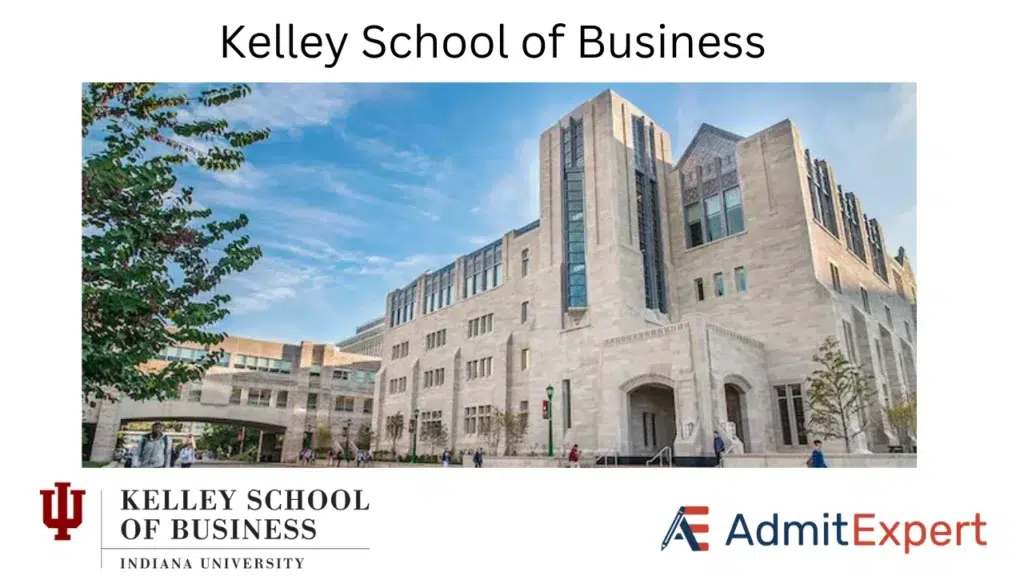
Indiana Kelley MBA at a Glance
| Metric | Latest official figure |
|---|---|
| University and location | Indiana University Bloomington; Bloomington, Indiana |
| Program | Full-Time +Flex MBA |
| Degree structure | Two years; first 10 months in Bloomington |
| Degree requirement | 54 credit hours |
| Second-year formats | In residence or approved online +Flex pathway |
| Latest entering class | Class of 2028 |
| Class size | 57 |
| Women | 35% |
| International students | 39% |
| Average age | 30 |
| Average work experience | 6 years |
| Average undergraduate GPA | 3.38 |
| Average GMAT, current edition | 618 |
| Average GRE | 160 Verbal / 161 Quantitative |
| MBA majors | 7 |
| STEM-designated majors | 5 |
| Class of 2025 median base salary | $127,900 |
| Class of 2025 mean base salary | $133,129 |
| Job offers within 90 days | 91.6% of job seekers |
| Job acceptances within 90 days | 89.2% of job seekers |
| 2026–27 annual budget, Indiana resident | $58,007 |
| 2026–27 annual budget, nonresident / international | $84,129 |
| Typical merit award | $15,000–$35,000 per year |
| Next Phase 1 deadline | Round 1 — October 1, 2026 |
Kelley's current Class of 2028 profile, academic structure, 2025 employment data, and 2026–27 tuition and scholarship page provide the principal data behind this guide.
What Makes the Kelley Full-Time +Flex MBA Distinctive?
Six elements reinforce one another:
- Me, Inc. starts career positioning before the academic semester;
- the Integrated Core builds a common business foundation;
- Career Foundation Academies connect students with specific industries and functions before internship recruiting;
- seven majors and additional minors or certificates allow academic customization;
- the summer internship tests the career transition;
- the second year can remain residential or move online through +Flex.
The program makes the most sense when those pieces form a sequence.
For example:
career target → Me, Inc. positioning → Academy preparation → relevant major/electives → internship → second-year format
That is much more useful than treating Academies, majors, and +Flex as unrelated features.
+Flex Changes the Economics and Experience of the Second Year
Kelley describes the Full-Time +Flex MBA as one two-year MBA program.
Students do not apply separately for an online track.
Everyone spends year one together in Bloomington.
Students can decide during the first year whether they want to finish year two:
- on campus;
- or through online courses from Kelley Direct.
The current admissions FAQ says the deadline to move to the online modality for the following academic year is August 1.
Program approval is required, and Kelley reserves the right to limit participation based on course availability.
The Online Second Year Can Let Students Start Working Earlier
One reason to +Flex is obvious.
A student who has already secured the right job may be able to:
- relocate;
- return to an existing employer;
- start full-time employment;
- move closer to family;
- travel;
- build a network in the target city
while completing the remaining MBA coursework online.
That can reduce the opportunity cost of staying physically in Bloomington for another academic year.
But the amount saved depends on the individual's:
- job;
- location;
- housing;
- tuition classification;
- second-year course plan.
+Flex should not be presented as a guaranteed dollar saving.
Online Year Two Is Academically Structured, Not Self-Paced
Kelley's current FAQ says online +Flex courses normally use 75-minute classes, usually meeting in the evening between 6 p.m. and 10:30 p.m. Eastern Time.
Courses generally include:
- one live session;
- one asynchronous component each week.
Students can finish with their cohort by taking the planned credit load across the fall, winter, and spring online terms.
That matters for someone planning to work full time.
The flexibility is geographic.
It does not mean the MBA stops requiring scheduled coursework.
The Degree Still Requires 54 Credits
Kelley says the Full-Time +Flex MBA is designed for students to complete 54 credit hours over two academic years.
The typical structure is:
| Stage | Typical academic structure |
|---|---|
| Year 1 fall | Core 1 and Core 2 — 18 credits |
| Year 1 spring | Core 3 plus electives — approximately 15–18 credits |
| Summer | Internship |
| Year 2 | Remaining electives and degree requirements, on campus or online |
The precise second-year mix depends on the student's academic choices and modality.
Staying in Bloomington Preserves More of the Traditional MBA Experience
Students who remain on campus can continue using residential opportunities such as:
- employer roundtables;
- Academy activities;
- networking nights;
- second-year Academies;
- study abroad;
- Washington Campus;
- 1Kelley leadership;
- peer coaching;
- GLOBASE leadership;
- club leadership;
- Capstone Week.
Those experiences are not all available in the same form to an online second-year student.
That is the main trade-off.
The question is not whether online coursework is academically legitimate.
It is which experiences the student would no longer be using.
Some Second-Year Experiences Are Limited to On-Campus Students
Kelley's FAQ specifically says participation in:
- GLOBASE;
- Entrepreneurial Innovation Academy;
- Leadership Academy;
- PLUS Life Sciences Academy
is limited to students remaining on campus.
Online +Flex students can still participate in student clubs if they have paid the relevant MBA Association dues, but geography can obviously affect practical participation.
Career coaching continues remotely.
Kelley also notes that not every recruiting event is available online.
+Flex Can Be Most Attractive After the Career Question Is Largely Solved
The structure can be especially attractive to a student who reaches the end of year one with:
- a clear career direction;
- a strong internship;
- an early full-time offer;
- a need to relocate;
- a reason to reduce residential opportunity cost.
A student who still needs heavy on-campus recruiting, leadership opportunities, Academy work, or international experiences may value the residential second year more.
That makes the modality decision a career-stage decision inside the MBA.
International Students Need a Separate +Flex Analysis
International students should not assume the online second year works the same way for them.
Kelley's international-admissions guidance explains that F-1 and J-1 students normally need a full load of in-person coursework to maintain student status while remaining in the United States.
For graduate students, Kelley identifies that in-person full load as at least 8 credit hours in the relevant fall and spring terms.
In many cases, an international student choosing a fully online second year would need to leave the United States.
Visa strategy should therefore be resolved with Indiana University's international-student advisers before relying on +Flex in a career plan.
Me, Inc. Starts Before the First MBA Classes
Kelley's Me, Inc. is a three-week professional-development experience before regular MBA courses begin.
Students work on:
- personal story;
- professional brand;
- strengths and weaknesses;
- career direction;
- networking;
- teamwork;
- leadership style.
They also begin working with:
- career coaches;
- faculty;
- staff;
- first- and second-year peers.
This is not merely orientation.
It is part of the recruiting process.
Recruiting Starts Before Students Feel Like MBA Students
Kelley introduces students to employers during August Roundtables.
That means career preparation starts before the student has completed the Integrated Core.
For a career changer, this creates an obvious challenge:
You need to explain the future role before the MBA has had time to teach you everything required for it.
Me, Inc. helps build that initial positioning.
The student then needs Academies, coursework, projects, and the internship to make the story increasingly credible.
Jump Start Helps Students Without a Business Background
Kelley also offers an optional Jump Start, a short accelerated introduction to business concepts for students who want additional preparation before the core.
That can be useful for someone coming from:
- education;
- science;
- engineering;
- military service;
- public service;
- another non-business field.
The purpose is not to erase the student's original background.
It is to reduce friction when the integrated business curriculum begins.
The Integrated Core Forces Business Disciplines to Work Together
Kelley's first semester centers on the Integrated Core.
The core covers areas such as:
- finance;
- financial accounting;
- marketing;
- operations;
- quantitative analysis;
- economics;
- strategy;
- business communication;
- critical thinking.
The word "integrated" matters.
A real management problem rarely arrives labeled:
"finance problem only"
A product decision can involve:
- customer demand;
- pricing;
- operations;
- financial return;
- competitive response;
- organizational execution.
The core is designed to teach students to see those connections.
Core Teams Make the First Semester a Team Experience
Students work in Core teams composed of classmates with different professional and academic backgrounds.
That can be especially valuable in a smaller MBA class.
The team becomes a place to practice:
- collaboration;
- conflict;
- communication;
- accountability;
- leadership without formal authority.
A student who already knows the finance content may still need to learn how to explain it to a teammate from another field.
Academies Are One of Kelley's Most Distinctive Career Features
Kelley's Academies combine:
- career education;
- mentoring;
- networking;
- company visits;
- practical projects;
- industry exposure.
The first-year Academy is designed to prepare the student for internship recruiting.
That makes Academy selection more than an extracurricular preference.
It can shape the first-year professional identity.
Kelley's First-Year Career Foundation Academies Cover Several Career Markets
The principal first-year Academy pathways include:
- Business Marketing;
- Capital Markets;
- Consumer Marketing;
- Strategic Finance;
- Strategy and Operations.
PLUS Life Sciences is an additional cross-disciplinary option that can be used in the first or second year.
Each Academy is built around a different employment market.
A candidate should therefore select based on the work they want to do—not simply the Academy with the most attractive label.
Business Marketing and Consumer Marketing Are Different Career Markets
Kelley maintains separate marketing Academies for a reason.
The Business Marketing Academy focuses on B2B markets and roles such as:
- product marketing;
- strategic account management;
- business development;
- customer management;
- pricing;
- domain marketing.
The Consumer Marketing Academy is more closely aligned with areas such as:
- brand management;
- consumer insights;
- retail;
- consumer products.
Both are "marketing."
The recruiting process and day-to-day work can be very different.
Academy Projects Create Evidence Before the Summer Internship
Academies include real-world consulting and project work.
That matters for a career switcher.
An engineer targeting marketing may arrive with strong technical experience but little evidence of:
- customer understanding;
- brand judgment;
- market analysis.
A project can begin closing that credibility gap before the summer internship.
The useful question is:
"What will I be able to say I have actually done after this Academy project?"
Capital Markets and Strategic Finance Serve Different Finance Careers
Kelley also separates finance into distinct Academy pathways.
The Capital Markets Academy prepares students for roles such as:
- investment banking;
- wealth management;
- equity research;
- other capital-markets careers.
It includes:
- financial modeling;
- investment analysis;
- firm visits;
- industry networking.
The Strategic Finance Academy is oriented more toward:
- corporate finance;
- treasury;
- planning and forecasting;
- business development;
- strategic financial analysis.
Those are not interchangeable career paths.
Strategy and Operations Supports Consulting and Corporate Roles
The Strategy and Operations Academy is designed around problem solving and execution.
That can be relevant to students pursuing:
- consulting;
- corporate strategy;
- operations;
- general management.
A consultant needs to structure ambiguous problems.
An operator also needs to implement.
The Academy becomes more useful when the applicant knows which side of that equation needs development.
PLUS Life Sciences Connects Kelley With Healthcare and Pharmaceuticals
PLUS Life Sciences provides a more specialized route for students targeting areas such as:
- healthcare;
- pharmaceuticals;
- life sciences.
This can be especially relevant given Kelley's proximity and recruiting relationships with employers such as Eli Lilly and other healthcare companies.
Again, the applicant should define the function.
Healthcare marketing, finance, strategy, and operations are different jobs.
Second-Year Academies Are Available Only for Students Staying On Campus
Students who remain in Bloomington can add second-year Academy experiences such as:
- Entrepreneurial Innovation Academy;
- Leadership Academy;
- Organizational AI Academy.
This is another reason the +Flex decision should wait until the student knows what they would be giving up.
If one of these Academies is central to the development plan, staying residential may have more value.
Organizational AI Is About Applying AI Inside Organizations
The Organizational AI Academy is not positioned as a software-engineering program.
Its focus is organizational application.
That can include:
- identifying AI use cases;
- redesigning workflows;
- implementation;
- change management;
- governance;
- adoption.
That is a different skill set from building models from scratch.
For managers, the organizational problem may be more important than the technical one.
Kelley Offers Seven MBA Majors
Kelley's current majors and minors include:
| Major | STEM-designated? |
|---|---|
| Business Analytics | Yes |
| Entrepreneurship and Corporate Innovation | No |
| Finance | Yes |
| Strategy and Leadership | No |
| Marketing | Yes |
| Strategic Analysis of Accounting Information | Yes |
| Supply Chain and Operations | Yes |
Each major generally requires 12 credit hours.
Students can use remaining elective capacity for:
- a second major;
- a minor;
- a certificate;
- other electives.
Five of the Seven Majors Are STEM-Designated
The STEM designation applies to specific majors.
It should not be represented as though every possible Kelley Full-Time MBA academic plan is automatically STEM-designated.
The five STEM majors are:
- Business Analytics;
- Finance;
- Marketing;
- Strategic Analysis of Accounting Information;
- Supply Chain and Operations.
That makes major selection particularly important for international students who care about STEM-related work-authorization planning.
Marketing Being STEM-Designated Is More Significant Than It May Appear
Marketing is sometimes treated as a largely qualitative field.
Kelley's marketing major explicitly emphasizes:
- analytics;
- technology;
- data-driven decision-making.
The school also offers an optional Product Management Certificate.
That creates a potentially useful path for students interested in:
- product marketing;
- customer analytics;
- digital marketing;
- brand strategy;
- product management.
The academic label still does not guarantee access to a particular role.
The Finance Major Can Support Several Different Paths
The Finance major can support:
- investment banking;
- corporate finance;
- asset management;
- financial consulting.
The Academy choice should then make the path more specific.
For example:
Finance major + Capital Markets Academy
and
Finance major + Strategic Finance Academy
can lead toward very different recruiting markets.
Strategy and Leadership Emphasizes the Human Side of Management
The non-STEM Strategy and Leadership major includes coursework in:
- international business;
- strategic capabilities;
- leadership;
- negotiation;
- consulting;
- technology and innovation;
- entrepreneurship;
- peer coaching.
It can be especially relevant for applicants who want broader managerial responsibility rather than a narrow technical specialization.
GLOBASE Adds an International Client Project
Kelley's GLOBASE combines remote client work with an on-the-ground international engagement.
Students begin by working with the client during the spring semester to understand:
- goals;
- history;
- problems;
- market context.
The team then travels for a week of in-country work.
That makes GLOBASE more than international travel.
It is an applied consulting experience.
GLOBASE Is Valuable When the Project Creates Career Evidence
A student can travel internationally without becoming more employable.
The stronger question is:
"What business capability will I demonstrate because of the project?"
That might be:
- market entry;
- cross-cultural communication;
- stakeholder management;
- project management;
- customer research;
- strategy under uncertainty.
The travel is context.
The work is the evidence.
1Kelley Adds a Different Kind of Leadership Experience
Students remaining on campus in year two can participate in 1Kelley, where MBA students mentor teams of high-achieving Kelley undergraduates working on real business challenges.
This changes the leadership role.
The MBA student is not simply contributing an analysis.
They are helping another team:
- organize;
- execute;
- improve;
- deliver.
For someone trying to move from individual contributor to manager, that kind of developmental leadership can be useful.
Capstone Week Integrates the MBA at the End
Kelley's residential fourth semester includes Capstone Week, which combines a business simulation with executive-development sessions.
The value is integration.
The final MBA experience should force students to use:
- finance;
- marketing;
- operations;
- strategy;
- communication;
- leadership
together.
That mirrors the same principle behind the Integrated Core at the beginning of the program.
Indiana Kelley MBA Class Profile: Class of 2028
Kelley's current official profile covers the Class of 2028.
| Metric | Class of 2028 |
|---|---|
| Class size | 57 |
| Women | 35% |
| International students | 39% |
| Countries represented | 14 |
| Average age | 30 |
| Age range | 24–44 |
| Average full-time work experience | 6 years |
| Students with full-time work experience | 100% |
| Average undergraduate GPA | 3.38 |
| Average GMAT, current edition | 618 |
| Average GRE Verbal | 160 |
| Average GRE Quantitative | 161 |
The current GMAT figure uses the new scoring scale.
It should not be compared directly with legacy GMAT averages from older Kelley classes.
The Current Cohort Is Much Smaller Than Recent Prior Cohorts
The Class of 2028 has 57 students.
For context, Kelley's current employment report lists:
- 95 students in the graduating Class of 2025;
- 104 students in the Class of 2026 internship cohort.
Those cohorts are from different entering years and should not be treated as directly comparable admissions populations.
But the Class of 2028 is clearly smaller than those recent cohorts.
That can affect:
- class dynamics;
- Academy size;
- number of peers targeting a specific role;
- visibility across the program.
One smaller entering class should not automatically be treated as a permanent enrollment trend.
Small Cohort Size Can Increase Both Access and Concentration Risk
A 57-person class can create very dense relationships.
Faculty, staff, career coaches, and classmates may know one another more closely.
At the same time, a highly specialized applicant should investigate:
- how many classmates use the same Academy;
- how many target the same geography;
- how many alumni work in the niche role.
A small cohort can be a feature.
It is not automatically an advantage for every career.
Six Years of Work Experience Is an Average, Not a Requirement
The current class averages six years of full-time experience.
Kelley's FAQ says work experience is not formally required, but admission without it is rare and the school likes to see applicants with meaningful post-undergraduate professional experience.
The right question is not:
"Have I reached six years?"
It is:
- What responsibility have I earned?
- How has my scope changed?
- What outcomes have I created?
- Why is the MBA useful now?
- What role becomes possible afterward?
Every Student in the Current Class Has Full-Time Work Experience
The Class of 2028 profile reports 100% with full-time work experience.
That is useful context for applicants early in their careers.
It does not create a formal admissions minimum.
It does suggest that classroom discussion and recruiting are built around students bringing professional examples into the MBA.
Current GMAT and Legacy GMAT Must Stay Separate
Kelley reports an average current GMAT of 618.
Older Kelley profiles reported GMAT scores on the previous scale.
A raw comparison such as:
"618 versus 685"
would be misleading because the exam scale changed.
Applicants using the current GMAT should compare:
- current-format scores;
- current percentiles;
- current class-profile data.
GRE Section Scores Should Stay Separate
Kelley reports:
- 160 average GRE Verbal;
- 161 average GRE Quantitative.
The school does not present those as a combined-score median.
Adding them together would create a derived figure that is not the statistic Kelley publishes.
Kelley Uses a Two-Phase MBA Application
The current application process begins with a short, free Phase 1.
Phase 1
Applicants submit:
- Kelley Graduate Application Form;
- resume.
Kelley then reviews the initial material.
Selected applicants are invited to Phase 2.
That means Phase 1 is not simply the first page of a conventional application.
It is an initial screening stage.
Phase 1 Is Free
There is no application fee for the Phase 1 submission.
Kelley says the initial form can be completed in only a few minutes once the resume is ready.
The more substantial application work happens after an invitation to Phase 2.
Phase 2 Contains the Full Admissions File
Invited candidates receive access to the Kelley Application Portal.
The Phase 2 checklist may include:
- admissions interview;
- GMAT/GRE if required;
- English-proficiency testing if required;
- personal essays;
- one professional recommendation;
- unofficial transcripts;
- Indiana University Graduate School Compliance Form;
- $75 university application fee.
The admissions committee reviews the complete file after the required documentation and interview are finished.
Kelley Requires One Professional Recommendation
The current admissions page requires one recommendation.
A current or recent supervisor is preferred.
The most useful recommender is someone who can speak meaningfully about:
- performance;
- leadership;
- teamwork;
- progression;
- professional judgment.
A more senior title is not automatically a stronger recommendation.
Kelley Publicly Describes the Essay Goals, While the Portal Controls the Operative Prompts
Kelley's current public admissions page says the essay portion is intended to reveal:
- communication skills;
- unique background;
- career goals;
- what the applicant would bring to Kelley;
- how Kelley fits the applicant.
Because the Full-Time +Flex application now uses a two-phase portal, candidates should use the live Phase 2 portal as the source of truth for the operative essay wording.
For strategic guidance once the current prompts are visible, use Admit Expert's Kelley MBA essay guide.
Kelley Does Not Publish a Minimum GMAT or GRE Score
Kelley accepts the GMAT and GRE.
The admissions team evaluates academic readiness in the context of the complete application.
A test score can strengthen the application.
It is not the only form of quantitative evidence.
Kelley Offers a GMAT/GRE Waiver Route
The current admissions requirements say candidates can indicate a test-waiver request in Phase 1.
Kelley focuses on evidence such as:
- strong academic achievement;
- quantitative and analytical coursework;
- advanced study;
- CPA or CFA credentials;
- other quantitatively oriented qualifications.
The key question is:
"What evidence in my record replaces the information a test score would provide?"
Test-Optional Admission Does Not Mean Test Scores Have No Career Value
Kelley explicitly notes that some employers—particularly in areas such as:
- management consulting;
- investment banking
may ask for standardized-test scores during recruiting.
That creates a second audience for the test decision.
An applicant should ask both:
- Does Kelley need the score?
- Could my target employer still value it?
A waiver can make sense for admissions while a strong score can still have recruiting value.
Work Experience Is Not a Formal Minimum, but It Matters
Kelley does not state a strict work-experience requirement.
Its current admissions materials say most applicants are already at least two years into their careers, while the FAQ says the school likes to see roughly three years of post-undergraduate experience at enrollment.
The Class of 2028 averages six years.
The consistent message is that professional context matters.
International Applicants Have Specific English Requirements
Kelley's international applicant page currently lists minimum English-proficiency scores of:
- TOEFL iBT 100 on the 120-point scale or 5 on the 6-point scale;
- IELTS 7.0;
- Duolingo English Test 130.
Scores must generally be no more than two years old.
Applicants who completed an undergraduate or postgraduate degree at an institution where English was the language of instruction can receive the stated English-proficiency waiver.
Indian Three-Year Degree Holders Need to Check Equivalency Carefully
Kelley's FAQ provides specific guidance for applicants educated in India.
A three-year bachelor's degree alone does not generally satisfy the school's stated U.S.-degree equivalency expectation.
Kelley says applicants with a three-year Indian bachelor's degree are expected to complete additional recognized university-level education, such as the relevant first part of a university master's program.
Certain university-offered postgraduate diploma programs can also satisfy the additional education expectation when they require a three-year bachelor's degree for admission.
Applicants should verify their exact credential before assuming eligibility.
Kelley Full-Time +Flex MBA Application Deadlines 2026–27
Kelley's current process uses separate Phase 1 and Phase 2 deadlines.
For the current cycle:
| Round | Phase 1 deadline | Phase 2 deadline | Final notification | Deposit deadline |
|---|---|---|---|---|
| Round 1 | October 1, 2026 | October 15, 2026 | December 22, 2026 | February 1, 2027 |
| Round 2 | December 15, 2026 | January 5, 2027 | March 15, 2027 | April 15, 2027 |
| Round 3 | February 15, 2027 | March 1, 2027 | April 15, 2027 | April 30, 2027 |
| Round 4 | April 1, 2027 | April 15, 2027 | May 15, 2027 | May 30, 2027 |
As of September 28, 2026, the next deadline is:
Round 1 Phase 1 — October 1, 2026
Applicants should not treat the Phase 2 date as the day to begin the process.
Phase 2 access follows Phase 1 review and invitation.
International Applicants Should Plan Around Round 2
Kelley advises international applicants to apply no later than Round 2.
For the current cycle, that means:
- Phase 1 by December 15, 2026;
- Phase 2 by January 5, 2027.
The earlier timing allows more room for:
- visa processing;
- financial documentation;
- relocation.
International candidates should not build a plan around later rounds without confirming the current admissions policy.
Kelley Offers Deferred Admission Through KAAP
The Kelley Accelerated Admission Process (KAAP) allows eligible college seniors to apply for deferred admission.
KAAP is currently open to:
- U.S. citizens;
- U.S. permanent residents.
Admitted students are expected to build at least two years of full-time professional experience before enrolling.
The value of deferred admission is not simply reserving a future seat.
The work period should strengthen:
- responsibility;
- judgment;
- career clarity;
- the eventual value of the MBA.
Because the current public Kelley pages show separate deferred-admission timing, applicants should use the live KAAP application page for the operative deadline.
Kelley MBA Employment Report: Class of 2025
The official 2025–26 Full-Time +Flex MBA Employment Report covers 95 graduates.
Employment Status
| Employment category | Class of 2025 |
|---|---|
| Total graduates | 95 |
| Seeking employment | 83 |
| Not seeking employment | 7 |
| No recent information | 5 |
| Sponsored and returning | 2 |
| Starting a business | 2 |
| Other non-seeking | 3 |
The 83 job seekers are the relevant denominator for offer and acceptance rates.
The 95-person graduating class is not.
Offer and Acceptance Rates Are Different Measures
| Outcome | At graduation | Within 90 days |
|---|---|---|
| Received an offer | 78.3% | 91.6% |
| Accepted an offer | 75.9% | 89.2% |
Those percentages apply to job seekers.
A 91.6% offer rate does not mean 91.6% of all 95 graduates had accepted jobs.
Similarly, an offer and an accepted offer are not the same outcome.
The Gap Between Graduation and 90 Days Matters
At graduation:
- 78.3% had received an offer;
- 75.9% had accepted one.
Within 90 days:
- 91.6% had received an offer;
- 89.2% had accepted.
The increase is substantial.
That matters for financial planning.
A student should not assume that the full-time salary begins immediately at graduation.
Kelley MBA Salary and Signing Bonus
| Compensation metric | Class of 2025 |
|---|---|
| Mean base salary | $133,129 |
| Median base salary | $127,900 |
| Mean signing bonus | $30,150 |
| Median signing bonus | $30,000 |
Kelley's employment report says 85.1% of students accepting an offer provided usable salary data.
The compensation statistics therefore describe reporting graduates rather than every person in the class.
Do Not Add the Salary Median and Bonus Median
The report publishes:
- $127,900 median base salary;
- $30,000 median signing bonus.
It would be incorrect to simply add those and call $157,900 the official median total compensation.
The salary and bonus figures do not necessarily use the same respondent population.
Kelley separately publishes a school-defined mean starting-compensation figure in its program materials.
That should remain separate from reconstructed calculations.
Median Base Salary Has Not Increased Every Year
Kelley's current historical table reports:
| Graduating class | Median base salary |
|---|---|
| 2023 | $137,500 |
| 2024 | $129,000 |
| 2025 | $127,900 |
The current median is lower than the prior two graduating classes.
That is worth stating plainly.
It should not automatically be called a permanent downward trend.
Salary outcomes can change with:
- industry mix;
- role mix;
- geography;
- hiring conditions;
- cohort composition.
Three annual points describe what happened.
They do not prove why.
Employment by Industry
| Industry | Share of accepted new jobs | Median base salary |
|---|---|---|
| Technology | 23.0% | $134,000 |
| Consulting | 16.2% | $175,000 |
| Manufacturing | 14.9% | $125,000 |
| Financial Services | 13.5% | $127,000 |
| Consumer Packaged Goods | 12.2% | $122,500 |
| Healthcare | 5.4% | $134,000 |
These are the major industry categories Kelley publishes in the current employment table.
Technology is the largest by share.
Consulting pays the highest median among these large categories.
Those are two different observations.
Technology Is the Largest Full-Time Industry
Technology accounts for 23.0% of accepted new jobs.
Its median base salary is $134,000.
Top Class of 2025 employers include:
- Amazon;
- Microsoft;
- Infosys;
- other technology and technology-enabled companies.
The industry share does not tell us the function.
A technology company can hire MBAs into:
- marketing;
- finance;
- operations;
- general management;
- consulting-like roles;
- product.
Applicants should define the job.
Consulting Has the Highest Large-Industry Median Salary
Consulting represents 16.2% of accepted jobs and reports a $175,000 median base salary.
That is materially higher than the overall class median.
This is exactly why one classwide salary number can be misleading for individual planning.
A student targeting consulting faces a different compensation market from a student targeting:
- CPG;
- manufacturing;
- corporate finance;
- marketing.
The highest-paying industry is not automatically the right career choice.
Manufacturing Is a Larger Kelley Destination Than Many MBA Applicants Expect
Manufacturing accounts for 14.9% of accepted jobs.
That is larger than financial services in the current industry table.
The outcome fits Kelley's strengths in:
- operations;
- supply chain;
- strategic finance;
- B2B marketing;
- general management.
It also reflects the importance of Midwestern corporate employers in the school's recruiting footprint.
Financial Services Is 13.5% by Industry—but Finance Is Larger by Function
Financial services represents 13.5% of industries.
Finance/accounting represents 20.3% of functions.
Those numbers are not contradictory.
A graduate can work in a finance role at:
- manufacturing company;
- technology company;
- healthcare company;
- consumer company.
That makes the function table especially important for candidates targeting corporate finance.
Consumer Packaged Goods Is a Meaningful Kelley Pathway
Consumer packaged goods accounts for 12.2% of accepted jobs.
That aligns with Kelley's Consumer Marketing Academy and long-standing brand-management recruiting ecosystem.
Candidates targeting CPG should still define the function:
- brand management;
- finance;
- operations;
- supply chain;
- analytics.
An industry percentage does not tell us which role is most common.
Employment by Function
| Function | Share of accepted new jobs | Median base salary |
|---|---|---|
| Consulting | 21.6% | $175,000 |
| Finance / Accounting | 20.3% | $128,500 |
| Marketing / Sales | 20.3% | $127,900 |
| General Management | 16.2% | $127,000 |
| Operations / Logistics | 10.8% | $119,000 |
| Other | 8.1% | $126,500 |
The function mix is unusually balanced after consulting.
Finance and marketing are tied at 20.3%.
General management is also substantial.
This is a more useful description of Kelley than saying the school is only a marketing or consumer-products MBA.
Marketing Is One of Kelley's Largest Functions
Marketing/sales accounts for 20.3% of accepted positions.
The school supports that pathway through:
- Marketing major;
- Business Marketing Academy;
- Consumer Marketing Academy;
- Product Management Certificate;
- employer relationships;
- Academy projects.
That creates a relatively developed marketing ecosystem.
The function still includes multiple different career types.
General Management Is a Significant Route
General management accounts for 16.2% of functions.
That can be relevant to candidates interested in:
- leadership-development programs;
- rotational programs;
- P&L roles;
- corporate strategy;
- broader operating leadership.
A student coming from the military or a specialist function may find this route particularly attractive.
Operations and Logistics Connect to Kelley's Supply-Chain Strength
Operations/logistics represents 10.8% of functions.
Kelley also offers a STEM-designated Supply Chain and Operations major.
This can support careers in:
- supply chain;
- procurement;
- manufacturing operations;
- logistics;
- process improvement.
The Midwestern employer network can be especially relevant for these roles.
Kelley's Geography Is Midwest-Heavy—but Not Midwest-Only
Kelley's current employment reporting shows approximately:
- 50% of accepted jobs in the Midwest;
- 26% in the West and Southwest combined;
- 11% in the Northeast and Mid-Atlantic combined;
- 11% in the South.
That gives Kelley a clear geographic center of gravity.
Half of reported placements are in the Midwest.
At the same time, roughly half are elsewhere.
A Midwest Concentration Can Be an Advantage or a Constraint
For someone targeting:
- Chicago;
- Indianapolis;
- Minneapolis;
- other Midwestern corporate markets;
the density can be useful.
For someone committed to:
- New York;
- California;
- another region;
the report shows that mobility is possible, but the student should research the target employer and office directly.
"National placement" does not mean equal recruiting depth everywhere.
Top Employers Show Both Technology and Traditional Corporate Strength
The employment report lists several organizations with multiple Class of 2025 hires, including:
| Employer | Reported hires |
|---|---|
| Amazon | 6 |
| EY | 5 |
| Microsoft | 5 |
| Pella | 4 |
| Discover Financial Services | 3 |
| TekniPlex | 3 |
| Deloitte Consulting | 3 |
| Tyson Foods | 3 |
The list reinforces the breadth of the recruiting market.
It also shows why Kelley's manufacturing, consumer, technology, consulting, and finance outcomes all matter.
The Summer Internship Is Central to the Kelley Model
Kelley describes internships as a critical part of the Full-Time +Flex journey.
The first-year structure is built around preparing students for that summer:
- Me, Inc.;
- Integrated Core;
- Career Foundation Academy;
- Academy project;
- employer visits;
- interview preparation;
- career coaching.
The internship then becomes the test of the career transition.
Class of 2026 Internship Compensation
The 2025–26 employment report publishes internship salary data for the Class of 2026.
| Internship compensation | Monthly amount |
|---|---|
| Mean base salary | $7,859 |
| Median base salary | $7,800 |
These are monthly internship figures.
They should not be compared directly with annual full-time salaries.
The report says 78.5% of students accepting an internship offer provided usable salary data.
Internship Industries Differ From Full-Time Industries
| Internship industry | Class of 2026 share | Median monthly base salary |
|---|---|---|
| Consumer Packaged Goods | 20.6% | $8,233 |
| Manufacturing | 20.6% | $5,417 |
| Healthcare | 17.8% | $6,933 |
| Consulting | 15.1% | $14,583 |
| Financial Services | 9.6% | $8,667 |
| Technology | 5.5% | $10,116 |
| Other | 5.5% | $5,633 |
This distribution is very different from the Class of 2025 full-time industry table, where technology is the largest category.
That does not mean technology suddenly disappeared from Kelley recruiting.
The two tables describe:
- different cohorts;
- different stages of the recruiting cycle.
They should remain separate.
Marketing/Sales Dominates the Class of 2026 Internship Function Mix
| Internship function | Share | Median monthly base salary |
|---|---|---|
| Marketing / Sales | 46.6% | $7,687 |
| Consulting | 17.8% | $14,510 |
| Finance | 12.3% | $7,296 |
| General Management | 9.6% | $9,633 |
| Operations / Logistics | 9.6% | $9,533 |
The marketing/sales share is one of the clearest signs of Kelley's first-year marketing recruiting strength.
It also demonstrates why internship and full-time function tables can tell different stories.
Internship Data Is Especially Relevant to Academy Choice
The first-year Academies are explicitly designed to prepare students for internship recruiting.
That means applicants can use the internship data to ask better questions.
For example:
- Which Academy feeds the roles I want?
- Which employers hire interns from it?
- What skills are tested?
- What percentage of internships convert to return offers?
- What happens if the first-choice role does not work out?
Those questions are more useful than relying only on a classwide employment rate.
Is Indiana Kelley a Good MBA for Technology?
Technology is the largest Class of 2025 industry at 23%.
Kelley also offers:
- STEM-designated majors;
- Organizational AI Academy;
- technology-focused marketing and strategy coursework;
- Product Management Certificate;
- technology employers such as Amazon and Microsoft.
The school clearly supports technology careers.
The applicant still needs to specify the function.
Is Indiana Kelley a Good MBA for Consulting?
Consulting represents:
- 16.2% of Class of 2025 industries;
- 21.6% of Class of 2025 functions.
Its median base salary is $175,000.
The Strategy and Operations Academy, consulting coursework, career coaching, and Academy projects can support the pathway.
Applicants should also remember that some consulting employers may request standardized test scores even when Kelley waives them for admission.
Is Indiana Kelley a Good MBA for Marketing?
Marketing is one of Kelley's clearest areas of depth.
Marketing/sales represents 20.3% of Class of 2025 functions and 46.6% of Class of 2026 internship functions.
The ecosystem includes:
- STEM-designated Marketing major;
- Business Marketing Academy;
- Consumer Marketing Academy;
- Product Management Certificate;
- strong CPG and corporate employer relationships.
Applicants should still distinguish among:
- brand management;
- B2B marketing;
- product marketing;
- customer insights;
- digital marketing.
Is Indiana Kelley a Good MBA for Finance?
Finance/accounting represents 20.3% of Class of 2025 functions.
Kelley offers two clearly different finance Academies:
- Capital Markets;
- Strategic Finance.
The Finance major is also STEM-designated.
That gives students routes into:
- investment banking;
- corporate finance;
- asset management;
- treasury;
- financial strategy.
The correct Academy depends on which finance market the student actually wants.
Is Indiana Kelley a Good MBA for Consumer Products?
Consumer packaged goods accounts for 12.2% of Class of 2025 full-time industries and 20.6% of Class of 2026 internship industries.
The Consumer Marketing Academy and Marketing major are directly relevant.
Kelley's employer ecosystem has long included large consumer brands.
A CPG candidate should still define whether the target is:
- brand management;
- finance;
- supply chain;
- operations;
- analytics.
Is Indiana Kelley a Good MBA for Healthcare and Life Sciences?
Healthcare represents 5.4% of Class of 2025 full-time industries and 17.8% of Class of 2026 internship industries.
PLUS Life Sciences gives students a dedicated cross-disciplinary route.
Employers such as Eli Lilly and other healthcare organizations also appear in Kelley's recruiting ecosystem.
The difference between the full-time and internship percentages is another reminder not to project one cohort's distribution into the next.
Is Indiana Kelley a Good MBA for General Management?
General management is 16.2% of Class of 2025 functions.
That is large enough to be a meaningful pathway.
The Strategy and Leadership major and Strategy and Operations Academy can support roles involving:
- broad business responsibility;
- rotational programs;
- corporate strategy;
- P&L development.
The Integrated Core can be particularly useful for a student moving from a specialist function into broader leadership.
Who Should Consider Kelley Most Seriously?
Kelley deserves close consideration if you value:
- a small, personalized MBA environment;
- career preparation before classes begin;
- industry-specific Academies;
- marketing;
- corporate finance;
- consulting;
- technology;
- manufacturing and operations;
- a strong Midwest recruiting base;
- a traditional summer internship;
- the ability to choose a residential or online second year after the first-year career cycle.
Applicants should think more carefully if they strongly prefer:
- a very large MBA class;
- an entirely residential experience with no interest in modality flexibility;
- a career market concentrated primarily in a geography where Kelley has fewer placements;
- second-year experiences that require Bloomington participation while also planning to +Flex online.
The strongest Kelley fit is often about sequencing.
How to Decide Whether Kelley Fits Your MBA Goals
1. Define the target job
Specify:
- function;
- industry;
- geography;
- employer type.
"Marketing" is too broad.
"Brand management at a consumer company" is more useful.
2. Choose the first-year career pathway
Map the target to:
- Me, Inc.;
- Academy;
- career coach;
- employer visits;
- project work.
The Academy should help prepare you for the summer internship.
3. Build the academic pathway
Select:
- major;
- minor or certificate where relevant;
- electives;
- STEM path where relevant.
The academic plan should reinforce the recruiting plan.
4. Treat the internship as the test
Ask what evidence the summer internship needs to create.
The internship can:
- validate the function;
- produce a return offer;
- reveal a poor fit;
- create experience for a second-year search.
5. Make the +Flex decision after year one
Compare:
- on-campus recruiting access;
- second-year Academies;
- GLOBASE;
- leadership roles;
- location needs;
- job status;
- financial implications;
- visa constraints.
The choice should be based on what remains unfinished after the first year.
6. Model the financial commitment
Include:
- resident or nonresident tuition;
- mandatory fees;
- living expenses;
- confirmed scholarship;
- second-year modality;
- foregone earnings;
- potential early employment;
- a reserve for a longer post-MBA search.
Do not assume the online second year creates the same saving for every student.
Kelley MBA Tuition and Cost of Attendance 2026–27
Kelley's current 2026–27 annual budget is:
| Expense | Indiana resident | Nonresident / international |
|---|---|---|
| Tuition | $29,573 | $55,695 |
| Mandatory fees | $2,423 | $2,423 |
| Housing and food | $17,025 | $17,025 |
| Books and supplies | $1,950 | $1,950 |
| Transportation | $2,958 | $2,958 |
| Personal expenses | $4,078 | $4,078 |
| Annual total | $58,007 | $84,129 |
This is an annual budget.
It is not the total price of the two-year MBA.
The Resident and Nonresident Tuition Difference Is Large
The annual tuition difference is:
$26,122
between Indiana residents and nonresidents.
That makes residency classification materially important.
Kelley says students generally cannot simply become Indiana residents for tuition purposes by moving to Bloomington for school.
Residency is determined under Indiana University's rules.
Housing Is an Estimate, Not a Guaranteed Student Expense
The $17,025 housing-and-food figure is a planning allowance.
Kelley notes that more than 90% of MBA students live off campus.
Actual spending can change with:
- roommate choice;
- apartment;
- family;
- food habits;
- second-year location.
This becomes particularly important under +Flex because the student may no longer be living in Bloomington.
International Students Need Additional Family Planning if Dependents Accompany Them
Kelley's international page currently advises additional annual financial resources for accompanying dependents.
The published guidance includes additional amounts for:
- spouse;
- first child;
- additional children.
Those planning figures reflect visa-documentation and family-cost considerations.
A single-student budget can therefore materially understate the household cost of the MBA.
+Flex Can Reduce Living-Cost or Opportunity-Cost Exposure—but Not Automatically
An online second year can create economic flexibility if the student:
- starts working;
- moves to a lower-cost location;
- returns to family housing;
- avoids Bloomington relocation costs.
But the effect depends on the actual situation.
The tuition model does not become zero.
Online coursework remains part of the MBA.
The applicant should calculate the second year using the location and employment plan they realistically expect.
Opportunity Cost Belongs in the MBA Price
A traditional two-year MBA also costs the income the student gives up.
For someone leaving:
- consulting;
- finance;
- technology;
- engineering;
- consumer business;
foregone compensation can be substantial.
+Flex creates a potentially unusual way to reduce that opportunity cost if the student begins working before degree completion.
But that should be treated as an option, not a guaranteed outcome.
Kelley Merit Scholarships
All admitted Full-Time +Flex MBA students are automatically considered for Kelley merit aid.
No separate general merit application is required.
Kelley says most awards range from:
$15,000 to $35,000 per year
The school considers factors including:
- academic performance;
- GMAT/GRE where submitted;
- professional experience;
- overall application strength.
No particular GPA or test score guarantees funding.
Dean's Fellowships Can Cover Full Tuition for Both Years
Kelley's Dean's Fellowships provide two years of full tuition.
The school describes recipients as exceptional across the full profile, including:
- work experience;
- test scores;
- undergraduate performance;
- leadership potential;
- admissions interview.
Dean's Fellows also receive access to the Kelley Dean's Council.
That is a much larger award than the typical $15,000–$35,000 annual merit range.
It should therefore be treated as selective upside, not the baseline funding assumption.
Consortium, Forté, and ROMBA Have Different Structures
Kelley participates in:
- The Consortium;
- Forté;
- Reaching Out MBA.
These are different partner ecosystems.
Applicants should not assume:
- the same eligibility;
- the same scholarship amount;
- automatic stacking.
The actual Kelley award letter determines the financial package.
Indiana Connections Can Reduce the Resident / Nonresident Gap
Kelley currently offers two supplemental merit awards for certain admitted nonresidents with Indiana educational connections.
Back to Bloomington Fellowship
Eligible Indiana University Bloomington graduates can receive awards ranging from:
- $10,000;
- up to the full resident/nonresident tuition difference.
Certain Kelley Indianapolis graduates can also be considered.
Hoosier Heritage Fellowship
Applicants with qualifying Indiana educational ties outside IU Bloomington can receive:
- $5,000;
- up to the full resident/nonresident tuition difference.
These awards can be combined with additional Kelley scholarship support under the school's current rules.
Paid Student Employment Can Supplement Funding After Enrollment
Kelley does not offer graduate assistantships at admission.
Students can apply for paid positions in Kelley departments and offices beginning in the spring of the first year.
The school says these roles typically involve roughly 5–12 hours per week and may include:
- grading;
- research;
- administrative work.
This is potential supplemental income.
It should not be treated as guaranteed funding for the first tuition bill.
Military Applicants Receive Several Financial Advantages
Kelley accepts military education benefits and currently provides:
- application-fee waiver for military and veteran applicants;
- in-state tuition eligibility for military-connected students under the school's stated rules;
- merit-scholarship consideration in addition to eligible benefits.
The financial effect depends on the applicant's specific benefit eligibility and award package.
Plan From Confirmed Aid, Not Scholarship Possibilities
The correct affordability sequence is:
published cost → confirmed scholarship → confirmed benefits → remaining cash need
not:
published cost − every scholarship name on the website
An applicant should also check whether an award is stated:
- per year;
- for both years;
- as tuition coverage;
- as cash;
- as a residency-gap fellowship.
Those structures have different economic value.
Indiana Kelley MBA FAQs
What is the Kelley Full-Time +Flex MBA?
It is Kelley's two-year Full-Time MBA.
Students spend the first 10 months in Bloomington and can then complete year two on campus or, subject to program requirements and approval, through online Kelley Direct coursework.
How many credits are required?
Kelley says the Full-Time +Flex MBA is designed around 54 credit hours.
What is the latest Kelley MBA class size?
The official Class of 2028 profile contains 57 students.
What is the average GMAT at Kelley?
The Class of 2028 reports an average current GMAT score of 618.
That uses the current GMAT scale and should not be compared raw with legacy GMAT averages.
What is the average GRE at Kelley?
Kelley reports:
- 160 average GRE Verbal
- 161 average GRE Quantitative
The school reports the sections separately.
What is the average GPA at Kelley?
The Class of 2028 reports an average undergraduate GPA of 3.38.
How much work experience do Kelley MBA students have?
The current class averages six years of full-time experience.
All students in the Class of 2028 profile have full-time work experience.
Does Kelley require the GMAT or GRE?
Kelley accepts the GMAT and GRE but also offers a waiver route for candidates who can demonstrate academic readiness through other evidence.
Strong test scores can still strengthen an application and may matter in some recruiting markets.
Does Kelley publish a minimum GMAT or GRE score?
No.
Kelley does not publish a minimum required GMAT or GRE score.
How many recommendations does Kelley require?
The current Full-Time +Flex admissions process requires one professional recommendation.
A current or recent supervisor is preferred.
How does the two-phase Kelley application work?
Phase 1 is free and requires the Kelley Graduate Application Form plus a resume.
Selected candidates are then invited to Phase 2, where the portal may require essays, recommendation, interview, transcripts, testing or waiver documentation, English-proficiency evidence, the university compliance form, and a $75 fee.
What is the Kelley MBA application fee?
Phase 1 is free.
Applicants invited to Phase 2 pay a $75 university application fee unless an applicable waiver applies.
What is the next Kelley MBA deadline?
As of September 28, 2026, the next current-cycle deadline is:
Round 1 Phase 1 — October 1, 2026
The Round 1 Phase 2 deadline is October 15, 2026.
When should international applicants apply?
Kelley currently recommends that international applicants complete the process no later than Round 2.
Does Kelley offer deferred MBA admission?
Yes.
The Kelley Accelerated Admission Process allows eligible U.S. citizens and permanent-resident college seniors to apply for deferred admission before building at least two years of professional experience.
Can international students use +Flex online in year two?
Visa rules can limit that option.
F-1 and J-1 students generally need a full load of in-person coursework to remain in the United States in student status.
An international student considering online year two should review the plan with Indiana University's international advisers.
Is every Kelley MBA major STEM-designated?
No.
Five of the seven current majors are STEM-designated:
- Business Analytics;
- Finance;
- Marketing;
- Strategic Analysis of Accounting Information;
- Supply Chain and Operations.
Entrepreneurship and Corporate Innovation and Strategy and Leadership are not listed as STEM majors.
What is the latest Kelley MBA median salary?
The Class of 2025 reports a $127,900 median base salary.
The mean base salary is $133,129.
What percentage of Kelley MBA job seekers received offers?
Among the 83 Class of 2025 job seekers:
- 78.3% had an offer at graduation;
- 91.6% had an offer within 90 days.
What percentage accepted offers?
Among job seekers:
- 75.9% had accepted by graduation;
- 89.2% had accepted within 90 days.
Which industry hires the most Kelley MBAs?
Technology is the largest Class of 2025 industry at 23.0%.
Consulting is 16.2%, manufacturing 14.9%, financial services 13.5%, and consumer packaged goods 12.2%.
Which Kelley MBA function is largest?
Consulting is the largest function at 21.6%.
Finance/accounting and marketing/sales are each 20.3%.
Where do Kelley MBA graduates work?
The Midwest accounts for about half of reported Class of 2025 placements.
The West and Southwest together account for roughly one-quarter, with additional placements in the Northeast/Mid-Atlantic and South.
How important are internships at Kelley?
Internships are built into the first-year career model.
The Class of 2026 employment report lists a $7,800 median monthly internship base salary among salary reporters, with marketing/sales the largest internship function.
How much does Kelley cost?
For 2026–27, Kelley publishes an annual budget of:
- $58,007 for Indiana residents
- $84,129 for nonresidents and international students
These are annual figures, not the full two-year cost.
How much is Kelley tuition?
For 2026–27, annual tuition is:
- $29,573 for Indiana residents
- $55,695 for nonresidents / international students
Mandatory fees are listed separately at $2,423.
How large are Kelley merit scholarships?
Kelley says most merit awards range from $15,000 to $35,000 per year.
All admitted students are automatically considered.
What is the Kelley Dean's Fellowship?
Dean's Fellowships provide full tuition for both years to selected candidates with exceptional overall profiles.
Final Thoughts
Kelley is no longer best understood as a conventional two-year residential MBA with an online option attached.
The +Flex structure changes the decision.
Every student still begins with an immersive first year in Bloomington.
That first year contains the elements that define the Kelley model:
- Me, Inc.;
- Integrated Core;
- Career Foundation Academy;
- career coaching;
- employer interaction;
- major and elective selection;
- applied project work;
- summer internship preparation.
The Academy system is especially important.
Business Marketing and Consumer Marketing address different customer markets.
Capital Markets and Strategic Finance address different finance careers.
Strategy and Operations supports consulting and corporate leadership.
PLUS Life Sciences creates a healthcare route.
Those distinctions are more useful than a generic claim that Kelley has "strong career services."
The academic structure then adds seven majors, five of them STEM-designated, plus minors, certificates, global experiences, and applied leadership opportunities.
After the internship, the student gets a second decision point.
Staying in Bloomington preserves the full residential ecosystem:
- second-year Academies;
- GLOBASE;
- 1Kelley;
- peer coaching;
- in-person recruiting;
- Washington Campus;
- Capstone Week.
Moving online can let the student relocate, work earlier, or reduce some living and opportunity costs, but it does not preserve every experience. International students have an additional visa constraint that can make the choice much less flexible than it appears.
The employment data should also be read with precision.
Technology is the largest current full-time industry.
Consulting has the highest large-industry median salary.
Finance and marketing are nearly tied with consulting when the data is viewed by function.
Half of reported jobs are in the Midwest, but roughly half are elsewhere.
And the current median salary has not risen monotonically over the last three graduating classes.
The financial analysis needs the same care.
$58,007 and $84,129 are annual budgets.
The resident/nonresident tuition difference is significant.
Most Kelley merit awards are quoted per year, while Dean's Fellowships cover full tuition for both years.
The +Flex option can change the economics if a student works or relocates during year two, but the actual saving depends on the student's real circumstances.
The strongest reason to apply is therefore not:
"Kelley has great career services and lets me finish online."
It is:
"This is the role I want, this is the Academy and academic path that can prepare me for the internship, and after year one I will be able to choose the second-year format that best supports the career, network, experiences, and economics I still need."
If Kelley is on your target list, continue with Admit Expert's Kelley MBA essay guide and MBA application deadlines tracker.
Related Articles

Deferred MBA Programs: 2027 Deadlines, Eligibility & Top Schools
Compare the leading deferred MBA programs for college seniors and eligible graduate students, including HBS 2+2, Stanford, Wharton, Booth, Kellogg, MIT Sloan, Columbia, Haas and Darden, with current 2027 deadlines and rules.
Read Article →
M7 Business Schools: 2026–2027 Guide to Rankings, Admissions, Costs & Careers
A current comparison of Harvard, Stanford, Wharton, Chicago Booth, Kellogg, MIT Sloan and Columbia covering 2026 rankings, Class of 2027 profiles, GMAT/GRE scores, 2027 application deadlines, MBA costs and Class of 2025 career outcomes.
Read Article →
Stanford GSB MBA Guide 2026–27: Admissions, Class Profile, Curriculum, Employment, Fees & Scholarships
A complete guide to the Stanford Graduate School of Business MBA covering admissions, the latest class profile, GMAT and GRE scores, curriculum, application deadlines, employment outcomes, tuition, cost of attendance, scholarships, and financial aid.
Read Article →