

Washington Foster MBA Guide 2026–27: Admissions, Class Profile, Curriculum, Employment, Fees & Scholarships
A complete guide to the University of Washington Foster Full-Time MBA, covering the Class of 2027 profile, Seattle recruiting, curriculum, 2026–27 admissions, career outcomes, costs, scholarships, and applicant fit.
The University of Washington Foster Full-Time MBA is often evaluated through one obvious advantage:
Seattle.
That advantage is real.
The Seattle region gives Foster students direct access to major technology, retail, aerospace, consumer, consulting, healthcare, and startup employers. The latest employment report reflects that concentration clearly: 40.5% of Class of 2025 accepted jobs were in technology, and 84% of the school's published employment-location snapshot was in Washington State.
But location alone is not a career strategy.
A student joining a technology company could work in:
- product management;
- product marketing;
- finance;
- operations;
- strategy;
- general management;
- supply chain.
Those roles need different preparation.
That is why the useful question is not:
"Do I want an MBA in Seattle?"
It is:
"Can Foster's curriculum, applied projects, career coaching, internship pipeline, Seattle network, and elective flexibility help me become credible for the specific role I want?"
That question matters because Foster's current career data tells a more nuanced story than "Seattle tech MBA."
Technology is the largest Class of 2025 industry at 40.5%, but consulting is the largest function at 29.7%, marketing/sales is close behind at 27.0%, general management accounts for 17.6%, and finance/accounting 13.5%.
The Class of 2026 internship market looks different again: technology represents 44.7% of internships by industry, while marketing/sales accounts for 42.4% by function.
Those distinctions are exactly why industry, function, internship, and full-time data should stay separate.
Academically, Foster combines a structured first-year core with early applied work, then gives students substantial freedom to customize the rest of the degree. The MBA does not require a conventional concentration, but students can add certificates, an ESG specialization, cross-campus coursework, experiential projects, and the optional STEM-designated Management Science degree option.
This guide focuses on the two-year, in-person Full-Time MBA at the University of Washington in Seattle, not Foster's Evening, Hybrid, Technology Management, Executive, or Global Executive MBA programs.
It uses the latest detailed official Class of 2027 profile, the 2026–27 admissions cycle, the Class of 2025 employment report, the Class of 2026 internship report, and Foster's current 2026–27 tuition and scholarship information.
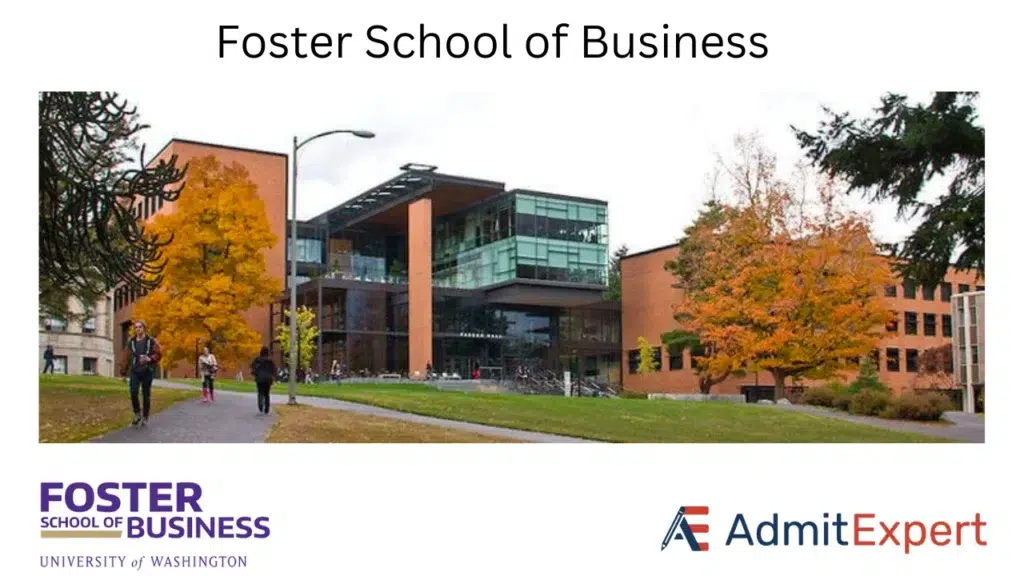
Washington Foster MBA at a Glance
| Metric | Latest official information |
|---|---|
| University | University of Washington |
| School | Michael G. Foster School of Business |
| Location | Seattle, Washington |
| Program | Two-year, in-person Full-Time MBA |
| Degree requirement | 88 credits |
| Total Full-Time MBA students | 217 across both years |
| Latest entering-class profile | Class of 2027 |
| Entering class size | 102 |
| Average first-year core class size | 51 |
| Average second-year elective class size | 27 |
| Average age | 29 |
| Average work experience | 6 years |
| Median undergraduate GPA | 3.4 in the dated Class of 2027 profile |
| Median GMAT | 655 |
| Median GRE | 160 Verbal / 158 Quantitative |
| Women | 51% |
| International students | 56% |
| Student organizations | 22 |
| STEM route | Optional MBA Management Science degree option |
| Class of 2025 mean / median base salary | $144,411 / $142,800 |
| Offers within 3 months | 77.9% of 95 job seekers |
| Six-month offer rate | 86% on Foster's current career page |
| Class of 2026 internship monthly mean / median | $9,550 / $9,966 |
| Current six-quarter tuition + fees, Washington resident | $87,414 |
| Current six-quarter tuition + fees, nonresident | $122,778 |
| Standard application fee | $90 |
| Next application deadline | Round 1 — October 1, 2026 |
Foster's current Class of 2027 profile describes a relatively compact MBA community.
The program reports 217 Full-Time MBA students across both years, with 102 students in the entering class.
That scale affects almost every part of the experience: class size, career support, student leadership, peer visibility, and the number of classmates recruiting for a particular niche.
What Makes the Foster MBA Distinctive?
Six parts of the program reinforce one another:
- a small, highly international MBA cohort;
- Seattle access to technology and major corporate employers;
- a broad first-year management core;
- required applied work, including Applied Strategy and a summer experience;
- extensive second-year elective freedom without a mandatory concentration;
- individualized career coaching and strong regional employer relationships.
The value comes from the combination.
A technology applicant may use Foster for Seattle employer access, AI electives, Strategic Product Management, alumni, and a product-oriented internship.
A consultant may use Applied Strategy, case-interview coaching, consulting internships, and second-year strategic consulting projects.
An entrepreneur may use the Entrepreneurship Certificate, Buerk Center, startup competitions, angel-investing courses, and cross-campus technical collaborators.
A social-impact candidate may use Board Fellows, impact-lending electives, nonprofit projects, and ESG coursework.
The strongest Foster plan is therefore rarely one-dimensional.
Seattle Is an Advantage Only If You Know Which Part of the Ecosystem You Need
Foster is based on the University of Washington's Seattle campus.
Its current career materials highlight relationships with employers across:
- technology;
- consulting;
- retail;
- healthcare;
- manufacturing;
- consumer products;
- aerospace;
- finance;
- startups.
Representative Class of 2025 employers include:
- Amazon;
- Accenture;
- Adobe;
- Apple;
- Blue Origin;
- Boeing;
- Deloitte;
- EY;
- Goldman Sachs;
- Google;
- Kearney;
- McKinsey & Company;
- Microsoft;
- Nestlé;
- Nike;
- PwC;
- Boston Consulting Group.
That is real recruiting evidence.
It is not a promise that every company hires every year or that every office and function is equally accessible.
Washington State Dominates Current Employment Geography
Foster's current Class of 2027 profile includes a Class of 2025 employment snapshot showing:
84% of employment in Washington State
and:
16% elsewhere
That is one of the strongest geographic concentrations among major U.S. MBA programs.
For someone targeting Seattle or Washington, the density can be a major advantage.
For someone committed to:
- New York;
- Chicago;
- San Francisco;
- another international market;
the same statistic should trigger more research.
The useful question becomes:
"Which Foster employers and alumni hire into the city and office I actually want?"
Foster Is Not Only a Technology MBA
Technology is the largest current industry destination at 40.5%.
That makes technology a major part of the Foster story.
But consulting represents 25.7% of accepted jobs, retail 10.8%, financial services 5.4%, manufacturing 5.4%, and several other sectors appear in the employment report.
By function, consulting and marketing/sales together account for more than half of accepted jobs.
That is a different picture from simply saying:
"Foster is a tech school."
The Class of 2027 Is Small Enough for Repeated Interaction
The current entering class contains 102 students.
Foster reports:
- average first-year core class size — 51;
- average second-year elective class size — 27.
Those numbers help explain how the program feels academically.
A student is not moving through a 700-person MBA ecosystem.
The same classmates can appear repeatedly in:
- core classes;
- study teams;
- clubs;
- recruiting;
- applied projects;
- leadership programs.
That can create dense relationships.
It also means a highly specialized career path may have fewer peers pursuing exactly the same role.
Small Class Size Is a Trade-Off, Not an Automatic Advantage
A smaller class can provide:
- visibility;
- faculty access;
- closer career support;
- more opportunities to lead;
- repeated peer interaction.
A larger program can provide:
- more classmates in every niche;
- larger clubs;
- more internal career communities;
- broader peer variety within a narrow industry.
Neither structure is inherently better.
The applicant should decide which environment better supports the way they learn and recruit.
Foster Has a Highly International Entering Class
The Class of 2027 is 56% international.
The profile also reports:
- 27% Washington State residents;
- 17% residents of other U.S. states.
That makes Foster unusually international for a relatively small U.S. MBA program.
The diversity of backgrounds can increase the range of perspectives in class.
International students also need to evaluate employment outcomes by work authorization, not simply the international share of the entering class.
The First Year Builds a Common Management Foundation
Foster's current 88-credit curriculum begins with a shared core.
Autumn Quarter
Students complete courses in:
- Financial Reporting and Analysis;
- Corporate Finance;
- Marketing Strategy;
- Competitive Strategy;
- Leadership Development;
- Building Effective Teams.
Winter Quarter
The core moves into:
- Statistics for Business Decisions;
- Microeconomic Analysis;
- Leading Teams and Organizations;
- Applied Strategy;
- Professional Communications.
Spring Quarter
Students complete:
- Managerial Accounting;
- Operations and Supply Chain Management;
- Decision Support Models;
- Data Management for Analytics.
This creates a broad management base before the degree becomes more elective.
Foster's Core Combines Quantitative and Interpersonal Skills
The curriculum is not simply a collection of technical business courses.
Foster places:
- statistics;
- finance;
- modeling;
- data management
alongside:
- communications;
- leadership;
- teams;
- strategy.
That combination matters.
A technically strong applicant may need to become better at:
- influencing people;
- explaining decisions;
- leading teams.
A less quantitative applicant may need:
- stronger modeling;
- financial fluency;
- data confidence.
The same core can serve opposite development needs.
Applied Strategy Is a Required First-Year Consulting Project
Foster's Applied Strategy course takes place during the winter quarter of year one.
Student teams work with an external client on a real strategic challenge.
The current project structure uses teams of roughly five to six first-year MBAs and can involve hundreds of hours of team effort.
Projects can address questions such as:
- market needs;
- product viability;
- customer segments;
- pricing;
- revenue potential;
- profitability;
- competitive strategy.
The useful outcome is not merely having "consulting project" on a resume.
It is being able to explain what the student actually did.
Applied Strategy Can Create Evidence Before Internship Recruiting
For a career changer, the project can help establish:
- problem framing;
- client interaction;
- market research;
- financial analysis;
- recommendation development;
- project management;
- executive communication.
A student moving into consulting can use that evidence directly.
A product candidate may use the same project to demonstrate:
- customer analysis;
- prioritization;
- commercial judgment.
An operations candidate can focus on implementation or process questions.
The Best Applied Strategy Project Is the One Relevant to the Career Gap
A recognizable company name is useful.
It is not necessarily the most important part of the project.
The better question is:
"What will I be able to prove after this project that my current resume does not yet prove?"
That is how experiential learning becomes career capital.
Electives Begin in the Third Quarter of the First Year
Foster says students can begin taking electives in the third quarter of year one.
That timing matters.
Summer internship recruiting can begin well before the student reaches the second year.
A candidate should therefore ask:
"Which knowledge do I need before the internship interview?"
not simply:
"Which electives do I eventually want to take?"
The Second Year Is Highly Customizable
The second year is built largely from electives.
Foster still requires:
- Ethical Leadership;
- Analysis of Global Economic Conditions;
but the rest of the year provides substantially more choice.
Elective topics include:
- AI;
- data and analytics;
- entrepreneurship;
- finance;
- investing;
- global business;
- marketing;
- product management;
- operations;
- supply chain;
- social impact;
- sustainability;
- strategy;
- leadership.
That flexibility rewards students with clear career priorities.
Foster Does Not Require a Traditional Concentration
Foster explicitly says Full-Time MBA students do not choose a formal concentration.
Instead, students can build a customized academic portfolio through:
- electives;
- certificates;
- specializations;
- independent study;
- approved courses elsewhere at UW;
- concurrent degrees.
That is different from an MBA where every student must declare one or more majors.
The Lack of a Required Concentration Makes Course Coherence More Important
Without a formal concentration, the student has more freedom.
The risk is fragmentation.
A transcript containing:
- AI;
- finance;
- sustainability;
- product;
- entrepreneurship;
- marketing
may sound broad while communicating no clear development plan.
A stronger sequence is:
post-MBA role → capability gaps → electives and experiences
The course portfolio should tell a story.
Up to 16 Credits Can Be Taken Outside Foster
Foster allows students to take up to 16 approved credits at other University of Washington schools and colleges.
Possible areas include:
- public affairs;
- public health;
- international studies;
- real estate;
- engineering;
- information;
- environmental fields.
That can be particularly useful for careers at the intersection of business and another discipline.
The student still needs:
- program approval;
- course availability;
- prerequisites;
- room in the degree plan.
Cross-campus access is not unrestricted access to every UW course.
AI Is Now Visible in Foster's Elective Curriculum
Foster's current course directory includes AI-focused electives such as:
- AI in Business;
- Building Business Applications of LLMs and Generative Models.
The latter includes hands-on work applying generative models to areas such as:
- market research;
- advertising;
- AI search;
- agents.
This is useful because Foster is located in a technology-heavy market.
But AI coursework should still be connected to a role.
AI Fluency Is Not the Same as an AI Career
A product manager may use AI to evaluate:
- features;
- workflows;
- customer value.
A consultant may use it to:
- analyze information;
- redesign processes;
- advise on adoption.
A marketer may use it in:
- research;
- content;
- targeting.
The useful MBA capability is often knowing how to lead AI-enabled work rather than becoming the engineer building the underlying model.
Strategic Product Management Is Directly Relevant to Seattle Tech Careers
Foster's elective catalog includes Strategic Product Management.
The course focuses on areas such as:
- product innovation;
- prioritization;
- execution;
- defining success;
- making decisions with data;
- communicating across teams.
That makes it particularly relevant to applicants targeting product roles.
The course itself does not guarantee product-management access.
The applicant still needs to consider:
- technical background;
- prior experience;
- internship opportunities;
- alumni;
- employer requirements.
The MBA Management Science Option Is Foster's STEM Route
Foster's Full-Time MBA is not automatically STEM-designated for every student.
Instead, students can earn the MBA Management Science degree option.
To qualify, students complete 16 credits from a defined set of eligible management-science electives.
The option can be completed within the standard two-year MBA without adding program length or additional tuition if planned carefully.
Students Apply to the Management Science Option After Most Core Work Is Complete
Foster says Full-Time MBA students can apply to the Management Science option after completing the majority of the core, at the earliest after the first year.
That means international students who care about STEM designation should still plan the elective route early.
Waiting until the final quarter can create unnecessary scheduling risk.
STEM Status Does Not Guarantee Employment or Sponsorship
Eligible international graduates can use the Management Science designation as part of a potential STEM OPT strategy under current U.S. rules.
It does not guarantee:
- a job;
- sponsorship;
- H-1B selection;
- permanent work authorization.
The Class of 2025 employment report shows why international students should evaluate work authorization separately from academic designation.
Entrepreneurship Extends Across the University of Washington
Foster students can pursue the Graduate Entrepreneurship Certificate through the Buerk Center for Entrepreneurship.
The certificate connects graduate students across disciplines such as:
- business;
- engineering;
- life sciences;
- medicine;
- architecture;
- human-centered design.
Students can work with:
- university inventors;
- technology ventures;
- angel funds;
- entrepreneurs.
That cross-campus structure can be particularly valuable to founders who need technical or domain collaborators.
The Entrepreneurship Certificate Is Not Only for Founders
The underlying skills can also support students targeting:
- product;
- innovation;
- venture capital;
- corporate development;
- startup strategy.
The useful question is what the student wants to become better at:
- customer discovery;
- commercialization;
- financing;
- startup evaluation;
- business-model design.
Foster Also Offers a Global Business Certificate
The Global Business Program Certificate combines:
- global-business coursework;
- international electives;
- experiential international activity.
The structure can include:
- study abroad;
- global consulting;
- exchange;
- other approved international experiences.
A global certificate is most valuable when the applicant has a real cross-border career need rather than simply wanting international travel.
The ESG Leadership Specialization Adds Another Structured Option
Although Foster does not require a formal MBA concentration, it offers an ESG Leadership Specialization.
Students complete:
- the Ethical Leadership core;
- 12 additional credits from approved ESG-related electives or experiences.
Examples can involve:
- climate and capital markets;
- sustainable supply chains;
- social impact;
- Board Fellows;
- impact lending;
- global study.
That structure can be relevant to students targeting sustainability, impact, or stakeholder-oriented leadership.
Foster Requires Practical and International Experiences Beyond the Classroom
The current curriculum lists required degree activities such as:
- MBA core case competition;
- summer internship or project;
- international perspective activities;
- practical experience activities.
That matters because applied work is not limited to one consulting course.
Students are expected to connect the academic program with external experience.
The Summer Experience Is a Degree Requirement
Foster's career page describes the summer internship or experience as part of the Full-Time MBA program.
For many career changers, this becomes the bridge between:
pre-MBA background → internship → post-MBA role
That makes the first-year sequence especially important.
The student needs to be prepared for internship recruiting before completing every elective they might eventually want.
Second-Year Strategic Consulting Projects Create Another Client Route
Beyond the required first-year Applied Strategy course, advanced MBA students can participate in separate strategic consulting projects.
Current projects can involve:
- customer journey;
- pricing;
- growth;
- cost-benefit analysis;
- strategic initiatives.
These provide another route for students who want deeper client-facing work in the second year.
Board Fellows Develop Governance Experience
Foster's Board Fellows Program places MBA and MPA students with local nonprofit boards as non-voting members.
Fellows:
- attend board meetings;
- serve on committees;
- work on a board-level project;
- receive mentorship.
That creates a different leadership experience from running a student club.
The student operates inside real governance structures.
Board Fellows Is Particularly Useful for Students Who Need Governance Experience
A candidate targeting:
- nonprofit leadership;
- corporate governance;
- social impact;
- senior management
may benefit from seeing how boards:
- oversee strategy;
- evaluate risk;
- work with executives;
- allocate responsibility.
The program is selective and requires an application.
It should not be treated as guaranteed participation.
Fritzky Leadership Fellows Uses Peer Coaching
Foster's Fritzky Leadership Fellows pairs selected second-year Full-Time MBA students with first-year teams.
The program is designed around:
- coaching;
- mentorship;
- self-reflection;
- peer development.
A second-year Fellow helps first-year students navigate:
- team dynamics;
- leadership challenges;
- the MBA experience.
That can be especially relevant to someone who wants to move from doing the work personally to developing other people.
Leadership Fellows Requires Selection
Students apply to the program.
The current process includes:
- application materials;
- leadership essay;
- other evidence;
- group interview.
That is a useful reminder that selective MBA opportunities should be described as opportunities, not entitlements.
Foster MBA Class Profile: Class of 2027
The latest detailed Class of 2027 profile describes an entering class of 102.
Class Composition
| Metric | Class of 2027 |
|---|---|
| Entering class size | 102 |
| Average age | 29 |
| Average work experience | 6 years |
| Women | 51% |
| Men | 46% |
| Nonbinary students | 3% |
| International students | 56% |
| Washington State residents | 27% |
| Residents of other U.S. states | 17% |
| First-generation college students | 14% |
| LGBTQIA2S+ students | 10% |
| U.S. military | 24% of U.S. citizens and permanent residents |
| U.S. Students of Color | 58% of U.S. citizens and permanent residents |
| U.S. Underrepresented Students of Color | 27% of U.S. citizens and permanent residents |
The denominator matters.
The military and U.S. racial-representation figures use U.S. citizens and permanent residents rather than the full 102-person class.
They should not be compared mechanically with the 56% international share.
Foster's Country List Covers Two Classes
The dated Class of 2027 profile lists countries represented across the Classes of 2026 and 2027 together.
It should therefore not be used to claim a one-cohort country count for the Class of 2027 alone.
The broader point is still clear:
Foster's MBA community is highly international.
Six Years of Work Experience Is Context, Not a Requirement
The current class averages six years of prior work experience.
The applicant should not interpret that as:
- a minimum;
- an ideal anniversary;
- a reason to delay applying automatically.
The better questions are:
- What responsibility have I earned?
- How has my scope increased?
- What decisions have I owned?
- What impact can I demonstrate?
- Why is the MBA useful now?
Foster GMAT, GRE, and GPA
The current Class of 2027 profile reports:
| Academic measure | Class of 2027 |
|---|---|
| Median undergraduate GPA | 3.4 in the dated profile |
| Median GMAT | 655 |
| GMAT middle 80% | 615–695 |
| Median GRE Verbal | 160 |
| GRE Verbal middle 80% | 155–166 |
| Median GRE Quantitative | 158 |
| GRE Quantitative middle 80% | 154–168 |
The score ranges describe enrolled students.
They are not published admission cutoffs.
The GMAT Figure Should Stay on Its Own Scale
Foster's current class profile reports a 655 median GMAT.
Applicants should compare their score against the relevant version and current percentile data rather than making a raw numerical comparison with older legacy-GMAT profiles.
The two GMAT versions use different score scales.
GRE Section Medians Should Not Be Added Into an Invented Total Median
Foster reports:
- 160 median GRE Verbal;
- 158 median GRE Quantitative.
Adding them to create "318 median GRE" would produce a statistic the school does not publish.
The median of two separate distributions does not necessarily equal the median of their combined totals.
Undergraduate Majors Are Quantitatively Oriented—but Broad
| Undergraduate field | Share |
|---|---|
| Engineering | 29% |
| Business | 26% |
| Mathematics / Computer Science | 15% |
| Economics | 7% |
| Social / Behavioral Sciences | 7% |
| Arts / Humanities | 3% |
| Biological / Agricultural Sciences | 3% |
| Other | 10% |
Engineering is the largest single category.
But 71% of the class studied something else.
The profile should therefore not be read as an engineering requirement.
Quantitative Readiness Still Matters
An applicant from a less quantitative background can demonstrate readiness through:
- coursework;
- professional analysis;
- certifications;
- GMAT or GRE.
A technical applicant has a different challenge.
Analytical readiness may already be obvious, so the application should also show:
- communication;
- leadership;
- judgment;
- commercial perspective;
- contribution.
Foster MBA Admissions Requirements 2026–27
The current Full-Time MBA application includes:
- online application profile;
- two required essays;
- two optional essays;
- resume;
- two letters of recommendation;
- GMAT/GRE or Test Optional Summary of Qualifications;
- transcripts;
- English-language evidence where required;
- required video interview;
- $90 application fee.
Selected candidates later complete a separate admissions interview.
Foster Is Test-Optional, Not a Waiver-First Program
Applicants can choose to apply without GMAT or GRE scores.
They do not need to receive a waiver decision before submitting the MBA application.
Instead, test-optional candidates complete a 150-word Summary of Qualifications explaining the academic and professional evidence that demonstrates quantitative and analytical preparedness.
That is different from schools where a waiver must be approved before the application can be submitted.
Foster Still Encourages Standardized Testing
The test-optional policy should not be interpreted as:
"Foster does not care about test scores."
The admissions page says applicants are encouraged to consider submitting scores for several reasons, including:
- academic-readiness evidence;
- scholarship consideration;
- future employer screening.
Foster specifically notes that some employers in areas such as:
- finance;
- investment banking;
- consulting
may request GMAT or GRE scores.
That makes testing both an admissions and recruiting decision.
International Applicants Are Strongly Encouraged to Submit a Score
Foster's current test-optional FAQ says international applicants are strongly encouraged to submit a valid standardized-test score because of the competitiveness of the international applicant pool.
That is not the same thing as requiring one.
It is a strategic consideration.
The Test-Optional Statement Is Only 150 Words
Applicants choosing test optional answer a short prompt asking for evidence of quantitative and analytical preparedness.
The response should be concrete.
Useful evidence can include:
- quantitative coursework;
- strong grades;
- STEM or business education;
- analytical professional work;
- CPA, CFA, PE, or similar credentials.
The goal is not to argue that testing is inconvenient.
It is to show that the admissions committee already has enough evidence.
An Expired GMAT or GRE Can Still Be Mentioned as Supporting Evidence
Foster says expired GMAT or GRE scores can be referenced in the test-optional application as evidence of aptitude.
The applicant can upload documentation with a note requesting that the old score be considered as supporting evidence.
That does not make the expired score an official valid test result.
It is contextual evidence.
Foster Is Not Using GMAT Superscore for the 2027 Application Cycle
The current admissions page says Foster will not incorporate GMAT Superscore into the 2027 application cycle.
The school continues to focus on individual test-attempt scores while it evaluates how Superscore may be used in the future.
Applicants should therefore build their testing strategy around the current rule rather than assume a Superscore will drive review.
Foster Requires Two Recommendations
The Full-Time MBA requires two letters of recommendation.
The best recommenders are people who can give concrete evidence about:
- performance;
- leadership;
- collaboration;
- growth;
- judgment;
- response to feedback.
Seniority is less useful than direct observation.
Two generic senior letters are not automatically stronger than two specific recommendations from people who know the applicant's work.
Foster Allows a Longer Resume Than Many MBA Programs
Foster currently permits a resume of up to three pages and asks applicants to include significant work experience since graduating from high school.
That is unusual in MBA admissions.
It does not mean the resume should be padded.
The extra space is useful when the applicant genuinely has:
- substantial experience;
- military service;
- complex technical work;
- entrepreneurship;
- meaningful community leadership.
Clarity still matters more than length.
Essay 1 Is a Post-MBA Plans Essay
Foster's first required essay recommends 550–750 words.
The prompt asks applicants to explain:
- what they may want to do next;
- which gaps currently prevent those career paths;
- how the Foster MBA will close those gaps.
This is a strong development-plan question.
The useful structure is:
current experience → target role → missing capability → Foster resource → career outcome
For detailed strategy, use Admit Expert's UW Foster MBA essay guide.
The Best Essay 1 Is Not a List of Foster Resources
A weak response can name:
- Seattle;
- Applied Strategy;
- electives;
- clubs;
- career coaches;
- alumni
without explaining why any of them matter.
A stronger response assigns each resource a job.
For example:
- Applied Strategy creates client evidence;
- Strategic Product Management fills a product-judgment gap;
- career coaching supports a function switch;
- Seattle employer access supports the target industry;
- an internship tests the transition.
The development logic matters more than the list.
Essay 2 Uses Foster's Mission Statement
The second required essay recommends 350–550 words.
Applicants choose one part of Foster's mission:
- foster leaders;
- foster insights;
- foster progress;
- better humanity
and connect it to a specific personal or professional experience.
The key word is specific.
The essay should show behavior.
Repeating the school's values without evidence produces little information about the applicant.
The Optional Essays Serve Two Different Purposes
Foster currently offers:
- a general optional essay of up to 500 words;
- an optional community essay with a recommended 350–550 words.
The general essay can provide context that helps admissions understand the application.
The community essay focuses on inclusion and belonging.
Applicants should not automatically use both just because the space exists.
Each response should add something new.
Foster Requires Applicants to Disclose AI Use
Foster's current application guidance does not prohibit generative AI tools.
However, it tells applicants that:
- their ideas should remain authentic and original;
- AI should be used primarily to refine rather than generate the substance;
- AI use on the application must be disclosed in the Foster Integrity Statement.
That is a current application-policy detail applicants should know before using writing tools.
Every Applicant Completes a Video Interview
Foster emails the required video-interview invitation one to three business days after the application round deadline.
Applicants generally have about one week to complete it.
The video interview is used to assess:
- communication;
- ability to think on the spot;
- broader applicant context.
It is not the same as the later admissions interview.
The Admissions Interview Is a Separate Invitation-Only Stage
Selected candidates receive an invitation to a live admissions interview roughly three to five weeks after the application deadline.
The interview is conducted virtually with Foster MBA Admissions staff.
If invited, completing the interview is required to remain under consideration.
Applicants should therefore distinguish:
- required video interview for all applicants;
- live admissions interview for selected applicants.
The Standard Application Fee Is $90
Foster charges a $90 nonrefundable application fee.
Foster itself says it does not generally offer fee waivers.
The University of Washington Graduate School has a limited financial-need waiver process.
Consortium applicants use the Consortium application and fee structure instead.
English-Language Requirements Changed With the New TOEFL Scale
Foster's current admissions page lists the following minimums where English testing is required:
- TOEFL — 5 on the current scale;
- TOEFL tests taken before January 21, 2026 — 100 iBT;
- IELTS — 7.0;
- Duolingo English Test — 130.
Applicants may also satisfy the requirement through a qualifying degree taught entirely in English under UW's current medium-of-instruction rules.
Living or working in the United States by itself does not satisfy the requirement.
Foster MBA Application Deadlines 2026–27
| Round | Application deadline | Decision notification | Enrollment deadline |
|---|---|---|---|
| Round 1 | October 1, 2026 | December 18, 2026 | February 4, 2027 |
| Round 2 | January 5, 2027 | March 26, 2027 | April 29, 2027 |
| Round 3 | March 23, 2027 | May 14, 2027 | June 2, 2027 |
Applications are due at 11:59 p.m. Pacific Time.
As of September 28, 2026, the next application deadline is:
Round 1 — October 1, 2026
Round 2 Is the Final Deadline for International Applicants
International applicants must apply by:
January 5, 2027
Foster says the earlier final deadline allows enough time for visa processing before the academic year.
Round 3 is therefore not a standard international application option.
Rounds 1 and 2 Have Scholarship Priority
Foster gives priority merit-scholarship consideration to candidates applying in:
- Round 1;
- Round 2.
That does not guarantee funding.
It does mean scholarship-sensitive applicants have a reason not to delay unnecessarily.
Consortium Applicants Use a Different Calendar
Applicants using The Consortium follow separate deadlines:
| Consortium round | Deadline |
|---|---|
| Early Application | October 15, 2026 |
| Traditional Application | January 5, 2027 |
Consortium applicants do not need to submit a separate standard Foster application.
The Consortium Fellowship Can Cover Full Tuition and Fees
Foster says applicants who apply through The Consortium can be considered for a full-tuition-and-fees fellowship for the two-year program.
Applicants who do not receive the Consortium Fellowship can still be considered for Foster merit scholarships.
Membership, admission, and fellowship selection remain separate decisions.
Foster MBA Employment Report: Class of 2025
Foster's official Class of 2025 employment report covers 106 graduates.
Employment Status
| Employment category | Class of 2025 |
|---|---|
| Total graduates | 106 |
| Seeking employment | 95 |
| Not seeking employment | 6 |
| No recent information | 5 |
The 95 job seekers are the correct denominator for the three-month offer and acceptance rates.
The full graduating class is not.
Offer and Acceptance Data Were Equal in the Three-Month Reporting Window
Foster's detailed report states that job-offer and acceptance data were equal for the reporting period.
Among 95 job seekers:
- 63 received/accepted offers by graduation;
- 11 more received/accepted offers after graduation but within three months;
- 21 had not reported receiving an offer by three months.
That produces:
74 of 95 — 77.9%
within three months.
Two-Thirds of Job Seekers Had Offers by Graduation
By graduation:
63 of 95 job seekers — 66.3%
had received and accepted offers under Foster's report.
Another 11.6% did so within the next three months.
That timing is useful for financial planning.
Not every successful search finished before commencement.
Foster's Current Career Page Reports 86% Offers at Six Months
Foster's career-outcomes page reports:
86% received offers at six months
That is a later reporting point than the detailed three-month employment table.
It should not be relabeled as a three-month rate.
The difference shows that some searches continued after the conventional three-month window.
Work Authorization Mattered in the Class of 2025
The detailed report breaks job seekers into:
- 40 with permanent work authorization;
- 55 without permanent work authorization.
Within three months:
| Work-authorization group | Received / accepted offer within 3 months |
|---|---|
| Permanent work authorization | 34 of 40 — 85.0% |
| Non-permanent work authorization | 40 of 55 — 72.7% |
This is one cohort's outcome.
It does not predict every future international student's result.
It does show why international applicants should evaluate employer sponsorship and work authorization separately from the overall 77.9% number.
Foster MBA Salary
| Compensation metric | Class of 2025 |
|---|---|
| Salary reporters | 66 |
| Mean base salary | $144,411 |
| Median base salary | $142,800 |
| Base salary range | $83,000–$192,000 |
The salary statistics cover 66 reporting graduates, not all 106 graduates.
The mean and median also answer different questions.
The $142,800 median is the midpoint of reported base salaries.
The $144,411 mean is the arithmetic average.
Signing Bonuses Were Common—but Not Universal
Foster's Class of 2025 snapshot reports 69% receiving a signing bonus.
The current career page describes the average signing bonus as more than $39,000.
That should not be added mechanically to the base-salary mean or median.
Not every graduate received a bonus, and the reporting groups can differ.
Employment by Industry
| Industry | Share of accepted new employment | Median base salary |
|---|---|---|
| Technology | 40.5% | $142,800 |
| Consulting | 25.7% | $175,000 |
| Retail | 10.8% | $135,000 |
| Financial Services | 5.4% | $119,000 |
| Manufacturing | 5.4% | $135,000 |
| Healthcare | 2.7% | Insufficient data |
| Consumer Products | 1.4% | Insufficient data |
| Government | 1.4% | Insufficient data |
| Media / Entertainment | 1.4% | Insufficient data |
| Other | 5.4% | Insufficient data |
Technology and consulting together account for:
66.2% of accepted new employment
That is a highly concentrated career mix.
Technology Is the Largest Industry by a Wide Margin
Technology accounts for 40.5% of accepted jobs.
Its median base salary is $142,800.
The technology outcome aligns closely with Foster's Seattle location and employer network.
The percentage still does not tell us the function.
That is why the function table is essential.
Consulting Is the Second-Largest Industry and Highest-Paying Large Category
Consulting represents 25.7% of accepted jobs.
Its median base salary is $175,000.
That makes consulting a substantial Foster recruiting market rather than a small alternative to technology.
The career model includes:
- case-interview coaching;
- mock interviews;
- consulting internships;
- client projects;
- major consulting employers.
Retail Is More Visible at Foster Than at Many MBA Programs
Retail accounts for 10.8% of current accepted jobs.
Seattle's corporate ecosystem includes major consumer and retail businesses.
The category can include roles in:
- strategy;
- marketing;
- general management;
- operations;
- finance.
Again, industry and function need to be read together.
Employment by Function
| Function | Share of accepted new employment | Median base salary |
|---|---|---|
| Consulting | 29.7% | $175,000 |
| Marketing / Sales | 27.0% | $135,000 |
| General Management | 17.6% | $142,800 |
| Finance / Accounting | 13.5% | $135,000 |
| Operations / Logistics | 9.5% | $142,650 |
| Information Technology | 2.7% | Insufficient data |
The function table makes Foster's career market look substantially broader than the technology-industry headline.
Marketing / Sales Is One of Foster's Largest Functions
Marketing/sales accounts for 27.0% of accepted jobs.
That is nearly as large as consulting.
A technology company can hire an MBA into:
- product marketing;
- go-to-market;
- sales strategy;
- customer growth.
This is exactly why a technology-industry statistic should not be equated with product management.
General Management Is Also Significant
General management represents 17.6% of accepted jobs.
Its median base salary is $142,800.
That can be relevant to applicants targeting:
- rotational leadership programs;
- corporate strategy;
- P&L roles;
- operating leadership.
The broad first-year core and leadership curriculum can support that type of transition.
More Than Half of Reported Accepted Jobs Were School-Facilitated
Foster's employment report breaks the primary source of accepted jobs into:
- 51.4% school-facilitated
- 48.6% graduate-facilitated
The school-facilitated routes include:
- internship conversion;
- job postings;
- Foster network/resources;
- other school activity.
That demonstrates that career infrastructure plays a material role in employment outcomes.
Internship Conversion Is the Largest School-Facilitated Job Source
Among reported accepted job sources:
- 35.1% came from conversion of a school-facilitated internship;
- another 6.8% came from conversion of a student-sourced internship.
Together:
41.9% of reported accepted-job sources were internship conversions
That makes the summer internship one of the most important components of the two-year MBA.
The Class of 2026 Internship Market Was Even More Technology-Heavy
Foster's employment report also includes Class of 2026 internship outcomes.
Internship by Industry
| Industry | Share | Monthly median base salary |
|---|---|---|
| Technology | 44.7% | $10,115 |
| Other | 12.9% | $9,600 |
| Consulting | 10.6% | $14,583 |
| Healthcare | 10.6% | $8,320 |
| Retail | 8.2% | $10,000 |
| Manufacturing | 5.9% | $7,000 |
| Financial Services | 4.7% | $3,225 |
| Energy | 2.4% | Insufficient data |
Technology accounts for nearly half the internship industry mix.
That strengthens Foster's technology recruiting story.
Internship by Function Looks Very Different
| Function | Share | Monthly median base salary |
|---|---|---|
| Marketing / Sales | 42.4% | $9,527 |
| Finance / Accounting | 16.5% | $8,810 |
| Operations / Logistics | 15.3% | $10,115 |
| Consulting | 11.8% | $14,502 |
| General Management | 11.8% | $9,167 |
| Information Technology | 2.4% | Insufficient data |
The largest internship function is marketing/sales.
The largest internship industry is technology.
That is one of the clearest examples of why broad labels can mislead.
Class of 2026 Internship Compensation Was Substantial
Foster reports:
- $9,550 mean monthly base salary
- $9,966 median monthly base salary
for the Class of 2026 internship report.
That income can offset some summer living and opportunity cost.
It should not be counted in an MBA budget until an internship is actually secured.
Is Washington Foster a Good MBA for Technology?
Technology is clearly one of Foster's largest current strengths.
Evidence includes:
- 40.5% of Class of 2025 accepted jobs;
- 44.7% of Class of 2026 internships;
- Seattle location;
- employers such as Amazon, Microsoft, Google, Apple, Adobe, Salesforce;
- AI electives;
- Strategic Product Management;
- technology-heavy alumni network.
The applicant still needs to define the function.
Is Foster a Good MBA for Product Management?
Foster's Seattle location, technology recruiting, Strategic Product Management course, analytics core, and alumni network can make the program relevant for product careers.
But product management is not the same thing as "technology."
The employment report does not publish a standalone product-management share.
Applicants should therefore investigate:
- alumni in product;
- internship employers;
- technical-background expectations;
- product clubs and preparation;
- target-company recruiting.
Is Foster a Good MBA for Consulting?
Consulting is the second-largest Class of 2025 industry at 25.7% and the largest function at 29.7%.
Foster also offers:
- Applied Strategy;
- advanced consulting projects;
- case-interview mock sessions;
- career coaching;
- major consulting employers.
That makes consulting a substantial structured pathway.
Is Foster a Good MBA for Marketing?
Marketing/sales is 27.0% of full-time functions and 42.4% of internship functions.
Those are large shares.
For an applicant targeting marketing inside technology, retail, consumer products, or another industry, Foster's current data can be especially relevant.
The student should still distinguish among:
- product marketing;
- brand;
- go-to-market;
- sales strategy;
- customer growth.
Is Foster a Good MBA for Finance?
Finance/accounting represents 13.5% of full-time functions.
Financial services is only 5.4% of industries.
That suggests much of Foster's finance employment may occur inside non-financial companies.
A finance applicant should therefore distinguish between:
- corporate finance;
- investment banking;
- investment management;
- fintech;
- finance inside technology.
Foster also notes that some finance and banking employers can request standardized-test scores during recruiting.
Is Foster a Good MBA for Entrepreneurship?
Foster offers:
- Entrepreneurship Certificate;
- Buerk Center;
- angel-investing coursework;
- business-plan competitions;
- startup accelerators;
- cross-campus collaborators;
- independent study.
That can support:
- founders;
- startup operators;
- venture investors;
- product innovators.
The applicant should define which entrepreneurial path matters.
Is Foster a Good MBA for Social Impact and Governance?
Foster's ecosystem includes:
- Board Fellows;
- ESG Leadership Specialization;
- impact lending;
- social-impact strategy;
- nonprofit projects.
That creates a useful pathway for students interested in:
- nonprofit leadership;
- social enterprise;
- responsible investment;
- board governance;
- sustainability.
These opportunities are especially valuable when they connect to the student's actual career rather than serving as isolated extracurriculars.
Who Should Consider Foster Most Seriously?
Foster deserves close consideration if you value:
- Seattle;
- technology;
- consulting;
- marketing;
- general management;
- product-related careers;
- a small MBA cohort;
- high international representation;
- required applied work;
- early client consulting;
- leadership coaching;
- entrepreneurship;
- a customizable second year;
- an optional STEM Management Science route.
Applicants should think more carefully if they strongly prefer:
- a much larger MBA class;
- recruiting centered primarily outside the Pacific Northwest;
- an automatically STEM-designated MBA without elective planning;
- a program where geography plays a smaller role in employment.
The strongest Foster fit is usually:
specific role + Seattle ecosystem + applied learning + intentional elective plan
How to Decide Whether Foster Fits Your MBA Goals
1. Define the role precisely
Specify:
- function;
- industry;
- geography;
- employer type.
"Technology" is not enough.
"Product marketing at a cloud-software company in Seattle" is more useful.
2. Identify the missing capabilities
Is the gap:
- finance?
- analytics?
- product judgment?
- customer knowledge?
- consulting experience?
- leadership?
- employer access?
- network?
The MBA should solve something specific.
3. Build the first-year pathway
Connect the gap to:
- core;
- Applied Strategy;
- first-year elective;
- career coaching;
- interview preparation;
- internship.
4. Build the second-year pathway
Use:
- electives;
- Management Science if relevant;
- certificate;
- specialization;
- Board Fellows;
- Leadership Fellows;
- strategic consulting;
- cross-campus courses.
5. Read employment data at the correct level
Do not use:
- 40.5% technology industry as product-management share;
- 27% marketing function as consumer-industry share;
- 84% Washington placement as proof that every Seattle employer recruits heavily;
- $175,000 consulting median as a salary estimate for another career.
6. Stress-test work authorization if relevant
International candidates should compare:
- permanent;
- non-permanent work-authorization outcomes;
- target-employer sponsorship;
- STEM option;
- recruiting timeline.
The entering-class international percentage does not answer those questions.
7. Model the full financial commitment
Include:
- tuition and fees;
- living costs;
- health costs;
- club dues;
- orientation;
- confirmed scholarship;
- financing;
- foregone salary;
- summer living;
- post-graduation job-search reserve.
Washington Foster MBA Tuition and Fees 2026–27
Foster's current tuition page publishes a six-quarter program cost for the current entering cohort:
| Program charge | Washington resident | Nonresident |
|---|---|---|
| Tuition per quarter | $14,166 | $20,060 |
| Fees per quarter | $403 | $403 |
| Three-quarter academic-year subtotal | $43,707 | $61,389 |
| Six-quarter tuition + fees | $87,414 | $122,778 |
This distinction is important.
The $87,414 and $122,778 figures are not one-year tuition bills.
They are the current six-quarter program tuition-and-fee totals.
Foster Holds the Entering Cohort's Tuition Rate Across Two Years
Foster says Full-Time MBA students are charged the same tuition rate for two years.
Incoming cohorts can face new rates.
That gives an enrolled student more tuition predictability than a program that reprices tuition annually.
Other expenses can still change.
Residency Has a Large Financial Effect
The current six-quarter difference between resident and nonresident tuition and fees is:
$35,364
That is large enough to materially change the MBA's net price.
Applicants should use the residency status formally determined under University of Washington rules rather than assume moving to Seattle will create resident tuition.
Living Costs Use a 12-Month Time Period
Foster separately publishes the following annual 12-month estimates:
| Living expense | Annual estimate |
|---|---|
| Room and board | $30,932 |
| Books | $1,100 |
| Local transportation | $2,108 |
| Personal expenses | $3,344 |
| Health | $3,600 |
| Annual living subtotal | $41,084 |
The time period is different from the six-quarter tuition total.
That is why the two tables should not be added casually without defining the planning period.
One-Time MBA Dues Add Another $650
Foster also lists:
- MBA Association dues — $450;
- estimated MBA club dues — $200.
These are one-time costs over the two-year MBA.
An orientation fee is also due after enrollment confirmation, but the current public page does not display a dollar amount.
A Useful First-Year Planning Scenario Is About $85,441 for a Resident
For illustration:
- resident three-quarter tuition + fees — $43,707;
- 12-month living estimate — $41,084;
- one-time MBA/club dues — $650.
That totals:
$85,441
before any orientation fee and before financial aid.
For a nonresident, the same calculation is:
$103,123
These are planning calculations, not school-published consolidated cost-of-attendance figures.
Living in Seattle Can Cost More or Less Than Foster's Allowance
The published living estimate is a planning budget.
Actual costs depend on:
- neighborhood;
- roommates;
- commute;
- household size;
- food;
- health coverage;
- personal spending.
Applicants should build their own Seattle budget rather than assume the allowance describes their lifestyle.
Opportunity Cost Belongs in the MBA Price
A Full-Time MBA also costs the compensation the student gives up while studying.
For someone leaving:
- technology;
- consulting;
- finance;
- engineering;
- another professional role;
foregone earnings can be one of the largest parts of the investment.
The relevant comparison is:
net direct cost + financing + lost income
against:
the access, skills, relationships, and long-term career trajectory created by the MBA.
The Job-Search Timeline Should Be Included in the Financial Plan
At three months, 77.9% of Class of 2025 job seekers had received/accepted offers under Foster's detailed report.
The later career page reports 86% offers at six months.
That means some successful searches continued well after graduation.
A prudent financial plan should include a post-graduation cash reserve.
Foster MBA Scholarships and Financial Aid
Foster automatically considers all Full-Time MBA applicants for merit scholarships.
Current rules state:
- domestic candidates are eligible;
- international candidates are eligible;
- no separate general scholarship application is required;
- Rounds 1 and 2 receive priority consideration.
Scholarship awards are based on the overall application.
Test Scores Can Still Influence Scholarship Review
Foster's current scholarship guidance lists factors such as:
- GMAT/GRE;
- GPA;
- professional experience;
- admission interview.
That does not mean a test-optional applicant is ineligible for scholarship aid.
It does mean a strong score can be one additional scholarship signal.
Applicants should make the test decision based on the strength of their overall evidence.
Foster Can Also Consider Need-Based Funding After Enrollment
Foster says it may consider need-based scholarship funding for enrolled Full-Time MBA students.
Eligible students must complete the FAFSA to be considered for this need-based funding.
That process is separate from automatic admission-time merit review.
Consortium Fellowship Is a Full-Tuition-and-Fees Award
Candidates applying through The Consortium can be considered for a fellowship covering:
full tuition and fees for the two-year program
Foster also considers Consortium applicants for general merit aid if they do not receive the Consortium Fellowship.
That makes the Consortium route financially significant for eligible applicants.
Forté and Reaching Out Are Part of Foster's Partner Ecosystem
Foster's current class-profile and diversity materials identify relationships with organizations including:
- Forté;
- Reaching Out MBA;
- The Consortium;
- MLT.
These partnerships can provide:
- community;
- professional development;
- recruiting support;
- fellowship structures.
The exact financial value depends on the award and partner program.
Applicants should use the actual scholarship letter rather than assume every partner designation adds separate money.
Veterans Have Separate Benefit Routes
The University of Washington participates in veteran-education benefit programs, and Foster points military students toward:
- GI Bill resources;
- veteran tuition support;
- external military scholarships;
- Foster Veterans Association.
Benefit eligibility depends on the individual's service and VA status.
Those benefits should be modeled separately from Foster merit scholarships.
Plan From Confirmed Funding, Not Scholarship Possibilities
The safest sequence is:
program cost → confirmed scholarship → confirmed benefits → remaining funding need
not:
program cost − every scholarship name on the website
The amount that matters is the one awarded to the student.
Foster MBA FAQs
What is the latest Washington Foster Full-Time MBA class profile?
The latest detailed official profile currently published is the Class of 2027, with 102 entering students.
How many Full-Time MBA students are at Foster?
Foster currently reports 217 Full-Time MBA students across both program years.
The entering Class of 2027 contains 102 students.
What is the median GPA at Foster?
The dated Class of 2027 profile reports a 3.4 median undergraduate GPA.
What is the median GMAT at Foster?
The Class of 2027 reports a 655 median GMAT, with a 615–695 middle-80% range.
What are the GRE medians at Foster?
Foster reports:
- 160 median GRE Verbal
- 158 median GRE Quantitative
The school publishes the sections separately.
How much work experience do Foster MBA students have?
The Class of 2027 averages six years of prior work experience.
That is a class statistic, not an admission minimum.
How international is the Foster MBA?
International students represent 56% of the Class of 2027.
Is the Foster MBA automatically STEM-designated?
No.
Students can pursue the STEM-designated MBA Management Science degree option by completing 16 eligible credits and satisfying the option's requirements.
Does Foster require the GMAT or GRE?
No.
Foster is test-optional.
Applicants applying without a score complete a 150-word Test Optional Summary of Qualifications explaining quantitative and analytical readiness.
Does Foster accept GMAT Focus?
Yes.
Foster accepts both the legacy GMAT and GMAT Focus, as well as the GRE.
Does Foster use GMAT Superscore?
Not for the 2027 application cycle.
Foster says it is continuing to focus on individual attempt scores while evaluating possible future use of Superscore.
Can an expired test score help a test-optional application?
Yes.
Foster allows applicants to reference an expired GMAT or GRE as supporting evidence in the test-optional review, although the expired score is not treated as a currently valid official test.
How many essays does Foster require?
The standard Full-Time MBA application has:
- two required essays;
- two optional essays.
The required topics are Post-MBA Plans and the Foster Mission Statement.
Does Foster allow applicants to use AI on essays?
Foster says AI tools are not prohibited, but applicants are expected to generate their own ideas and disclose AI-tool use in the Foster Integrity Statement.
How many recommendations does Foster require?
Foster requires two letters of recommendation.
Does Foster require a video interview?
Yes.
All applicants complete a required video interview after the application deadline.
Selected candidates later complete a separate live admissions interview.
What is the Foster MBA application fee?
The standard nonrefundable application fee is $90.
What is the next Foster MBA application deadline?
As of September 28, 2026, the next deadline is:
Round 1 — October 1, 2026 at 11:59 p.m. Pacific Time
What is the final deadline for international applicants?
The final international deadline is:
Round 2 — January 5, 2027
What is the latest Foster MBA salary?
For the Class of 2025, Foster reports:
- $144,411 mean base salary
- $142,800 median base salary
What percentage of Foster MBA job seekers received offers within three months?
74 of 95 job seekers, or 77.9%, had received offers within three months.
Foster states that offer and acceptance data were equal for that reporting period.
What is Foster's six-month MBA offer rate?
Foster's current career page reports 86% receiving offers at six months.
That is a later reporting point than the three-month detailed employment report.
Which industry hires the most Foster MBAs?
Technology is the largest Class of 2025 industry at 40.5%.
Consulting is second at 25.7%.
Which job function is largest?
Consulting is the largest Class of 2025 function at 29.7%, followed by marketing/sales at 27.0%.
Where do Foster MBA graduates work?
Foster's current employment snapshot places 84% in Washington State and 16% elsewhere.
How important is the summer internship at Foster?
Very important.
In the Class of 2025 employment report, internship conversion accounts for 41.9% of reported accepted-job sources when school-sourced and student-sourced internship conversions are combined.
What is the Class of 2026 internship salary?
Foster reports:
- $9,550 monthly mean base salary
- $9,966 monthly median base salary
for the Class of 2026 internship report.
How much does the Foster MBA cost?
For the current entering cohort, Foster publishes six-quarter tuition and fees of:
- $87,414 for Washington residents
- $122,778 for nonresidents
Living costs are additional.
Are those tuition numbers annual?
No.
The $87,414 and $122,778 figures are the published six-quarter tuition-and-fee totals.
The current three-quarter academic-year subtotal is $43,707 for residents and $61,389 for nonresidents.
How much should I budget for living expenses?
Foster currently publishes a $41,084 annual 12-month living subtotal across room and board, books, local transportation, personal expenses, and health.
Actual spending can differ.
Are international students eligible for Foster scholarships?
Yes.
Foster says both domestic and international applicants are eligible for merit scholarships.
Do I need a separate merit-scholarship application?
No.
All Full-Time MBA applicants are automatically considered for general Foster merit scholarships.
When should scholarship-sensitive applicants apply?
Foster gives scholarship priority to applicants in Round 1 and Round 2.
What does the Foster Consortium Fellowship cover?
Foster says the Consortium Fellowship can cover full tuition and fees for the duration of the two-year MBA for selected eligible candidates applying through The Consortium.
Final Thoughts
Washington Foster is easiest to understand when the school's small scale, Seattle location, curriculum, internship pipeline, and employment geography are considered together.
The Class of 2027 has 102 students.
The entire Full-Time MBA community is only 217 students across both years.
That can create a highly visible learning environment with small core and elective classes, but it also means applicants in narrow career niches should investigate the scale of the relevant alumni and employer ecosystem beyond the class itself.
The first-year curriculum builds broad capability across:
- finance;
- accounting;
- marketing;
- strategy;
- economics;
- data;
- modeling;
- operations;
- leadership;
- communication.
Applied Strategy then gives every student a real client problem before the program becomes more elective.
The second year provides substantial customization without forcing a conventional concentration.
Students can build around:
- AI;
- product;
- finance;
- entrepreneurship;
- ESG;
- global business;
- Board Fellows;
- Leadership Fellows;
- consulting;
- cross-campus courses.
International students can pursue the Management Science option for a STEM-designated degree with deliberate elective planning.
The career data shows why the Seattle story is so visible.
Technology accounts for 40.5% of Class of 2025 accepted jobs.
Technology also represents 44.7% of Class of 2026 internships.
Yet marketing/sales is the largest internship function, and consulting is the largest full-time function.
Those facts challenge the simplistic idea that most Foster MBAs are becoming "tech professionals" in one uniform sense.
The geographic concentration is just as important.
Foster's current snapshot places 84% of employment in Washington State.
That can be a major advantage for someone committed to Seattle.
It can also be a reason for someone targeting another region to investigate the exact pathway much more carefully.
The employment timeline deserves equal precision.
The detailed report shows 77.9% of job seekers receiving and accepting offers within three months.
Foster's current career page reports 86% receiving offers at six months.
Applicants should model the financial transition with the possibility of a longer job search.
Finally, the cost structure is more attractive to Washington residents than nonresidents, but the numbers need the right time period.
$87,414 and $122,778 are the current six-quarter tuition-and-fee totals, not annual budgets.
Living expenses add another published $41,084 per 12 months before individual lifestyle differences.
Scholarship consideration is automatic, international applicants are eligible, and Rounds 1 and 2 receive priority—but only confirmed aid belongs in the affordability model.
The strongest reason to apply is therefore not:
"Seattle is great for technology and Foster has a small class."
It is:
"This is the function and industry I want, these are the capabilities and relationships I still need, and Foster's core curriculum, Applied Strategy, internship pipeline, elective flexibility, leadership opportunities, Seattle employer network, and career coaching give me a concrete way to build them."
If Foster is on your target list, continue with Admit Expert's UW Foster MBA essay guide and MBA application deadlines tracker.
Related Articles

Deferred MBA Programs: 2027 Deadlines, Eligibility & Top Schools
Compare the leading deferred MBA programs for college seniors and eligible graduate students, including HBS 2+2, Stanford, Wharton, Booth, Kellogg, MIT Sloan, Columbia, Haas and Darden, with current 2027 deadlines and rules.
Read Article →
M7 Business Schools: 2026–2027 Guide to Rankings, Admissions, Costs & Careers
A current comparison of Harvard, Stanford, Wharton, Chicago Booth, Kellogg, MIT Sloan and Columbia covering 2026 rankings, Class of 2027 profiles, GMAT/GRE scores, 2027 application deadlines, MBA costs and Class of 2025 career outcomes.
Read Article →
Stanford GSB MBA Guide 2026–27: Admissions, Class Profile, Curriculum, Employment, Fees & Scholarships
A complete guide to the Stanford Graduate School of Business MBA covering admissions, the latest class profile, GMAT and GRE scores, curriculum, application deadlines, employment outcomes, tuition, cost of attendance, scholarships, and financial aid.
Read Article →