

NYU Stern MBA Guide 2026–27: Admissions, Class Profile, Curriculum, Employment, Fees & Scholarships
A complete guide to NYU Stern’s two-year MBA: admissions, curriculum, class profile, careers, New York recruiting, fees, scholarships, and applicant fit.
NYU Stern's two-year Full-time MBA combines a highly customizable business education with direct access to one of the world's largest financial and commercial markets.
That makes New York City an obvious part of Stern's appeal—but location alone is not a career strategy.
A student targeting investment banking, a consultant trying to move into technology, a founder building a science-based startup, and a marketer pursuing consumer businesses may all benefit from being in New York for completely different reasons.
The useful question is therefore not:
"Do I want an MBA in New York?"
It is:
"How would I use Stern's curriculum, employer access, alumni, projects, internship pipeline, and New York location to make the particular transition I want?"
Stern's current career data reinforces that distinction. Financial services remains the largest post-MBA industry, but consulting is close behind and technology is a meaningful third destination. The Northeast dominates geographic placement, while the academic program gives students extensive elective flexibility and the ability to take part of the degree outside Stern.
This guide focuses on the two-year Full-time MBA, not Stern's one-year focused MBAs, part-time MBA, or executive programs. It uses Stern's latest official Class of 2027 profile, the 2026–27 admissions cycle, Class of 2025 employment outcomes, and 2026–27 cost and scholarship information.
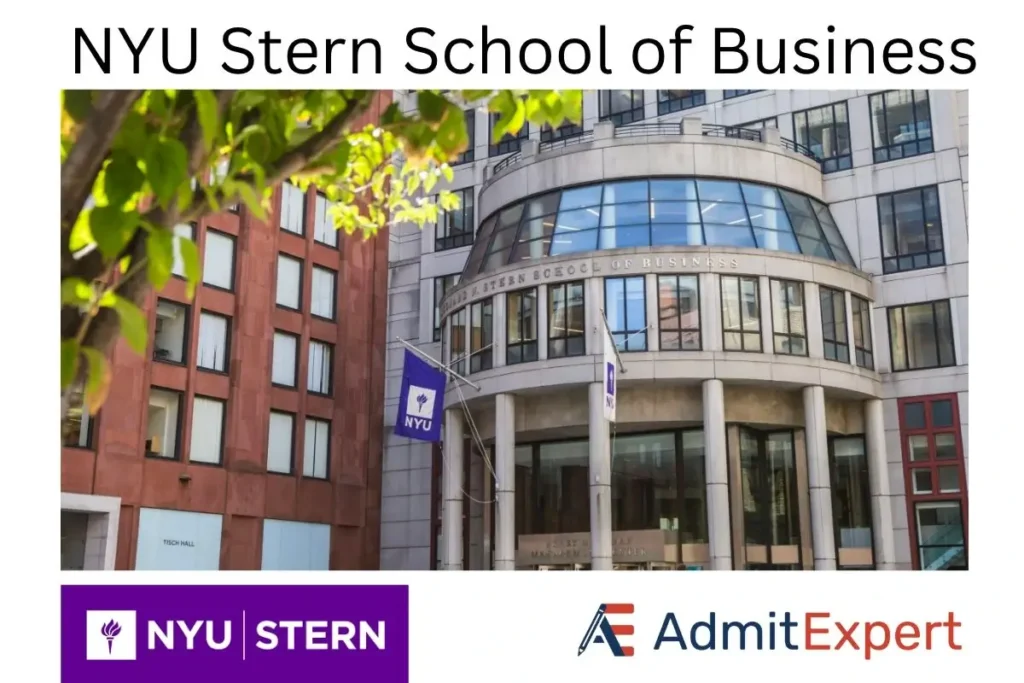
NYU Stern MBA at a Glance
| Metric | Latest official figure |
|---|---|
| Latest class profile | Full-time MBA Class of 2027 |
| Applications | 4,933 |
| Admission offers | 1,161 |
| School-reported admission rate | 24% |
| Students enrolled | 336 |
| Women | 45% |
| International citizenship | 43% |
| Average work experience | 5.1 years among students with experience |
| Average undergraduate GPA | 3.64 |
| Average current GMAT | 682 |
| Average legacy GMAT | 737 |
| Average GRE | 163 Verbal / 164 Quantitative |
| Degree requirement | 60 credits |
| STEM designation | Yes |
| Class of 2025 median base salary | $175,000 |
| Job seekers receiving an offer within 3 months | 86.3% |
| Job seekers accepting an offer within 3 months | 86.0% |
| 2026–27 first-year tuition | $92,658 |
| 2026–27 first-year cost of attendance | $140,668 |
| Admitted students receiving merit scholarships | Approximately 20–25% |
Stern's current Class of 2027 profile is unusually transparent about admissions volume.
The school reports:
- 4,933 applications;
- 1,161 admission offers;
- a 24% admission rate;
- 336 enrolled students.
That is a useful example of why admission offers and enrollment should never be confused.
The acceptance rate uses admission offers as the numerator.
Dividing 336 enrolled students by 4,933 applications would instead create an enrollment-to-application ratio, not an acceptance rate.
What Makes the NYU Stern MBA Distinctive?
Four aspects of the MBA interact especially strongly:
- New York City access;
- extensive academic customization;
- Stern's explicit IQ + EQ admissions and leadership philosophy;
- experiential learning through Stern Solutions and other applied programs.
The result is a program that can work particularly well for students who know which part of New York's business ecosystem they want to use.
New York Access Is Most Valuable When It Becomes Action
Stern's Full-time MBA is based in Greenwich Village in Manhattan.
That puts students near employers and professionals across:
- investment banking;
- asset management;
- private equity;
- fintech;
- consulting;
- media;
- entertainment;
- luxury and retail;
- technology;
- real estate;
- healthcare;
- startups;
- professional services.
But proximity does not automatically create a job offer.
A strong Stern plan identifies what the student would actually do with that access.
For example, an aspiring investment banker might use:
- alumni conversations;
- finance clubs;
- technical preparation;
- employer events;
- internship recruiting.
A candidate moving into technology might instead need:
- product or analytics electives;
- a relevant Stern Solutions project;
- technology clubs;
- conversations with operators;
- a summer internship.
The location becomes valuable through repeated interaction and evidence-building—not through the Manhattan address by itself.
Stern's Curriculum Became More Communication-Focused in Fall 2026
Stern's current two-year MBA curriculum requires 60 credits.
As of Fall 2026, the degree structure includes several required leadership and communication elements in addition to the analytical core.
Students must complete:
- Coaching for Impact in the first semester;
- Leadership in the first semester;
- Strategic Communication during the first year;
- Statistics and Data Analysis or establish proficiency;
- Financial Accounting and Reporting or establish proficiency;
- at least five of seven Menu Core courses during the first year;
- a summer internship between the first and second years;
- a second-year ethics/responsibility capstone.
That structure is more nuanced than describing Stern as simply having "four core courses."
The Menu Core Gives Students Early Choice
Students choose at least five of seven Menu Core areas:
- Data Science
- Firms & Markets
- Foundations of Finance
- The Global Economy
- Marketing
- Operations Management
- Strategy
Students who have already mastered certain material may be able to establish proficiency rather than repeat it.
That can be valuable for a career changer.
A banker moving toward general management may not need to maximize finance coursework.
A software engineer moving into investing may need exactly the opposite.
The right course plan asks:
What does my target role require that my current background does not yet prove?
Stern Offers More Than 200 Electives and 20+ Specializations
The current curriculum allows students to:
- choose from 200+ electives;
- select up to three specializations from more than 20 options;
- take up to 25% of their courses at other NYU graduate schools or eligible partner institutions.
That creates enormous flexibility.
It can also create poor academic planning if flexibility is treated as an end in itself.
A list containing:
- finance;
- entrepreneurship;
- luxury;
- technology;
- entertainment;
- strategy
may sound impressive but reveal no coherent development plan.
The better approach is:
career transition → capability gaps → courses and experiences
Coaching for Impact Makes Interpersonal Development Explicit
One distinctive Stern requirement is Coaching for Impact.
The course uses small-group coaching and impromptu speaking to develop:
- self-awareness;
- communication effectiveness;
- leadership presence;
- relationship-building;
- growth mindset.
This fits Stern's broader emphasis on IQ + EQ.
A technically or analytically strong applicant may not need an MBA primarily to become better at analysis.
They may need to become better at:
- communicating judgment;
- influencing people;
- handling disagreement;
- building trust;
- understanding their effect on others.
Stern makes those interpersonal capabilities part of the formal academic experience rather than leaving them entirely to clubs or extracurricular leadership.
Stern Requires a Summer Internship
The current degree requirements explicitly include participation in a summer internship between the first and second year.
That makes the summer a structural part of the two-year MBA.
For a career changer, the internship can provide:
- relevant experience;
- a test of the target function;
- employer relationships;
- a route to a return offer.
It also helps distinguish Stern's two-year MBA from the school's focused one-year programs.
Applicants comparing formats should therefore consider not only the number of months in school but also the value of having a traditional summer internship cycle.
Stern Solutions Creates Applied Business Experience
Through Stern Solutions, students can work on real organizational challenges in faculty-advised teams.
Experiential learning becomes especially useful when it closes a credibility gap.
A candidate interested in consulting may need experience:
- framing an ambiguous problem;
- interviewing stakeholders;
- analyzing evidence;
- presenting a recommendation.
A candidate targeting a startup may need to demonstrate:
- customer discovery;
- product thinking;
- commercialization;
- market analysis.
The project matters because it creates evidence of doing the work, not because the program name appears on a resume.
Endless Frontier Labs Connects MBAs with Science and Technology Ventures
Stern's Endless Frontier Labs supports early-stage science and technology ventures.
MBA students can engage with startups and investors through the associated ecosystem.
This can be particularly relevant for students interested in:
- venture capital;
- deep-tech commercialization;
- climate technology;
- life sciences;
- entrepreneurship.
The useful question is whether the experience builds the capability the student needs.
A prospective VC investor needs different evidence from a founder trying to launch a consumer company.
The Entire Two-Year Stern MBA Is STEM-Designated
Stern identifies its two-year Full-time MBA as a STEM-designated degree program.
For eligible international graduates, STEM designation may allow an additional 24 months of STEM OPT beyond standard post-completion OPT, subject to current U.S. immigration rules, employer eligibility, and individual status.
That can extend potential work authorization to three years.
It does not guarantee:
- employment;
- employer sponsorship;
- H-1B selection;
- permanent work authorization.
International applicants still need to investigate how their target employers handle sponsorship.
NYU Stern MBA Class Profile 2027
Stern's current profile contains 336 enrolled students.
Admissions and Class Composition
| Metric | Class of 2027 |
|---|---|
| Applications | 4,933 |
| Admission offers | 1,161 |
| Admission rate | 24% |
| Students enrolled | 336 |
| Women | 45% |
| International citizenship | 43% |
| Countries represented | 43 |
| LGBTQ+ students | 10% |
| U.S. military veterans / active duty | 9% |
| Students with work experience | 98% |
| Average work experience among those with experience | 5.1 years |
| Average age | 28 |
Stern's international figure has a broad definition
The 43% international-citizenship measure includes:
- foreign nationals;
- dual citizens;
- U.S. permanent residents.
It is therefore not the percentage of students who need an F-1 visa.
That distinction matters when comparing class profiles across schools, because different institutions use different definitions of "international."
Undergraduate Backgrounds
| Undergraduate field | Share |
|---|---|
| Business | 30% |
| Engineering / Math / Science | 25% |
| Economics | 19% |
| Social Sciences | 16% |
| Humanities / Arts / Other | 10% |
Business is the largest individual category at 30%.
But 70% of the class studied something else.
That reinforces a broader point:
Stern's finance reputation does not mean the incoming class is built only from business majors.
An engineer needs to show interpersonal and commercial development.
A humanities student needs to establish analytical readiness.
A business graduate still needs to differentiate through impact and leadership.
Pre-MBA Industry Background
| Pre-MBA industry | Share |
|---|---|
| Financial Industries | 31% |
| Consulting | 15% |
| Technology | 8% |
| Entertainment / Media | 6% |
| Military / Government | 5% |
| Healthcare / Pharmaceuticals | 4% |
| Nonprofit / Arts / Education | 4% |
| Law | 4% |
| Advertising / Public Relations | 3% |
| Real Estate | 3% |
| Manufacturing / Trade | 3% |
| Consumer Products / Retail | 2% |
| Engineering | 2% |
| Other | 10% |
Finance is clearly the largest incoming professional category.
That creates both an advantage and a challenge for finance applicants.
The advantage is that the admissions reader immediately understands the industry.
The challenge is differentiation.
A familiar employer or transaction-heavy resume establishes context.
It does not automatically show:
- what you owned;
- how your responsibility grew;
- what judgment you exercised;
- how you worked with other people;
- why an MBA is necessary now.
NYU Stern GMAT, GRE, EA, and GPA
Stern reports averages for its main academic statistics.
Current GMAT
| Metric | Class of 2027 |
|---|---|
| Average | 682 |
| Middle 80% | 645–725 |
| Full range | 595–775 |
Legacy GMAT
| Metric | Class of 2027 |
|---|---|
| Average | 737 |
| Middle 80% | 690–760 |
| Full range | 660–770 |
GRE
| Metric | Class of 2027 |
|---|---|
| Average Verbal | 163 |
| Middle 80% Verbal | 158–168 |
| Average Quantitative | 164 |
| Middle 80% Quantitative | 160–170 |
Undergraduate GPA
| Metric | Class of 2027 |
|---|---|
| Average GPA | 3.64 |
| Middle 80% | 3.36–3.89 |
| Full range | 3.18–4.00 |
Current and Legacy GMAT Scores Must Stay Separate
The 682 current-GMAT average and 737 legacy-GMAT average come from different versions of the exam.
They should not be interpreted as:
"The class GMAT fell by 55 points."
The scales are different.
Applicants taking the current GMAT should evaluate themselves against:
- current-format scores;
- percentiles;
- the rest of the academic record.
Old advice built around a raw "730+" target belongs to the legacy exam.
A Middle-80% Range Is Not a Cutoff
Stern's current-GMAT middle 80% is 645–725.
That means approximately 80% of enrolled scores fall inside the interval.
It does not mean:
- 645 is the minimum;
- a lower score is impossible;
- a higher score guarantees admission.
The full range itself extends lower and higher.
The useful admissions question remains:
Does the complete academic profile demonstrate readiness for Stern's curriculum?
Stern Accepts Six Different Standardized Tests
Stern's current standardized-test policy accepts:
- GMAT;
- GRE;
- Executive Assessment;
- LSAT;
- MCAT;
- DAT.
Stern states that it has no preference among the accepted tests and no minimum standardized-test score.
That gives applicants unusual flexibility.
The right test is the one that most credibly demonstrates readiness for the applicant's profile.
Test Waivers Are Available—but the Full-Time MBA Is Not Universally Test-Optional
Stern now allows eligible Full-time MBA applicants to request a standardized-test waiver.
Applicants must have completed a bachelor's degree before requesting the waiver and must submit:
- waiver request;
- resume;
- undergraduate and graduate transcripts.
Stern evaluates requests case by case and highlights evidence such as:
- quantitative undergraduate or graduate study;
- analytical professional experience;
- certifications.
The current waiver-request deadline is April 1, 2027, but Stern strongly recommends applying at least three weeks before the intended MBA application date.
That distinction is important.
A waiver process does not mean the program is universally test-optional.
If the waiver is denied, the applicant still needs an accepted standardized test for a complete application.
The Class Profile Shows Waivers Are a Meaningful Route
The Class of 2027 reports the following test types:
| Application test route | Share |
|---|---|
| GMAT | 39% |
| GRE | 27% |
| Executive Assessment | 6% |
| General test waiver | 16% |
| NYU test waiver | 7% |
| MCAT / LSAT / DAT | 5% |
This shows that Stern is genuinely using multiple forms of academic evidence.
It should not be interpreted as evidence that one path is easier.
Admissions still evaluates the complete academic record.
NYU Stern MBA Application Requirements 2026–27
Stern's current MBA application includes:
- academic records;
- professional history;
- resume;
- standardized test or approved waiver;
- essays;
- one required EQ Endorsement;
- optional second EQ Endorsement;
- interview if invited;
- $250 application fee, unless waived.
Stern's admissions philosophy puts unusual emphasis on the combination of intellectual ability and emotional intelligence.
Essay 1: Professional Aspirations
The first required essay asks:
What are your short-term career goals? Why is the Stern MBA the necessary next chapter in your professional story?
Maximum: 500 words
This is more than a goals question.
The phrase "necessary next chapter" asks the applicant to establish a gap between:
- where they are now;
- where they want to go;
- what Stern provides in between.
A strong response should connect:
past experience → target role → missing capability → Stern resources
A list of courses and clubs without the development gap is much weaker.
For detailed strategy, see our NYU Stern MBA essay analysis.
Essay 2: Pick Six
Stern's signature visual essay asks applicants to introduce themselves using:
- a brief introduction of no more than three sentences;
- six images;
- one caption for each image.
The goal is explicitly to show qualities beyond professional and academic achievements.
That means Pick Six should not become a visual resume.
A strong set may reveal:
- relationships;
- interests;
- identity;
- humor;
- formative experiences;
- values;
- communities;
- curiosity.
The six images should collectively make the applicant more understandable as a person.
Stern Requires One EQ Endorsement
The current EQ Endorsement structure requires one endorsement.
A second is optional.
The required endorser should normally be the current supervisor. If that is not possible, the applicant explains why.
The endorsement asks for evidence about:
- comparative performance;
- strengths;
- constructive feedback;
- response to feedback;
- emotional intelligence.
Stern specifically asks for an example demonstrating EQ qualities such as:
- self-awareness;
- empathy;
- communication;
- self-management.
That makes recommender choice particularly important.
The best endorser is the person who has seen how the applicant behaves with other people—not simply the most senior person available.
Stern Interviews Are Not Blind
Interviews are invitation-only and required before admission.
Stern's current notification and interview process says interviews are conducted virtually by trained admissions professionals who have thoroughly read the entire application.
That is a very different interview from the blind formats used by some peer schools.
The interviewer can probe:
- details from essays;
- career choices;
- academic history;
- recommender context;
- inconsistencies;
- why Stern;
- why now.
Applicants should therefore know their submitted application extremely well.
After the interview, Stern says the post-interview decision typically arrives within up to three weeks.
NYU Stern MBA Application Deadlines 2026–27
Stern calls these application deadlines rather than conventional Rounds 1–4.
| Deadline | Application due | Initial notification by |
|---|---|---|
| 1st Deadline | September 15, 2026 | December 1, 2026 |
| 2nd Deadline | October 15, 2026 | January 1, 2027 |
| 3rd Deadline | January 15, 2027 | April 1, 2027 |
| 4th Deadline | April 15, 2027 | Ongoing |
Applications must be submitted by 11:59 p.m. Eastern Time.
As of September 28, 2026, the first deadline has passed.
The next Full-time MBA deadline is therefore:
October 15, 2026
Stern publishes the current dates on its MBA admissions deadline page.
"Initial Notification" Does Not Mean Final Decision
This is an important Stern-specific detail.
By the published initial-notification date, an applicant may receive:
- interview invitation;
- waitlist offer;
- denial.
An interview invitation is not a final admission decision.
After the interview, the applicant may receive:
- admission;
- waitlist;
- denial.
Applicants comparing school calendars should therefore not treat Stern's notification dates as directly equivalent to schools that publish a single final-decision date.
Stern Reviews Applications on an Ongoing Basis
Stern says it reviews applications continuously rather than waiting for each deadline to pass.
The school therefore encourages applicants to submit between deadlines when the application is ready.
The useful principle is:
Do not rush an incomplete or weaker application solely to hit an earlier date—but do not wait unnecessarily once the application is genuinely ready.
NYU x NYU / Stern Is the Deferred Pathway
Eligible NYU undergraduate students can apply through NYU x NYU / Stern.
The pathway allows admitted students to gain approximately two to five years of post-undergraduate work experience before enrolling.
The current eligibility framework includes an NYU undergraduate degree and academic requirements specific to the pathway.
Deferred admission is most useful when the applicant has a deliberate plan for the intervening years.
The objective is not simply to secure an MBA seat early.
It is to enter the MBA later with:
- stronger professional judgment;
- clearer goals;
- more responsibility;
- evidence that makes the MBA more valuable.
NYU Stern MBA Employment Report: Class of 2025
The latest Full-time MBA employment report covers the Class of 2025.
Employment Status
| Metric | Class of 2025 |
|---|---|
| Graduates | 326 |
| Seeking employment | 271 |
| Not seeking employment | 33 |
| No recent employment information | 22 |
| Offer within 3 months | 86.3% of seekers |
| Accepted within 3 months | 86.0% of seekers |
| Median base salary | $175,000 |
| Average base salary | $168,970 |
| Median signing bonus | $35,000 |
The denominator matters.
The 86.3% offer rate applies to 271 job seekers.
It does not mean 86.3% of the full graduating class accepted a job.
Likewise, the 22 graduates without recent employment information should not automatically be classified as unemployed or non-seeking.
Median and Average Salary Tell Different Stories
Stern reports:
- $175,000 median base salary
- $168,970 average base salary
The median is the midpoint of reported salaries.
The average is the arithmetic mean.
An article calling $175,000 the "average Stern MBA salary" would therefore be incorrect.
Stern's employment hub also reports $202,705 in average total compensation for the Class of 2025.
That measure should not be compared directly with the $175,000 median base salary because:
- one is an average;
- one is a median;
- one includes additional compensation.
Employment by Industry
| Industry | Share of reported placements | Median base salary |
|---|---|---|
| Financial Services | 36.6% | $175,000 |
| Consulting | 32.8% | $175,000 |
| Technology / Telecommunications | 14.2% | $152,500 |
| Healthcare / Pharma / Biotech | 3.4% | $138,500 |
| Consumer Packaged Goods | 3.4% | $122,500 |
Financial services and consulting together account for 69.4% of reported industry placements.
Adding technology brings the three largest sectors to 83.6%.
That is a highly concentrated employment market.
Stern supports many careers, but its biggest current pipelines are clearly:
- finance;
- consulting;
- technology.
Stern Is a Finance-Heavy MBA—but "Finance" Is Not One Career
Financial services is the largest Class of 2025 industry at 36.6%.
Investment banking alone accounts for 28.0% of reported placements.
That makes investment banking one of Stern's most visible structured MBA career paths.
Why New York matters for banking
Stern's Manhattan location places students close to:
- major investment banks;
- advisory firms;
- capital-markets teams;
- private-credit firms;
- asset managers;
- financial-services alumni.
That proximity can support:
- networking;
- employer events;
- informational conversations;
- recruiting preparation.
But the location does not eliminate the intensity of investment-banking recruiting.
Applicants still need:
- technical preparation;
- clear motivation;
- relationship-building;
- internship success.
Other finance paths require different preparation
Private equity, venture capital, asset management, commercial banking, and fintech are different markets.
A student should not use the 36.6% finance headline to assume equal access to all of them.
Investment banking has a comparatively structured internship pipeline.
PE and VC often depend much more heavily on:
- prior investing or transaction experience;
- sector expertise;
- independent networking.
Consulting Is Almost as Large as Finance
Consulting represents 32.8% of reported industry placements.
Its median base salary is also $175,000.
That makes consulting another major Stern recruiting market rather than a distant second behind finance.
For a career changer, consulting can provide a comparatively structured route through:
- summer internship recruiting;
- case interviews;
- large employers;
- office-specific hiring.
The applicant should still investigate:
- which offices;
- visa policies;
- hiring volumes;
- internship conversion;
- alternative strategy roles.
Technology Rebounded in the Class of 2025
Stern's official year-over-year employment data shows:
| Industry | Class of 2023 | Class of 2024 | Class of 2025 |
|---|---|---|---|
| Consulting | 41.9% | 37.0% | 32.8% |
| Financial Services | 29.4% | 35.7% | 36.6% |
| Technology / Telecommunications | 14.2% | 9.1% | 14.2% |
Technology returned to 14.2% after falling to 9.1% in the prior class.
Consulting declined over the same three-class window, while financial services increased.
Those figures describe what happened.
They do not prove why it happened.
Changes can reflect:
- employer demand;
- student preferences;
- market conditions;
- cohort composition.
One or two years should not automatically be called a permanent trend.
Employment by Function
| Function | Share | Median base salary |
|---|---|---|
| Consulting | 39.4% | $175,000 |
| Finance / Accounting | 34.2% | $175,000 |
| Marketing / Sales | 14.3% | $144,000 |
| Management | 5.6% | $145,000 |
Consulting as a function is larger than consulting as an industry.
That is possible because a graduate can perform:
- strategy;
- internal consulting;
- advisory work
inside an employer that belongs to another industry.
Likewise, finance professionals can work inside technology, healthcare, or consumer companies.
That is why a career goal should normally specify:
Function + industry + geography
rather than only "finance" or "tech."
Stern's Career Outcomes Are Heavily Concentrated in the Northeast
The Class of 2025 employment report places:
- 96% of reported destinations in North America
- 82.4% of placements in the Northeast
- 7.0% in the U.S. West
This is one of the clearest pieces of evidence that Stern's New York location affects the employment geography.
For someone targeting New York:
- investment banking;
- consulting;
- fintech;
- media;
- luxury;
- professional services
that concentration can be highly relevant.
For someone committed to another region, it should trigger more specific research into:
- alumni density;
- target offices;
- employer recruiting;
- geographic mobility.
School-Facilitated Recruiting Plays a Major Role
Stern's Class of 2025 employment reporting indicates that roughly three-quarters of accepted jobs were school-facilitated.
Those channels include sources such as:
- internships;
- on-campus recruiting;
- Stern job postings;
- Stern networks and alumni.
That matters because the economic value of the MBA is not simply the curriculum.
Students are also buying access to a recruiting infrastructure.
For many career changers, the internship is especially important because it can become the bridge into the full-time role.
NYU Stern MBA Cost of Attendance 2026–27
Stern's current cost of attendance for first-year students covers a nine-month academic year.
| Expense | 2026–27 amount |
|---|---|
| Tuition | $92,658 |
| LAUNCH orientation fee | $2,040 |
| Food | $6,910 |
| Housing | $25,306 |
| Books and supplies | $1,500 |
| Transportation | $2,438 |
| Personal expenses | $4,500 |
| Health insurance | $5,100 |
| Loan fees | $216 |
| Total first-year budget | $140,668 |
The $140,668 figure is not "tuition."
Tuition is $92,658.
The rest is a combination of:
- school fees;
- housing;
- food;
- insurance;
- transportation;
- supplies;
- personal expenses;
- loan-fee allowance.
The LAUNCH Fee Is a First-Year Cost
The $2,040 LAUNCH orientation fee applies to MBA1 students.
Stern's current 2026–27 budget for students already in their second year is lower by that amount before considering future tuition changes.
An incoming Class of 2029 applicant should still not use the current MBA2 budget as their guaranteed second-year cost.
Their second year will occur in a future academic year with new tuition and expense figures.
$140,668 Is Not the Full MBA Cost
The first-year budget covers nine academic months.
A realistic two-year plan should include:
- first-year published cost;
- second-year tuition at future rates;
- summer living expenses;
- optional travel and activities;
- financing costs;
- foregone salary and benefits.
The summer internship may generate income.
That income should not be assumed before an offer exists.
New York Housing Is a Major Part of the Financial Decision
The standard housing allowance is $25,306 for nine months.
Actual costs can vary materially depending on:
- neighborhood;
- roommates;
- lease timing;
- family structure;
- commute.
A student living alone in Manhattan may spend very differently from the standard budget.
Applicants should therefore treat the published housing figure as a financial-aid allowance rather than a guaranteed lifestyle cost.
Opportunity Cost Belongs in the MBA Price
Many Stern applicants leave relatively well-paid careers in:
- finance;
- consulting;
- technology;
- professional services.
That makes foregone compensation a major part of the two-year investment.
The real comparison is closer to:
net tuition and living cost + financing cost + lost earnings
versus
the career access and long-term trajectory available with and without Stern.
NYU Stern Merit Scholarships
Stern's current scholarship guidance says approximately 20–25% of admitted two-year Full-time MBA students receive a merit scholarship.
All domestic and international applicants are automatically considered.
No separate application is required for the main admission-time merit awards.
The majority of Stern scholarships are:
- full tuition;
- half tuition.
Scholarship decisions are normally communicated at admission and are final.
Major Stern Scholarship Types Differ in Value and Duration
Dean's Scholarship
The Dean's Scholarship covers full tuition and fees.
It is awarded to a limited number of highly meritorious admitted students.
Advancing Women in Business Scholarship
This merit award covers full tuition and mandatory fees for both years of the Full-time MBA.
Directors Scholarship
The Directors Scholarship provides $50,000 for the first year.
Community Scholarship
The Community Scholarship provides $25,000 for the first year.
The difference in duration matters.
A "$50,000 scholarship" and "$50,000 per academic year" would produce very different two-year funding.
Applicants should always read the award letter rather than comparing scholarship names.
Fertitta Veterans Funding Has a Different Structure
Eligible U.S. military veterans and active-duty students can be considered for the Fertitta Veterans MBA Scholarship.
The scholarship reduces tuition to a flat:
$30,000 per academic year
That is not a $30,000 scholarship.
It is the remaining tuition charge after the award.
Stern also participates in Yellow Ribbon and provides additional veteran support under current program rules.
Scholarships Do Not Automatically Stack
Stern's funding directory includes:
- admission-time merit scholarships;
- partner fellowships;
- awards after admission;
- donor awards for second-year students.
Those are not all additive.
A student should not total every scholarship name appearing on the site and treat that number as potential funding.
The reliable financing number is the amount confirmed in:
- admission letter;
- scholarship notice;
- subsequent official award.
Federal Graduate Loan Rules Changed in 2026
Stern's current loan-program guidance notes that Graduate PLUS is being phased out for new borrowers beginning July 1, 2026.
That makes the federal borrowing environment materially different from what older MBA financing guides describe.
U.S. applicants relying heavily on loans should use current 2026–27 federal-loan rules rather than assuming the financing structure available to students several years ago still exists.
International Students May Have Private-Loan Options
Stern states that international students may have access to private education loans:
- with a U.S. cosigner;
- in some cases, without a U.S. cosigner.
Terms vary by lender.
Loan availability does not mean the debt is economically sensible.
International students should model repayment against:
- target geography;
- expected salary;
- currency risk;
- interest rate;
- visa and sponsorship uncertainty.
Stern Has a Loan Assistance Program for Social-Enterprise Careers
The NYU Stern Loan Assistance Program can provide support to eligible MBA graduates pursuing qualifying social-enterprise careers.
Graduates may apply annually during the first 10 years after graduation, subject to current program rules and available funding.
That can be more decision-useful than the classwide salary median for someone intentionally choosing a lower-paid mission-driven career.
Is NYU Stern a Good MBA for Investment Banking?
Yes.
Investment banking accounts for 28% of reported Class of 2025 placements.
That is a substantial share of the class and one of Stern's clearest career strengths.
The combination of:
- New York location;
- alumni;
- bank recruiting;
- finance curriculum;
- internship pathways
creates a large structured market for banking candidates.
The important qualifier is that structured does not mean easy.
The candidate still needs to succeed in:
- technical preparation;
- networking;
- interviews;
- internship performance.
Is NYU Stern a Good MBA for Consulting?
Yes.
Consulting accounts for 32.8% of industry placements and 39.4% of functions.
That makes consulting nearly as significant as finance in Stern's current employment market.
For a career changer, consulting can offer:
- structured internship recruiting;
- broad role access;
- case preparation;
- multiple New York offices;
- transferable problem-solving experience.
Is NYU Stern a Good MBA for Technology?
Technology represents 14.2% of Class of 2025 industry placements.
That is a meaningful share and a return to the same level Stern reported for the Class of 2023 after a weaker 2024.
Technology applicants should still define the function:
- product;
- finance;
- strategy;
- marketing;
- operations;
- sales;
- business development.
The industry percentage does not tell you which of those roles are most accessible.
Is NYU Stern a Good MBA for Entrepreneurship?
Stern offers a substantial entrepreneurship ecosystem through:
- Endless Frontier Labs;
- entrepreneurship electives;
- startup projects;
- NYU's wider founder community;
- New York's venture market.
Applicants should distinguish among three very different goals:
- founding a company;
- joining a startup;
- investing in startups.
Those paths require different evidence and use Stern's ecosystem differently.
Who Should Consider NYU Stern Most Seriously?
Stern deserves close consideration if you value:
- New York City;
- investment banking;
- consulting;
- financial services;
- technology;
- media and entertainment;
- entrepreneurship;
- flexible academics;
- 200+ electives;
- cross-registration across NYU;
- a STEM-designated MBA;
- an admissions culture that explicitly values EQ as well as academic strength.
Applicants should think more carefully if they strongly prefer:
- a residential campus separated from a major city;
- a highly prescribed two-year curriculum;
- recruiting concentrated primarily outside the Northeast;
- a smaller number of academic choices.
The strongest Stern fit is usually specific.
New York should be part of how the plan works, not the entire reason for the plan.
How to Decide Whether Stern Fits Your MBA Goals
1. Define the post-MBA role
Specify:
- function;
- industry;
- geography;
- employer type.
2. Identify what is missing today
Is the gap:
- finance knowledge;
- product experience;
- leadership;
- interpersonal influence;
- employer access;
- analytical evidence;
- network?
3. Build a Stern development path
Connect those gaps to:
- required core;
- Menu Core;
- electives;
- specialization;
- Stern Solutions;
- NYU cross-registration;
- internship;
- New York employer ecosystem.
4. Test the employment data at the correct level
Do not use the 36.6% financial-services figure to justify an unspecified private-equity goal.
Do not use the 14.2% technology figure to justify product management.
Research the exact route.
5. Compare net cost
Include:
- tuition;
- New York living costs;
- confirmed scholarship;
- loan structure;
- internship income;
- opportunity cost;
- realistic job-search timing.
NYU Stern MBA FAQs
What is NYU Stern's latest Full-time MBA class profile?
The latest official profile currently published is the Class of 2027, with 336 enrolled students.
What is NYU Stern's MBA acceptance rate?
Stern reports a 24% admission rate for the Class of 2027, based on 1,161 offers from 4,933 applications.
What is the average GMAT at NYU Stern?
The Class of 2027 reports an average current GMAT of 682 and an average legacy GMAT of 737.
The two exam versions use different score scales.
What is the average GRE at Stern?
The current profile reports averages of 163 Verbal and 164 Quantitative.
What is the average GPA at Stern?
The Class of 2027 reports an average undergraduate GPA of 3.64.
How much work experience do Stern MBA students have?
Among Class of 2027 students with prior work experience, the average is 5.1 years.
Which standardized tests does Stern accept?
Stern accepts:
- GMAT;
- GRE;
- Executive Assessment;
- LSAT;
- MCAT;
- DAT.
The school states that it has no preference among accepted tests.
Does NYU Stern offer a test waiver?
Yes. Eligible Full-time MBA applicants can request a standardized-test waiver. Approval is case by case and is not automatic.
What are the Stern MBA essays?
The current application includes:
- a 500-word Professional Aspirations essay;
- the visual Pick Six essay;
- an optional additional-information essay.
How many recommendations does Stern require?
Stern requires one EQ Endorsement. A second endorsement is optional.
How much is the Stern MBA application fee?
The current application fee is $250, with waivers available for certain eligible applicants.
Is the Stern interview blind?
No. Stern's admissions professionals review the complete application before conducting the interview.
What is the next Stern MBA deadline?
As of September 28, 2026, the next Full-time MBA deadline is October 15, 2026 at 11:59 p.m. Eastern Time.
Are Stern's notification dates final-decision dates?
Not necessarily. The initial notification can be:
- interview invitation;
- waitlist;
- denial.
Applicants invited to interview receive a separate post-interview decision.
Is the NYU Stern MBA STEM-designated?
Yes. Stern identifies the entire two-year Full-time MBA as a STEM-designated degree.
How much does NYU Stern cost?
For 2026–27, first-year tuition is $92,658, and the published nine-month first-year budget is $140,668.
How many Stern admits receive scholarships?
Stern says approximately 20–25% of admitted two-year Full-time MBA students receive merit scholarships.
Are international students eligible for Stern merit scholarships?
Yes. Domestic and international applicants are automatically considered for the main admission-time merit scholarships.
Is Stern mainly a finance MBA?
Financial services is the largest Class of 2025 industry at 36.6%, but consulting accounts for 32.8% and technology 14.2%.
Stern is finance-heavy, not finance-only.
How many Stern MBA graduates enter investment banking?
Investment banking accounts for 28% of reported Class of 2025 placements.
Where do Stern MBA graduates work?
The Class of 2025 report is heavily Northeast-focused: 82.4% of reported placements were in the Northeast, and 96% were in North America.
Final Thoughts
NYU Stern is easiest to understand when New York is treated as an operating advantage rather than a marketing phrase.
The school gives students extraordinary access to:
- finance;
- consulting;
- technology;
- media;
- startups;
- professional services;
- alumni;
- employers.
But access creates value only when the student knows how to use it.
The curriculum supports that flexibility.
The two-year MBA requires 60 credits, but students can choose from more than 200 electives, select up to three specializations, and take up to a quarter of their courses elsewhere in NYU or eligible partner institutions.
Stern has also strengthened the required curriculum around leadership and communication, while keeping the traditional analytical core and mandatory summer internship.
The career outcomes show why the program is often associated with finance: 36.6% of Class of 2025 placements were in financial services, and investment banking alone accounted for 28%.
But consulting is nearly as large, technology remains meaningful, and Stern's year-over-year data shows that the employment mix can shift materially with the market.
The financial decision deserves the same precision.
A first-year budget above $140,000, New York living costs, changed federal loan rules, and the opportunity cost of leaving work all belong in the calculation. Merit scholarships can materially change the economics, but only about 20–25% of admitted students receive them.
The strongest reason to apply is therefore not:
"I want to study in New York."
It is:
"This is the role I want, these are the capabilities and relationships I am missing, and Stern's curriculum, internship pathway, recruiting infrastructure, alumni, and New York location give me a concrete way to close that gap."
If Stern is on your target list, continue with our NYU Stern MBA essay guide and MBA application deadlines tracker.
Related Articles

Deferred MBA Programs: 2027 Deadlines, Eligibility & Top Schools
Compare the leading deferred MBA programs for college seniors and eligible graduate students, including HBS 2+2, Stanford, Wharton, Booth, Kellogg, MIT Sloan, Columbia, Haas and Darden, with current 2027 deadlines and rules.
Read Article →
M7 Business Schools: 2026–2027 Guide to Rankings, Admissions, Costs & Careers
A current comparison of Harvard, Stanford, Wharton, Chicago Booth, Kellogg, MIT Sloan and Columbia covering 2026 rankings, Class of 2027 profiles, GMAT/GRE scores, 2027 application deadlines, MBA costs and Class of 2025 career outcomes.
Read Article →
Stanford GSB MBA Guide 2026–27: Admissions, Class Profile, Curriculum, Employment, Fees & Scholarships
A complete guide to the Stanford Graduate School of Business MBA covering admissions, the latest class profile, GMAT and GRE scores, curriculum, application deadlines, employment outcomes, tuition, cost of attendance, scholarships, and financial aid.
Read Article →