

Rice Jones MBA Guide 2026–27: Admissions, Class Profile, Curriculum, Employment, Fees & Scholarships
A complete guide to Rice Jones’s Full-Time MBA, covering its three-year class profile, curriculum, Houston advantage, 2026–27 admissions, employment, costs, scholarships, and applicant fit.
Rice University's Jones Graduate School of Business sits in a market that shapes how the MBA should be evaluated.
Houston is one of the world's most important energy centers, a major healthcare market, and a large corporate economy. Rice's Class of 2025 employment data reflects that geography clearly: consulting and energy each account for 24.1% of accepted jobs, while technology accounts for 16.1% and financial services 14.9%.
But Rice should not be reduced to an "energy MBA."
By function, finance/accounting is actually the largest current category at 34.5%, followed by consulting at 26.4%. A graduate can work in finance inside an energy company, strategy inside a technology company, or general management inside an industrial business.
That distinction is the key to understanding Rice.
The useful question is not:
"Is Rice strong in energy, finance, consulting, or entrepreneurship?"
It is:
"Can Rice give me the academic preparation, applied experience, employer access, network, and regional positioning needed for the specific role I want?"
The program's structure supports that kind of planning.
Full-Time MBA students complete a broad first-year core, participate in the required Global Field Experience, then use more than 100 electives and 10 specializations to shape the second year. They can also choose from experiential labs in areas such as healthcare, energy transition, marketing, real estate, venture capital, entrepreneurship, operations, and investing.
Rice's leadership model adds another layer: students work in teams from the beginning and can receive year-long team coaching through Team Learning Labs.
This guide focuses on the two-year Full-Time MBA in Houston, not Rice's Professional, Executive, Hybrid, or Online MBA formats.
It uses Rice's current three-year class-profile averages across the Classes of 2026, 2027, and 2028, the 2026–27 admissions cycle, Class of 2025 employment outcomes, Class of 2026 internship outcomes, and current 2026–27 tuition and scholarship information.
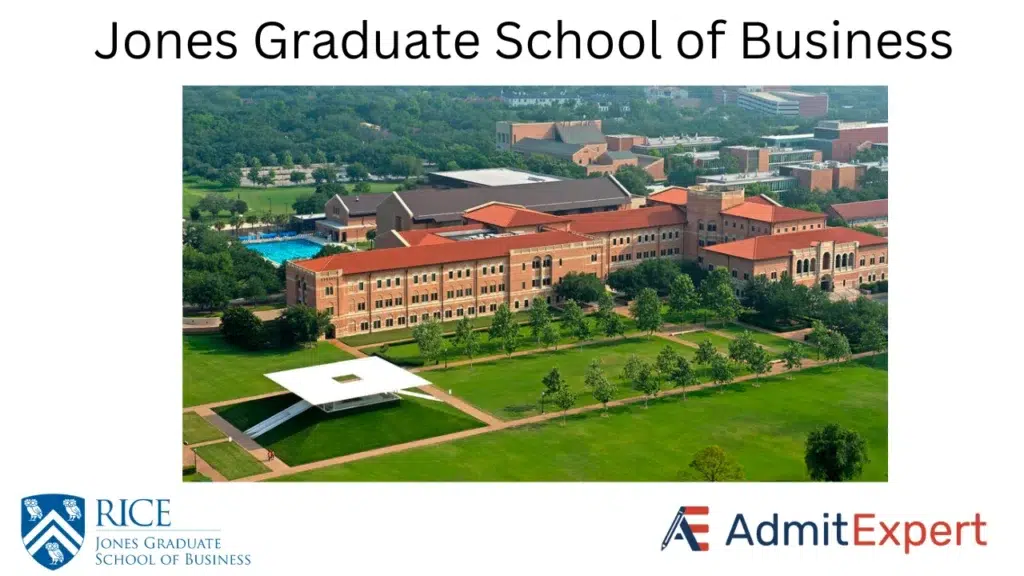
Rice Jones MBA at a Glance
| Metric | Latest official information |
|---|---|
| University | Rice University |
| School | Jesse H. Jones Graduate School of Business |
| Location | Houston, Texas |
| Program | Two-year Full-Time MBA |
| STEM designation | Yes |
| Class-profile methodology | Three-year averages across Classes of 2026, 2027, and 2028 |
| Average enrollment | 134 |
| Average work experience | 5.4 years |
| Average undergraduate GPA | 3.46 |
| Average GMAT | 694; current profile does not separately label exam edition |
| Average GRE | 157 Verbal / 159 Quantitative |
| Women | 36% |
| International students | 33% |
| Students with advanced degrees | 25% |
| Specializations | 10 |
| Electives | 100+ |
| Class of 2025 median base salary | $141,500 |
| Class of 2025 mean base salary | $146,381 |
| Offers within 3 months | 88 of 122 job seekers, or 72.1% |
| Acceptances within 3 months | 87 of 122 job seekers, or 71.3% |
| Class of 2026 internship participation | 88% |
| 2026–27 annual tuition | $79,116 |
| Tuition + required annual fees | $80,439 |
| Full-Time MBA scholarship coverage | Rice currently reports 95%–96% across different official pages |
| Next application deadline | Round 1 — October 16, 2026 |
Rice's current Full-Time MBA class profile is labeled as a Class of 2027 profile, but Rice explicitly states that the statistics shown are averages across the Classes of 2026, 2027, and 2028.
That reporting choice is useful because it smooths volatility in a relatively small program.
It also means the numbers should not be presented as though 134 students enrolled in one specific current class.
What Makes the Rice Full-Time MBA Distinctive?
Several parts of the program reinforce one another:
- Houston access to energy, healthcare, finance, technology, consulting, and entrepreneurship;
- a small-to-mid-sized Full-Time MBA cohort;
- a STEM-designated core;
- a required Global Field Experience;
- 100+ electives and 10 optional specializations;
- experiential labs in industry-specific areas;
- team-based leadership coaching;
- a recruiting market heavily concentrated in the Southwest.
The strongest Rice fit is therefore usually specific.
A student pursuing energy finance can use Houston, the energy specialization, finance electives, industry clubs, and energy recruiting together.
A healthcare candidate can combine the healthcare specialization, Texas Medical Center proximity, healthcare labs, and Houston employer access.
A founder can use Lilie, the Rice Alliance, the New Enterprise ecosystem, and cross-campus technical talent.
The school is most useful when those resources form a coherent path rather than a list of attractive features.
Houston Is a Career Asset Only When It Matches the Role
Rice's location matters because Houston is not simply where the MBA happens.
It is also a major employment market.
The Class of 2025 report places the overwhelming majority of accepted employment in the Southwest, and Rice's current employer relationships are particularly visible in:
- energy;
- consulting;
- finance;
- technology;
- healthcare.
That creates a natural advantage for students who want to build careers in Texas or the broader Southwest.
But geography should not become a substitute for career definition.
A student targeting:
"Houston energy"
still needs to specify whether the job is:
- corporate finance;
- investment banking;
- strategy;
- commercial operations;
- energy transition;
- consulting;
- product;
- general management.
Different functions use Houston differently.
Rice's Current Employment Market Is Exceptionally Southwest-Oriented
Rice's detailed Class of 2025 employment data places 82.8% of accepted employment in the Southwest.
That is one of the most important numbers in the report.
For a candidate who wants:
- Houston;
- Texas;
- the Gulf Coast;
- Southwest energy;
- Southwest finance;
- regional consulting;
that concentration may be highly relevant.
For someone committed to New York, Chicago, San Francisco, or another region, it should trigger a more careful question:
"Which Rice employers and alumni actually hire into my target office?"
A national brand does not guarantee equal recruiting density in every market.
Houston Makes Rice Particularly Distinctive for Energy
The current three-year class profile shows 14% of incoming students from energy backgrounds.
The Class of 2025 employment report shows 24.1% of accepted jobs in energy.
That makes energy one of the rare areas where Rice has both:
- a meaningful incoming professional base;
- a meaningful post-MBA employment base.
The Energy specialization is designed for students who want commercial and leadership depth in the sector.
Coursework can connect finance, operations, strategy, markets, and the energy transition.
The useful insight is that Rice's energy advantage is not one career.
It is an ecosystem.
Energy Careers at Rice Span Traditional and Transition-Oriented Markets
Houston's energy market includes:
- oil and gas;
- power;
- utilities;
- renewables;
- energy finance;
- energy consulting;
- infrastructure;
- energy transition.
Rice also offers experiential options such as the Renewables and the Energy Transition Lab.
A petroleum engineer moving into corporate finance needs a different academic plan from someone targeting renewable project development.
A consultant entering energy transition needs something different again.
"Energy" should therefore be treated as an industry context, not a complete career goal.
Rice Is Also Better Positioned for Healthcare Than Its Current Placement Share Alone Suggests
Healthcare and biotechnology represent 13% of incoming industry backgrounds in Rice's current three-year profile.
Healthcare accounts for only 3.4% of Class of 2025 accepted jobs.
That difference should not be read as proof that Rice is weak in healthcare.
The current Healthcare specialization is designed around Houston's proximity to the Texas Medical Center and covers multiple healthcare sectors.
Students can access coursework and projects involving:
- hospitals;
- healthcare delivery;
- biotech;
- pharmaceuticals;
- medical devices;
- health insurance;
- health technology;
- operations;
- finance;
- strategy.
The lower current employment share simply means applicants should investigate the actual recruiting pipeline rather than assume ecosystem size automatically creates placement volume.
The Healthcare Specialization Includes Applied Work
Rice's healthcare pathway requires approved healthcare electives and includes an experiential lab.
One example is the Operations Lab: Healthcare, in which students work on a real operating problem inside a major Houston healthcare system.
That is more useful for a career changer than merely taking a survey course.
The project can create evidence of:
- process improvement;
- stakeholder management;
- operating analysis;
- implementation planning.
A healthcare candidate should ask what evidence the experience could add to their resume before recruiting.
The First Year Builds the Common Management Foundation
Rice's Full-Time MBA curriculum begins with a common core.
Required areas include:
- data analysis;
- finance;
- managerial economics;
- marketing;
- financial accounting;
- organizational behavior;
- communications;
- strategy;
- operations;
- corporate social responsibility;
- leadership;
- negotiations.
That breadth is particularly valuable for specialists.
An engineer may already know how to solve a technical problem but need to understand:
- customer economics;
- finance;
- organizational behavior;
- strategy.
A banker may need operating and people-management depth.
A marketer may need finance and analytics.
The core becomes most useful when it fills gaps rather than repeating existing strengths.
The Full-Time MBA Is STEM-Designated
Rice identifies the Full-Time MBA curriculum as STEM-designated.
That applies to the program itself rather than requiring students to select one particular STEM major or concentration.
For eligible international graduates, STEM status can support the additional OPT extension under current U.S. rules.
It does not guarantee:
- employment;
- employer sponsorship;
- H-1B selection;
- permanent work authorization.
International applicants still need to investigate the sponsorship behavior of target employers.
More Than 100 Electives Create Significant Second-Year Flexibility
After completing the first-year core, Rice Full-Time MBA students can choose from 100+ electives.
Current areas include:
- accounting;
- analytics;
- AI;
- communications;
- energy;
- entrepreneurship;
- finance;
- healthcare;
- leadership;
- marketing;
- operations;
- real estate;
- strategy;
- technology management.
That flexibility is useful.
It also creates the risk of an unfocused transcript.
A strong course plan should begin with:
target role → missing capability → elective sequence
rather than simply taking the most interesting courses available.
Rice Offers 10 Full-Time MBA Specializations
Rice's current specialization directory lists:
- Accounting
- Energy
- Entrepreneurship
- Finance
- Healthcare
- Marketing
- Operations Management
- Organizational Behavior
- Real Estate
- Strategic Management
Specializations are optional.
Students can combine two if desired.
That makes them useful planning tools rather than mandatory degree labels.
Specializations Do Not Replace the General MBA
A specialization can provide depth.
It does not change the fact that employers also evaluate:
- prior experience;
- internship performance;
- leadership;
- technical competence;
- interview preparation.
For example, choosing Finance does not automatically create investment-banking access.
Choosing Entrepreneurship does not mean the student has a viable startup.
Choosing Healthcare does not guarantee a healthcare job.
The specialization has to support a broader career strategy.
The Finance Specialization Connects to Both Corporate and Investment Roles
Rice's Finance specialization includes foundational and advanced finance coursework.
The current employment data shows why the distinction between industry and function matters.
Financial services accounts for 14.9% of accepted jobs by industry.
Finance/accounting accounts for 34.5% by function.
That means many Rice graduates are performing finance work outside traditional financial-services employers.
A finance applicant should therefore decide whether the target is:
- investment banking;
- corporate finance;
- investment management;
- energy finance;
- private capital;
- another finance role.
The Strategic Management Specialization Supports Consulting and Corporate Strategy
Rice describes Strategic Management as relevant to careers in:
- strategic planning;
- management consulting;
- global business management.
That aligns with the Class of 2025 employment report, where consulting is one of the two largest industries.
A student pursuing consulting can combine:
- strategy coursework;
- case preparation;
- experiential projects;
- employer recruiting.
A student pursuing corporate strategy may need a different mix, particularly if the target employer is in energy, technology, or healthcare.
AI Is Present in Business Applications Rather Than as a Standalone MBA Identity
Rice's current elective menu includes courses such as:
- AI Tools for Business Decision Making;
- AI for Customer Analytics;
- Introduction to GenAI for Business Applications;
- Creating the Data-Driven Business.
That is a useful development.
It does not mean every Full-Time MBA student follows an AI specialization.
The stronger interpretation is that Rice is integrating AI into several business contexts.
An MBA student needs to understand:
- where AI creates value;
- where the data is weak;
- where model output is unreliable;
- how implementation changes workflows;
- how managers govern its use.
The Global Field Experience Is Required
Every Full-Time MBA student participates in Rice's Global Field Experience.
The course is built into the core curriculum.
Students work in teams of four on a real challenge for an organization in an emerging market.
The semester-long experience culminates in a one-week international immersion where the team presents recommendations to the client.
That structure is more meaningful than treating the course as a study trip.
The Global Field Experience Creates Client Evidence
For a career changer, the strongest value is not the destination.
It is the work.
A student can use the experience to demonstrate:
- client management;
- problem framing;
- research;
- analysis;
- cross-cultural communication;
- recommendation development;
- executive presentation.
Those are portable capabilities across:
- consulting;
- strategy;
- marketing;
- operations;
- finance.
The Timing of GFE Matters
Rice says the Full-Time MBA Global Field Experience takes place after the first year.
That means it follows a substantial portion of the core curriculum.
The student can therefore bring first-year finance, strategy, marketing, operations, and data skills into the consulting project.
Applicants should also include international travel and related expenses in their planning rather than assuming every cost is automatically covered.
Experiential Labs Add Industry-Specific Applied Work
Rice's Experiential Labs include options such as:
- Healthcare Strategy Lab
- Technology Commercialization Lab
- Marketing Lab
- Supply Chain Management Lab
- Operations Lab: Healthcare
- Real Estate Investments Lab
- Data-Driven Investments Lab
- Renewables and the Energy Transition Lab
- Student Venture Fund
- E-Lab: Venture Capital
- E-Lab: Enterprise Acquisition
- E-Lab: New Enterprise
- Healthcare Innovation and Entrepreneurship Lab
These experiences are particularly valuable for career changers because they can create evidence before full-time recruiting.
The Marketing Lab Turns Electives Into a Client Project
Rice's Marketing Lab places teams on strategic consulting projects for real clients.
Students analyze data and develop client recommendations.
That can be useful for someone moving into:
- brand strategy;
- product marketing;
- customer analytics;
- growth;
- broader commercial roles.
The course is more valuable if the project resembles the work the student wants to do after graduation.
The Technology Commercialization Lab Connects Business With Rice Research
The technology-commercialization ecosystem gives students experience evaluating research and turning technical ideas into commercial opportunities.
That can be relevant to students targeting:
- technology strategy;
- venture capital;
- product;
- deep-tech commercialization;
- entrepreneurship.
The key skill is not merely understanding the technology.
It is evaluating:
- customer problem;
- market size;
- business model;
- competitive position;
- financing;
- commercialization path.
Entrepreneurship Draws on the Wider Rice University Ecosystem
Rice's entrepreneurial environment extends beyond the business school.
The ecosystem includes:
- Lilie — Liu Idea Lab for Innovation and Entrepreneurship;
- Rice Alliance for Technology and Entrepreneurship;
- venture competitions;
- startup courses;
- New Enterprise;
- Student Venture Fund;
- venture-capital labs;
- entrepreneurship-through-acquisition programming.
That can serve several different goals.
Founding, Joining, and Investing in Startups Are Different Career Paths
An entrepreneurship-minded applicant should distinguish among:
- founding a company;
- joining a startup;
- buying and operating a business;
- investing in startups;
- commercializing university technology.
Each path uses Rice differently.
A founder may care about product testing and technical cofounders.
An ETA candidate needs sourcing, acquisition finance, and operating capability.
A venture investor needs investment judgment and network access.
Leadership Development Begins With Teams
Rice's leadership-development model places students into diverse teams from the beginning.
The core includes areas such as:
- organizational behavior;
- negotiations;
- leadership;
- communications.
The program then reinforces those skills through experiential work.
That matters because a manager's analytical answer can still fail if the team cannot execute it.
Team Learning Labs Provide Year-Long Coaching
Full-Time MBA students can use Team Learning Labs, a year-long team-based coaching program.
Coaches work with teams on:
- performance;
- cohesion;
- inclusion;
- self-awareness;
- psychological safety;
- communication;
- feedback.
This is different from a one-time leadership workshop.
The coaching follows teams through their development.
Leader as Coach Adds a Second-Year Leadership Option
Rice also offers an optional Leader as Coach program in year two.
Students practice skills such as:
- listening;
- creating psychological safety;
- goal setting;
- sustaining motivation;
- helping others improve performance.
That can be particularly useful for candidates moving from individual-contributor roles into people management.
Rice Full-Time MBA Class Profile: Three-Year Averages
Rice's current class-profile page uses averages across the Classes of 2026, 2027, and 2028.
That means every figure below is a multi-cohort statistic.
Academic Profile
| Academic measure | Three-year average | Middle 50% |
|---|---|---|
| Undergraduate GPA | 3.46 | 3.20–3.79 |
| GMAT | 694 | 678–720 |
| GRE Verbal | 157 | 153–161 |
| GRE Quantitative | 159 | 154–166 |
Rice does not separately label the GMAT version behind this three-year aggregate.
That is important because the reporting window spans a period in which MBA applicants used different GMAT formats.
The 694 should therefore not be mechanically compared with a current-GMAT number at another school.
The Profile Uses a Middle 50% Range, Not a Middle 80% Range
Many MBA programs publish a middle-80% score range.
Rice publishes a middle 50% range on the current class-profile page.
Those ranges are not directly comparable.
A narrower middle-50% band will naturally exclude more of the distribution.
The 678–720 GMAT range is therefore not a minimum or maximum.
Class Composition
| Measure | Three-year average |
|---|---|
| Enrollment | 134 |
| Average work experience | 5.4 years |
| Women | 36% |
| Men | 64% |
| International students | 33% |
| First-generation students | 17% |
| U.S. minorities | 35% |
| Underrepresented minorities | 30% |
| Consortium members | 12 |
| Students with advanced degrees | 25% |
The enrollment figure is an average, not a class headcount.
Rice's use of a multi-year profile makes the statistics more stable but less useful for claims about year-over-year changes.
Undergraduate Background
| Undergraduate field | Three-year average |
|---|---|
| Business / Economics | 41% |
| STEM | 39% |
| Humanities / Other | 20% |
The class is therefore close to evenly split between business/economics and STEM, with a meaningful humanities/other group.
That does not mean applicants need to fit one of the two largest categories.
It means the admissions committee is accustomed to evaluating very different academic backgrounds.
Incoming Industry Background
| Pre-MBA industry | Three-year average |
|---|---|
| Financial Services | 16% |
| Energy | 14% |
| Healthcare / Biotechnology | 13% |
| Consulting | 9% |
| Technology | 9% |
| Government / Education / Nonprofit | 5% |
| Consumer Packaged Goods | 3% |
| Entrepreneurship | 3% |
| Manufacturing | 3% |
| Real Estate | 2% |
| Media / Entertainment | 2% |
| Other | 18% |
| Unknown | 1% |
The distribution reinforces one of Rice's distinctive strengths: the incoming class already contains meaningful experience in Houston-relevant sectors such as energy and healthcare.
At the same time, no single industry dominates.
Three-Year Averages Are Stable Benchmarks—but Weak Trend Data
A multi-year average has an advantage.
One unusually small or unusual class has less effect on the profile.
The trade-off is that it hides year-to-year movement.
You cannot use Rice's current 33% international figure to claim international representation rose or fell in the latest class unless comparable single-year data is available.
The same caution applies to GMAT, GPA, and industry background.
Rice MBA Admissions Requirements 2026–27
The current MBA admissions guide requires:
- undergraduate degree;
- transcripts;
- professional resume;
- GMAT, GRE, Executive Assessment, or approved waiver;
- one required professional recommendation;
- two career-goal short answers;
- one required creative essay;
- optional additional-information essay;
- application fee;
- additional assessment activities if invited.
International applicants also have separate transcript-verification and visa requirements.
Rice Accepts GMAT, GRE, and Executive Assessment
Full-Time MBA applicants can submit:
- GMAT;
- GMAT Focus;
- GRE;
- Executive Assessment.
Rice considers the highest submitted score.
The school also permits an approved standardized-test waiver for eligible Full-Time applicants.
Rice's Test Waiver Has Specific Eligibility Requirements
Rice's current waiver policy requires candidates to have:
- an active Full-Time MBA application;
- at least three years of post-undergraduate professional experience;
- and at least one qualifying form of quantitative evidence.
Examples include:
- strong STEM or quantitative undergraduate/graduate work;
- terminal degree such as MD or PhD;
- CPA or CFA;
- another graduate standardized test demonstrating comparable quantitative ability.
Waivers are case-by-case.
A Waiver Must Be Approved Before the Application Can Be Submitted
For the Full-Time MBA, Rice says applicants must have either:
- a standardized test score;
- or an approved waiver
before submitting the application.
The school therefore advises requesting the waiver early enough for review before the selected deadline.
This is not a generic test-optional policy where every applicant simply decides whether to omit a score.
The Short-Answer Essays Force Career Clarity
Rice currently asks for two 100-word career-goal responses.
One focuses on the short-term goal.
The other focuses on the long-term goal.
The word limit is small enough that vague language becomes expensive.
A strong answer identifies:
- function;
- industry;
- employer type;
- long-term direction.
"Work in energy" or "move into technology" is too broad.
The Creative Essay Is Built Around a Meaningful Photo
Rice's required creative essay asks applicants to choose a photo with significant personal meaning and explain its story.
Applicants can respond through:
- a written essay of up to 500 words;
- or a video of roughly one to three minutes.
The format creates an opportunity to show something the resume does not.
For detailed strategy, use Admit Expert's Rice Jones MBA essay guide.
The Creative Essay Should Not Become a Second Career Essay
The admissions committee already has:
- resume;
- short-term goal;
- long-term goal.
The photo essay can instead reveal:
- relationships;
- identity;
- values;
- formative experiences;
- interests;
- community;
- humor;
- curiosity.
The image is not the point by itself.
The story is.
Rice Requires One Recommendation—but Allows Two
Rice requires one professional recommendation and allows a maximum of two.
A current or former supervisor is preferred.
The second letter is useful only if it adds materially different evidence.
Two letters repeating the same praise are not automatically stronger than one detailed recommendation.
A Rice Student or Alumni Referral Is Separate From the Recommendation
Rice also allows current students or alumni to submit a Build the Class referral.
That is not a substitute for the required recommendation.
It can also qualify the applicant for an application-fee waiver under the current policy.
Applicants should keep these two parts of the application distinct.
Interview and Video Assessment Are Invitation-Only
After preliminary application review, Rice may invite selected candidates to additional assessment activities.
These can include:
- Rice Video Interview;
- conversation with a member of the Rice Business community.
The school does not invite every applicant.
Not receiving an early invitation does not automatically mean the application has already been denied.
The Rice Interview Is Currently Virtual
The current admissions guide says Full-Time MBA interviews are conducted via Zoom.
The interview is designed to let applicants explain:
- motivation;
- accomplishments;
- personality;
- fit;
- career direction.
Preparation should connect the complete application rather than introduce an entirely different story.
Rice MBA Application Deadlines 2026–27
| Round | Application deadline | Rolling decisions begin |
|---|---|---|
| Round 1 | October 16, 2026 — 11:59 p.m. CT | Starting December 10, 2026 |
| Round 2 | January 6, 2027 — 11:59 p.m. CT | Starting March 10, 2027 |
| Round 3 | March 31, 2027 — 11:59 p.m. CT | Starting May 5, 2027 |
| Round 4 | June 1, 2027 — 11:59 p.m. CT | Rolling, space available |
Round 4 is restricted to:
- U.S. citizens;
- permanent residents.
International applicants therefore need an earlier round.
Round 1 and Round 2 Receive Priority Scholarship Consideration
Rice's admissions guide says complete Full-Time MBA applications submitted in Rounds 1 and 2 receive priority consideration for merit scholarships.
That does not mean a later applicant can never receive aid.
It does mean scholarship-sensitive candidates have a reason to apply earlier.
Consortium Deadlines Are Different
Consortium applicants use separate Rice deadlines:
| Consortium round | Deadline |
|---|---|
| Round 1 | October 15, 2026 |
| Round 2 | January 5, 2027 |
Those dates should not be substituted for the regular Full-Time MBA calendar.
Rice Offers Deferred Enrollment
Rice's Deferred Enrollment pathway is available to eligible students applying during the final year of undergraduate study.
The current deadline is:
May 1, 2027 — 11:59 p.m. CT
Admitted students can defer Full-Time MBA enrollment for two to five years.
The deferred pathway follows the Full-Time application requirements, but Rice does not offer the Full-Time standardized-test waiver for deferred applicants.
International Transcript Evaluation Happens After Admission
International applicants upload unofficial transcripts or mark sheets when applying.
If admitted and enrolling, Rice then requires third-party evaluation of non-U.S. degree credentials.
That distinction matters because applicants should not assume every international candidate has to purchase a credential evaluation before submitting the MBA application.
Rice says the Full-Time MBA is the program that sponsors an I-20 for international MBA applicants.
Rice Jones MBA Employment Report: Class of 2025
Rice's official Career Development Office report library publishes detailed Class of 2025 Full-Time MBA employment data.
The detailed report covers 152 graduates.
Employment Status
| Employment category | Class of 2025 |
|---|---|
| Total graduates | 152 |
| Seeking employment | 122 |
| Not seeking employment | 26 |
| No recent employment information | 4 |
The 122 job seekers are the correct denominator for offer and acceptance rates.
The full 152-person class is not.
Rice's Offer and Acceptance Counts Differ by One Graduate
Within three months:
- 88 of 122 job seekers had received offers;
- 87 of 122 had accepted offers.
That produces:
- 72.1% offer rate
- 71.3% acceptance rate
This one-person difference matters because offer and acceptance are different employment outcomes.
Rice Also Publishes a Separate 72% Recruiting-Source Statistic
Rice's 2025 career highlights says 72% of students accepted job offers from the Rice Business community.
That is not another three-month employment rate.
It describes where accepted offers came from.
The detailed employment report separately reports the job-search outcome rates.
Those measures should not be combined.
School-Facilitated Recruiting Is a Major Part of the Rice Career Model
Rice's Class of 2025 career report describes the accepted-offer source mix as heavily connected to school resources.
The Rice Business community can include:
- internships;
- job postings;
- interviews;
- networking;
- alumni and employer connections.
That matters because the MBA investment is not only tuition for classes.
Students are also buying access to recruiting infrastructure.
Rice MBA Salary and Signing Bonus
| Compensation metric | Class of 2025 |
|---|---|
| Salary reporters | 70 of 87 accepting employment |
| Mean base salary | $146,381 |
| Median base salary | $141,500 |
| Mean signing bonus | $31,659 |
| Median signing bonus | $30,000 |
| Signing-bonus reporters | 47 of 70 salary reporters |
The mean and median answer different questions.
The salary data also covers 70 reporting graduates, not all 152 graduates.
Do Not Add the Salary Median and Bonus Median
It would be incorrect to calculate:
$141,500 median salary + $30,000 median signing bonus = $171,500 median total compensation
The salary and bonus medians come from different reporting groups.
The person at the midpoint of one distribution is not necessarily the same person at the midpoint of the other.
Employment by Industry
| Industry | Share of accepted employment | Median base salary |
|---|---|---|
| Consulting | 24.1% | $190,000 |
| Energy | 24.1% | $130,672 |
| Technology | 16.1% | $137,500 |
| Financial Services | 14.9% | $172,500 |
| Consumer Products | 4.6% | Insufficient data |
| Healthcare / Biotechnology / Pharmaceuticals | 3.4% | $116,300 |
| Manufacturing | 3.4% | Insufficient data |
| Nonprofit / Education | 3.4% | Insufficient data |
| Other | 3.4% | $102,500 |
| Real Estate | 2.3% | Insufficient data |
Consulting and energy together account for 48.2% of accepted jobs.
That concentration is one of the clearest characteristics of the current Rice employment market.
Consulting and Energy Have the Same Share—but Very Different Salary Medians
Both industries account for 24.1% of accepted jobs.
Their reported median base salaries differ substantially:
- consulting — $190,000;
- energy — $130,672.
That illustrates why the overall MBA salary cannot be treated as an individual's expected outcome.
Career choice changes the compensation distribution.
Consulting Is One of Rice's Clearest Structured Recruiting Pathways
Consulting accounts for:
- 24.1% by industry;
- 26.4% by function.
Rice's current employer list includes firms such as:
- McKinsey & Company;
- Boston Consulting Group;
- Bain & Company;
- Deloitte;
- Infosys Consulting.
The school also uses Houston employer relationships, national recruiting, clubs, and career coaching to support consulting candidates.
Energy Is Rice's Most Geographically Distinctive Career Market
Energy is also 24.1% of accepted employment.
Current major employers include organizations such as:
- Chevron;
- ExxonMobil;
- Phillips 66;
- CenterPoint Energy;
- other energy companies and advisory firms.
For an applicant with technical energy experience, Rice can provide a credible route toward:
- finance;
- strategy;
- commercial roles;
- operations;
- energy transition;
- consulting.
That is a more useful story than simply wanting to "stay in energy."
Technology Is a Meaningful Secondary Market
Technology represents 16.1% of accepted jobs.
Its median base salary is $137,500.
Rice's current technology employer relationships include companies such as:
- Amazon;
- Dell Technologies;
- Microsoft;
- HPE;
- AT&T.
The industry percentage still needs a function.
Technology finance, product, strategy, marketing, and operations are different careers.
Financial Services Is 14.9% by Industry—but Finance Is Much Larger by Function
Financial services represents 14.9% of industries.
Finance/accounting represents 34.5% of functions.
That is one of the most important distinctions in the report.
Rice finance outcomes are not limited to banks and investment firms.
A substantial number of graduates perform finance work inside:
- energy;
- technology;
- industrial;
- other corporate employers.
Employment by Function
| Function | Share of accepted employment | Median base salary |
|---|---|---|
| Finance / Accounting | 34.5% | $150,000 |
| Consulting | 26.4% | $190,000 |
| General Management | 10.3% | $125,000 |
| Marketing / Sales | 9.2% | $140,000 |
| Information Technology | 2.3% | Insufficient data |
| Other | 17.2% | $115,000 |
The function table makes Rice look more finance-heavy than the industry table.
That is not a contradiction.
It reflects the role Houston corporations play in recruiting finance professionals.
Corporate Finance Is a Particularly Important Rice Story
A candidate evaluating Rice for finance should therefore distinguish:
- investment banking;
- corporate finance;
- energy finance;
- treasury;
- financial planning and analysis;
- investment management.
Houston creates a particularly strong market for finance roles tied to large operating companies.
The same Finance specialization can serve very different outcomes.
Geography Is a Defining Part of the Rice Employment Story
The detailed Class of 2025 report places:
- 82.8% of accepted employment in the Southwest;
- 98.9% in North America.
The Southwest concentration is much stronger than at many national MBA programs.
That should be treated as a feature or constraint depending on the applicant's goals.
Strong Southwest Placement Does Not Mean Rice Is Only Regional
Rice's employers include nationally recognized consulting firms, banks, technology companies, healthcare organizations, and energy companies.
Graduates also work outside Texas.
The more precise interpretation is:
Rice has national employer access with a very strong Southwest center of gravity.
That is different from saying either:
- "Rice is only a Texas MBA";
- or "geography does not matter."
Class of 2026 Internship Outcomes Show a Different Recruiting Mix
Rice's 2025 employment report also includes internship results for the Class of 2026.
The school reports:
- 88% of students participated in an internship;
- $6,942 average monthly compensation;
- 77% of accepted internship offers came through Rice Business community channels;
- 89 employers hired Class of 2026 interns.
These are internship outcomes for a different cohort.
They should not be combined with the Class of 2025 full-time job-search rate.
Internship by Industry
| Internship industry | Class of 2026 share | Mean monthly compensation |
|---|---|---|
| Financial Services | 23% | $10,133 |
| Consulting | 22% | $11,593 |
| Energy | 18% | $5,106 |
| Technology | 18% | $6,198 |
| Healthcare | 8% | $7,327 |
| Consumer Packaged Goods | 4% | $4,600 |
| Real Estate | 3% | $5,100 |
| Manufacturing | 2% | $5,477 |
| Nonprofit | 1% | Not published |
The internship distribution differs from the full-time employment distribution.
That is expected.
Different cohorts and different recruiting stages can produce different mixes.
Internship by Function
| Internship function | Class of 2026 share | Mean monthly compensation |
|---|---|---|
| Finance / Accounting | 36% | $9,275 |
| Consulting | 22% | $11,245 |
| Other | 22% | $5,669 |
| Marketing / Sales | 13% | $6,970 |
| General Management | 5% | $8,936 |
Finance is again the largest function.
That reinforces the importance of looking beyond the financial-services industry label.
The Standard Two-Year MBA Uses the Internship as a Career Bridge
Rice describes the summer internship as a central part of the Full-Time MBA experience.
For a career changer, the path often becomes:
first-year core → recruiting → internship → return offer or second-year re-recruiting
That is one of the major differences between a full-time two-year MBA and a program designed for people who remain continuously employed.
Career Support Continues Into Re-Recruiting
Rice's Career Development Office works with students on:
- career targeting;
- networking;
- employer research;
- applications;
- interview preparation;
- full-time re-recruiting after internships.
That matters because the internship does not always produce the final desired outcome.
Students returning for year two can still pivot, refine, or restart the search.
Is Rice Jones a Good MBA for Energy?
Yes, if the applicant's target role aligns with Rice's unusually strong energy ecosystem.
Evidence includes:
- 14% energy background in the incoming three-year profile;
- 24.1% Class of 2025 employment in energy;
- Houston location;
- Energy specialization;
- energy-transition experiential lab;
- energy employers;
- finance and consulting roles tied to the sector.
The important qualifier is that "energy" must be broken into a function.
Is Rice Jones a Good MBA for Consulting?
Consulting is tied with energy as the largest Class of 2025 industry at 24.1%.
It is 26.4% by function and reports a $190,000 median base salary.
Rice also has active relationships with major consulting employers.
That makes consulting a substantial structured pathway.
Applicants should still investigate:
- office preferences;
- case preparation;
- visa policies;
- internship hiring;
- industry practice.
Is Rice Jones a Good MBA for Finance?
Finance is arguably even more important than the industry table first suggests.
Finance/accounting is 34.5% of functions.
The Finance specialization and Houston's corporate/energy finance ecosystem create multiple paths.
Applicants should distinguish investment banking from corporate finance.
They are different recruiting markets.
Is Rice Jones a Good MBA for Technology?
Technology represents 16.1% of accepted jobs.
Rice also offers:
- technology-related electives;
- AI courses;
- commercialization labs;
- entrepreneurship resources;
- Carnegie-style cross-disciplinary project opportunities within the university.
The technology pathway is meaningful.
It is not the dominant current career destination.
Is Rice Jones a Good MBA for Healthcare?
Healthcare's current full-time placement share is modest at 3.4%.
But the academic and geographic ecosystem is substantial.
Rice's healthcare specialization connects students to:
- the Texas Medical Center;
- healthcare operations;
- health-tech entrepreneurship;
- industry speakers;
- lab projects.
Applicants should investigate recent employer-level placements in the exact function they want.
Is Rice Jones a Good MBA for Entrepreneurship?
Rice offers a deep entrepreneurship ecosystem through:
- Lilie;
- Rice Alliance;
- New Enterprise;
- Student Venture Fund;
- venture-capital lab;
- technology commercialization;
- healthcare entrepreneurship;
- entrepreneurship-through-acquisition resources.
That makes Rice attractive to founders and investors.
The applicant still needs to identify which entrepreneurial path they mean.
Who Should Consider Rice Jones Most Seriously?
Rice deserves close consideration if you value:
- Houston;
- energy;
- consulting;
- corporate finance;
- investment banking;
- entrepreneurship;
- healthcare access;
- a STEM-designated MBA;
- a smaller collaborative program;
- required global consulting;
- applied labs;
- leadership coaching;
- strong Southwest career access.
Applicants should think more carefully if they strongly prefer:
- recruiting centered primarily in another geography;
- a program with a much larger class;
- a class profile reported as one current cohort rather than multi-year averages;
- a less Houston-centered professional ecosystem.
The strongest Rice fit usually combines career role + Houston advantage + applied learning.
How to Decide Whether Rice Fits Your MBA Goals
1. Define the post-MBA role
Specify:
- function;
- industry;
- geography;
- employer type.
"Energy" is not enough.
"Corporate finance at a Houston energy company" is much more useful.
2. Identify what is missing today
Is the gap:
- finance?
- consulting skill?
- customer insight?
- AI literacy?
- healthcare knowledge?
- leadership?
- global client experience?
- employer access?
The MBA should solve a real problem.
3. Build the academic route
Map the gap to:
- core;
- specialization;
- electives;
- experiential lab;
- Global Field Experience.
The specialization should support the career rather than define it.
4. Build the recruiting route
Connect the target to:
- Career Development Office;
- relevant club;
- employer events;
- internship;
- alumni;
- target geography.
5. Read the data precisely
Do not confuse:
- 72.1% offers with 71.3% acceptances;
- 72% school-sourced accepted jobs with the job-acceptance rate;
- 14.9% financial services with 34.5% finance functions;
- 134 average enrollment with a current class headcount;
- $79,116 tuition with the full annual cost of living.
6. Model the full financial commitment
Include:
- tuition;
- required fees;
- health insurance where applicable;
- books;
- housing;
- food;
- transportation;
- confirmed scholarship;
- foregone earnings;
- financing;
- post-graduation job-search reserve.
Rice Jones MBA Tuition and Cost 2026–27
Rice's current Full-Time MBA tuition page lists:
| Expense | Annual amount |
|---|---|
| Tuition | $79,116 |
| Graduate Student Association fee | $45 |
| Student Organization fee | $8 |
| Health & Wellness Support fee | $720 |
| MBA Activity fee | $550 |
| Required fees subtotal | $1,323 |
| Tuition + required fees | $80,439 |
These are annual charges.
They are not the complete two-year cost.
Health Insurance and Books Are Additional Published Expenses
Rice also publishes:
- health insurance — $3,448;
- estimated textbooks — $2,600;
- parking — $217 to $1,067 depending on permit.
Health insurance is required unless the student has qualifying alternative coverage.
Adding tuition, required fees, insurance, and books produces an annual subtotal of:
$86,487
before housing, food, transportation, personal expenses, and parking.
That is a calculated planning subtotal—not a school-published cost of attendance.
Rice Does Not Publish One Consolidated Full-Time Living Budget on the Tuition Page
This is a meaningful difference from schools that publish a single cost-of-attendance number.
A Rice applicant therefore needs to build a personal living-cost estimate.
The total can vary materially with:
- housing;
- roommates;
- car ownership;
- food;
- insurance;
- travel;
- family circumstances.
For a two-year MBA, those choices matter.
The $2,500 Enrollment Deposit Is Credited Toward Fall Charges
Rice requires a $2,500 nonrefundable enrollment deposit after admission.
The deposit is applied to fall charges.
That means it changes payment timing.
It should not be counted as:
tuition + another $2,500 permanent expense.
Tuition Can Change in Year Two
Rice explicitly says tuition changes each year.
The $79,116 figure is the current 2026–27 annual tuition.
A fall 2027 entrant should therefore treat it as the latest official planning reference, not a guaranteed tuition rate for their own first or second year.
Opportunity Cost Belongs in the MBA Price
A Full-Time MBA also costs the income the student gives up.
For someone leaving:
- energy;
- consulting;
- finance;
- technology;
- healthcare;
foregone compensation can be substantial.
The more useful ROI comparison is:
net direct cost + financing cost + lost earnings
against:
the access, skills, network, and long-term career trajectory created by the MBA.
Rice's Scholarship Coverage Is High—but the Current Official Pages Do Not Use One Consistent Summary
Rice's current official pages publish slightly different scholarship figures.
The tuition page says:
- 95% of Full-Time MBA students receive scholarships upon admission;
- average award: $91,000.
The main Full-Time MBA page says:
- 96% receive scholarships;
- average award: $40,000 annually.
Those statements do not use identical percentages or an obviously identical award period.
The safest interpretation is:
scholarship support is very common, but the only reliable figure for an individual applicant is the award in the admission letter.
Do Not Convert the $91,000 Figure Into an Annual Scholarship
Rice's tuition page does not clearly state that the $91,000 average is per year.
It should therefore not be presented as:
$91,000 annually
unless Rice explicitly says so.
Likewise, the $40,000 annual figure from the program page should not be silently converted into another official two-year average.
Keep the published statements separate.
All Admitted Full-Time MBA Students Are Automatically Considered
Rice says domestic and international Full-Time MBA admits are automatically considered for merit scholarship support as part of application review.
No separate general merit application is required.
Scholarship information is communicated with the admission decision.
Rounds 1 and 2 Receive Priority Merit Consideration
The admissions guide gives complete applications in Rounds 1 and 2 priority consideration for merit scholarships.
That creates a straightforward planning implication:
If scholarship is important, earlier rounds are strategically more attractive.
That does not guarantee a larger award.
It improves the timing of consideration.
Crownover Scholars Combines Funding With Leadership Access
Rice's Crownover Scholars Program provides selected students with financial support plus mentoring and leadership exposure.
Rice notes that the program has historically supported students interested in management consulting.
The value is therefore broader than a tuition discount.
It can include access to:
- experienced business leaders;
- mentoring;
- career relationships.
The exact financial amount should come from the student's award letter.
McNair Scholars Provides Full Tuition for One Student Each Year
The McNair Scholars Program selects one recipient each academic year.
The award provides full-tuition benefits for the two-year MBA.
Rice says the program recognizes:
- academic excellence;
- leadership.
That is a highly selective opportunity.
It should not be used as the baseline assumption when modeling affordability.
Scholarship Percentage Is Not the Same as Net Affordability
Even if most students receive scholarships, the MBA still has:
- tuition balance;
- fees;
- housing;
- food;
- insurance;
- books;
- transportation;
- opportunity cost.
The right comparison between schools is:
net price after confirmed aid
not:
percentage of students receiving something.
Rice Jones MBA FAQs
What is the latest Rice Full-Time MBA class profile?
Rice's current Full-Time MBA class-profile page is labeled "Class of 2027 Profile," but the school states that the reported statistics are three-year averages across the Classes of 2026, 2027, and 2028.
What is the Rice MBA class size?
Rice currently reports an average enrollment of 134 across the Classes of 2026, 2027, and 2028.
That should not be presented as one specific class's headcount.
What is the average GMAT at Rice?
Rice reports a 694 three-year average GMAT, with a 678–720 middle-50% range.
The current aggregate page does not separately label the GMAT edition behind the figure.
What is the average GRE at Rice?
Rice reports three-year averages of:
- 157 Verbal
- 159 Quantitative
The middle-50% ranges are 153–161 Verbal and 154–166 Quantitative.
What is the average GPA at Rice?
The current three-year profile reports an average undergraduate GPA of 3.46, with a 3.20–3.79 middle-50% range.
How much work experience do Rice MBA students have?
The current profile reports 5.4 years of average work experience across the three-year reporting window.
Is the Rice Full-Time MBA STEM-designated?
Yes.
Rice identifies the Full-Time MBA curriculum as STEM-designated.
Which standardized tests does Rice accept?
The Full-Time MBA accepts:
- GMAT;
- GMAT Focus;
- GRE;
- Executive Assessment.
Eligible applicants can request a standardized-test waiver.
Who is eligible for a Rice MBA test waiver?
Rice currently requires at least three years of post-undergraduate professional experience plus qualifying quantitative evidence, such as strong STEM/quantitative study, certain advanced degrees, CPA/CFA credentials, or comparable graduate-test evidence.
Waivers are case-by-case.
Can I submit the application before the waiver is approved?
No.
Rice says a Full-Time MBA applicant needs either a test score or an approved waiver before submitting.
How many recommendations does Rice require?
Rice requires one professional recommendation and permits a maximum of two.
A current or former supervisor is preferred.
What are the Rice MBA essays?
The current Full-Time MBA application includes:
- one 100-word short-term career-goal response;
- one 100-word long-term career-goal response;
- one creative photo-based essay, completed either in writing or video;
- an optional additional-information essay.
Is the Rice MBA interview required?
Additional admissions assessments are invitation-only.
Selected applicants may complete a Rice video interview and an interview with a member of the Rice Business community.
What is the Rice MBA application fee?
The standard application fee is $200.
Rice offers waivers to several groups, including eligible military candidates, Rice alumni, certain partner-program participants, event attendees, and applicants referred through Build the Class.
What is the next Rice MBA deadline?
As of September 28, 2026, the next Full-Time MBA deadline is:
Round 1 — October 16, 2026 at 11:59 p.m. Central Time
Can international applicants apply in Round 4?
No.
Round 4 is restricted to U.S. citizens and permanent residents.
Does Rice offer deferred MBA admission?
Yes.
Eligible students can apply in their final undergraduate year and, if admitted, defer enrollment for two to five years.
The current deferred-application deadline is May 1, 2027.
What is the latest Rice MBA salary?
For the Class of 2025, Rice reports:
- $146,381 mean base salary
- $141,500 median base salary
What percentage of Rice MBA job seekers received offers?
The detailed Class of 2025 data shows 88 of 122 job seekers received offers within three months, or approximately 72.1%.
What percentage accepted offers?
87 of 122 job seekers accepted offers within three months, or approximately 71.3%.
What does Rice's 72% "Rice Business community" figure mean?
It refers to the source of accepted job offers, not the three-month employment rate.
Rice says 72% of accepted offers came through Rice Business community channels.
Which industries hire the most Rice MBAs?
For the Class of 2025:
- consulting — 24.1%;
- energy — 24.1%;
- technology — 16.1%;
- financial services — 14.9%.
What is the largest Rice MBA job function?
Finance/accounting is the largest reported Class of 2025 function at 34.5%.
Consulting is second at 26.4%.
Where do Rice MBA graduates work?
The detailed Class of 2025 report places 82.8% of accepted employment in the Southwest.
That makes the Southwest the dominant current geographic market.
How important are internships at Rice?
For the Class of 2026, Rice reports:
- 88% internship participation;
- $6,942 average monthly compensation;
- 77% of accepted internship offers from Rice Business community channels.
How much is Rice MBA tuition?
Annual Full-Time MBA tuition for 2026–27 is $79,116.
What are Rice's required MBA fees?
Required annual fees total $1,323, producing $80,439 in tuition plus required fees before insurance, books, housing, food, and other living costs.
How much scholarship aid does Rice provide?
Rice's current official pages use two different summaries:
- one says 95% receive scholarships with an average award of $91,000;
- another says 96% receive scholarships with an average award of $40,000 annually.
Use your actual admission award letter for the amount and duration that apply to you.
Are international applicants eligible for Rice scholarships?
Yes.
Rice says admitted domestic and international Full-Time MBA students are automatically considered for merit scholarships.
What is the McNair Scholars award?
Rice selects one McNair Scholar each academic year.
The award provides full-tuition benefits for the two-year MBA.
Final Thoughts
Rice Jones is easiest to understand when Houston, the curriculum, experiential learning, and career geography are considered together.
The current class profile is unusual because it is deliberately reported as a three-year average.
That makes the academic and demographic statistics more stable.
It also means applicants should not mistake average enrollment of 134 for a current single-class headcount or use the profile to invent year-over-year trends.
The curriculum combines a broad STEM-designated first-year core with substantial second-year choice.
Students can select from more than 100 electives and 10 specializations while also using:
- Global Field Experience;
- experiential labs;
- entrepreneurship resources;
- leadership coaching;
- industry clubs;
- summer internship.
Houston then gives those choices a distinctive professional context.
Energy is a major incoming background and a major post-MBA destination.
Finance is even larger by function than financial services is by industry.
Consulting is tied with energy as the largest industry.
Healthcare has strong academic and geographic infrastructure even though the current employment share is smaller.
The employment report also shows why data definitions matter.
Rice's 72.1% three-month offer rate is not the same thing as its 72% school-sourced accepted-offer statistic.
Finance is 34.5% by function but financial services only 14.9% by industry.
The Southwest dominates geography.
And salary statistics describe reporting graduates, not every member of the class.
The financial decision requires the same discipline.
$79,116 is annual tuition.
$80,439 is tuition plus required fees.
Insurance and books are additional.
Housing and food are not included in the tuition-page subtotal.
Scholarships are very common, but Rice's current official pages use two different summary figures, which makes the actual admission award letter more important than either marketing statistic.
The strongest reason to apply is therefore not:
"Rice is in Houston and is strong in energy."
It is:
"This is the role I want, these are the capabilities and relationships I still need, and Rice's Houston location, STEM curriculum, Global Field Experience, specializations, experiential labs, recruiting infrastructure, and scholarship support give me a concrete path to build them."
If Rice Jones is on your target list, continue with Admit Expert's Rice Jones MBA essay guide and MBA application deadlines tracker.
Related Articles

Deferred MBA Programs: 2027 Deadlines, Eligibility & Top Schools
Compare the leading deferred MBA programs for college seniors and eligible graduate students, including HBS 2+2, Stanford, Wharton, Booth, Kellogg, MIT Sloan, Columbia, Haas and Darden, with current 2027 deadlines and rules.
Read Article →
M7 Business Schools: 2026–2027 Guide to Rankings, Admissions, Costs & Careers
A current comparison of Harvard, Stanford, Wharton, Chicago Booth, Kellogg, MIT Sloan and Columbia covering 2026 rankings, Class of 2027 profiles, GMAT/GRE scores, 2027 application deadlines, MBA costs and Class of 2025 career outcomes.
Read Article →
Stanford GSB MBA Guide 2026–27: Admissions, Class Profile, Curriculum, Employment, Fees & Scholarships
A complete guide to the Stanford Graduate School of Business MBA covering admissions, the latest class profile, GMAT and GRE scores, curriculum, application deadlines, employment outcomes, tuition, cost of attendance, scholarships, and financial aid.
Read Article →