

Notre Dame Mendoza MBA Guide 2026–27: Admissions, Class Profile, Curriculum, Employment, Fees & Scholarships
A complete guide to Notre Dame Mendoza’s Two-Year MBA, covering its modular curriculum, majors, current student snapshot, 2026–27 admissions, career outcomes, costs, scholarships, and applicant fit.
The Notre Dame MBA is easy to describe in broad terms.
It is a small, residential two-year MBA with a strong alumni culture, an explicit emphasis on responsible leadership, and a campus experience that is much more immersive than studying in a major commercial city.
But none of those descriptions answers the question that matters most to an applicant:
"How would Mendoza actually help me become credible for the role I want after the MBA?"
That answer depends on the route through the program.
A finance applicant can combine a STEM-designated Finance major with Applied Investment Management, Wall Street recruiting, and finance-focused clubs.
A candidate targeting technology can use the Analytics & AI major, Digital Product Management minor, Grow Irish projects, Silicon Valley Tech Immersion, and the Technology Club.
A consultant can build around Strategy, Grow Irish client projects, Business on the Frontlines, case preparation, and individualized career coaching.
A military applicant may use the MBA very differently again: a small cohort, leadership development, a large veterans community, and the new Angrick Military Scholars program can all matter, but only if the post-military career transition itself is credible.
Mendoza's current employment data also requires a more nuanced view than its values-oriented brand might suggest.
For the Class of 2025, financial services is the largest industry at 31.2%, followed by consulting at 21.9% and technology at 18.8%. By function, finance/accounting accounts for 26.6%, consulting for 23.4%, marketing/sales for 17.2%, operations/logistics for 15.6%, and general management for 14.1%.
The school therefore combines a mission-driven educational philosophy with very conventional corporate MBA recruiting markets.
That combination is one of the most useful ways to understand Mendoza.
This guide focuses on the two-year, full-time Notre Dame MBA, not the Executive MBA or specialized master's programs. It uses the school's current MBA snapshot, the 2026–27 admissions cycle, Class of 2025 employment outcomes, Class of 2026 internship data, and the published 2026–27 tuition and scholarship information.
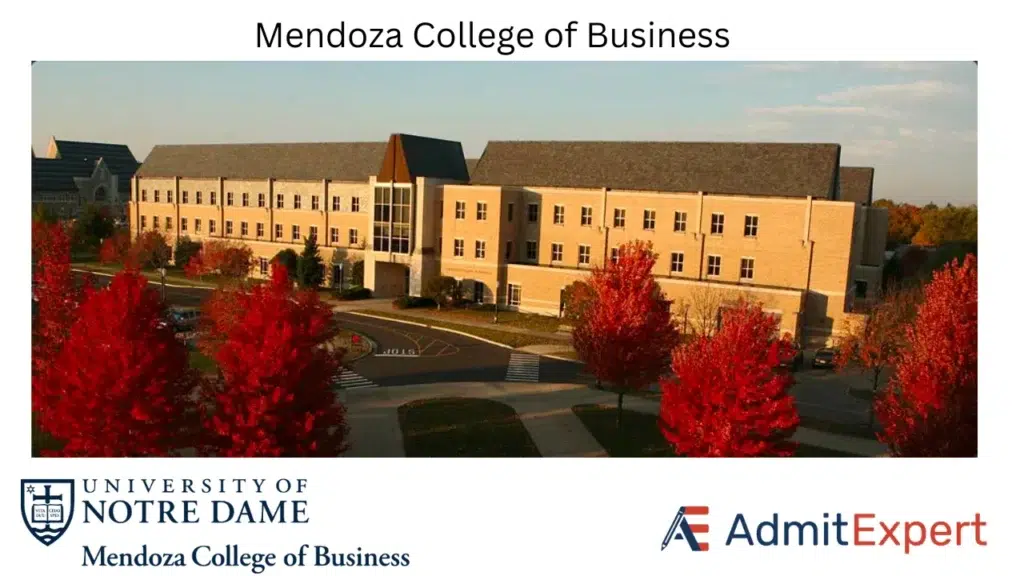
Notre Dame Mendoza MBA at a Glance
| Metric | Latest official information |
|---|---|
| University | University of Notre Dame |
| Location | Notre Dame, Indiana, near South Bend |
| Program | Two-year, full-time MBA |
| Degree requirement | 61 credits |
| Academic calendar | Four semesters; two approximately seven-week modules per semester |
| Current published cohort figure | Average cohort size of 85 |
| Average work experience | 5 years |
| Women | 23% |
| U.S. military veterans | 20% |
| Countries represented | 17 |
| Average undergraduate GPA | 3.3 |
| Median GMAT | 655 |
| Median GRE | 315 |
| MBA majors | Finance, Strategy, Marketing, Analytics & AI |
| STEM-designated majors | Finance; Analytics & AI |
| Class of 2025 mean / median base salary | $139,148 / $136,000 |
| Class of 2025 mean / median reported bonus | $36,847 / $35,000 |
| Offers within 3 months | 72.2% |
| Acceptances within 3 months | 71.1% |
| Class of 2026 internship acceptance | 100% |
| 2026–27 annual tuition | $75,460 |
| 2026–27 annual cost of attendance | $107,800 |
| Meyer Fellowship | Full tuition + $25,000 annual stipend + health insurance + student fees |
| Angrick Military Scholars | $30,000 per year for up to 10 scholars per cohort |
| Next regular MBA deadline | Round 1 — October 20, 2026 |
Mendoza's current MBA overview publishes an average cohort size and current admissions statistics rather than a clearly dated Class of 2027 or Class of 2028 profile.
That distinction matters.
The 85-student figure should not be converted into a current class enrollment count, and the school does not publish the applications-and-admits data needed to calculate a current acceptance rate from this snapshot.
What Makes the Notre Dame MBA Distinctive?
Six elements reinforce one another:
- a small residential cohort;
- a leadership philosophy built around people, performance, purpose, and ethics;
- a modular 61-credit curriculum with four majors and multiple minors;
- Grow Irish and other applied experiences before and after internship recruiting;
- personalized career coaching and a highly engaged alumni network;
- unusually substantial named funding opportunities, especially Meyer and Angrick.
The important part is how those pieces interact.
A small class matters more if students actually participate in clubs, teams, projects, and peer coaching.
The alumni network matters more if the student has a clear career target and uses it intelligently.
A major matters more if it develops skills the target role requires.
A values-based leadership framework matters more if the student can connect it to difficult decisions rather than repeat the language of the school's mission.
Mendoza's Small Cohort Changes the MBA Experience
The current program page publishes an average cohort size of 85.
That is small enough that the social and academic experience can feel materially different from an MBA with 500, 700, or 900 students per class.
A smaller cohort can mean:
- repeated interaction with classmates;
- greater visibility in clubs and teams;
- easier access to peers across career paths;
- more personal relationships with faculty and staff;
- a community where contribution is noticed quickly.
It also means fewer classmates overall in any highly specialized niche.
An applicant targeting a very narrow function should therefore investigate both:
- the intimacy of the program;
- the scale of the relevant alumni and employer network beyond the current class.
Small Does Not Automatically Mean Personal
A class can be small without producing meaningful relationships.
The student still has to:
- join;
- contribute;
- follow through;
- help classmates;
- ask for feedback;
- use the alumni network reciprocally.
Mendoza's culture places a particularly strong emphasis on community.
Applicants should think about what they would actually add to that community rather than simply saying they value "collaboration."
Notre Dame's Leadership Philosophy Is Explicitly Values-Based
Mendoza's current leadership framework uses the language Tender, Strong, and True.
The framework describes leadership through three complementary ideas.
Tender
Tender leadership emphasizes qualities such as:
- empathy;
- humility;
- gratitude;
- fairness;
- care for other people.
Strong
Strong leadership emphasizes:
- courage;
- moral conviction;
- empowering others;
- high standards;
- responsibility.
True
True leadership emphasizes:
- self-awareness;
- authenticity;
- ethical consistency;
- awareness of strengths and limitations.
The value of the framework is not the labels.
It is the tension between them.
A manager can be empathetic without avoiding hard decisions.
A leader can be strong without becoming arrogant.
A person can be authentic while still changing when feedback reveals a weakness.
Leadership Launch Begins the Development Process at Orientation
Mendoza starts the MBA with Leadership Launch, a multi-day experience centered on the question of what defines a leader.
The goal is introspection before students begin making claims about the leaders they want to become.
The school then reinforces the framework through:
- core coursework;
- leadership lunch sessions;
- ethics;
- communication;
- team work;
- electives;
- clubs and leadership positions.
That is more useful than treating leadership as one standalone class.
Ethics Is Built Into the Core
The current 61-credit curriculum includes Foundations of Ethical Business Conduct in the core.
Students also encounter ethics-oriented electives in areas such as:
- finance;
- data analytics;
- emerging markets;
- sustainability;
- leadership.
For an applicant, the relevant question is not whether they agree that ethics matters.
Almost everyone says they do.
The more useful question is:
"When have my values changed a business decision, especially when another option was easier or more profitable?"
That is where responsible-leadership language becomes evidence.
The MBA Uses Eight Short Academic Modules
The two-year MBA requires 61 credits across four semesters.
Each semester contains two roughly seven-week modules.
The structure creates eight academic modules across the degree.
That modular format allows the program to combine:
- core courses;
- major requirements;
- electives;
- interterm experiences;
- experiential work;
- recruiting.
The first year is more core-heavy.
The second year becomes primarily elective.
The Current Core Is More Analytical and Technology-Aware Than a Traditional General-Management Core
Mendoza's current core includes:
- Career Leadership;
- Communications;
- Data Storytelling;
- Finance;
- Financial Accounting I;
- Financial Accounting II;
- Foundations of Ethical Business Conduct;
- Fundamentals of AI;
- Introduction to Business Analytics;
- Introduction to Statistical Analysis;
- Leading People and Teams;
- Marketing Management;
- Managerial Economics;
- Process Analytics;
- Strategic Decision Making.
The addition of Fundamentals of AI and Data Storytelling is particularly important.
Mendoza is not treating responsible leadership and technological fluency as competing ideas.
The program is asking managers to become more capable with data and AI while remaining responsible for how those tools are used.
Fundamentals of AI Does Not Turn the MBA Into a Technical Degree
An MBA student does not need to become a machine-learning engineer to make better AI decisions.
A manager may instead need to understand:
- what AI can realistically automate;
- what data it requires;
- where model outputs can fail;
- how AI changes customer experience;
- what implementation requires from people;
- how ethics and governance affect adoption.
The management problem is broader than the model.
Career Leadership Starts in the First Seven Weeks
Mendoza's Career Leadership Course meets twice per week during Module 1.
That is an important scheduling choice.
Recruiting begins early, so the school does not wait until students have completed a semester of business classes before asking them to define a career direction.
The course is reinforced by individualized coaching.
Mendoza says students can connect with a career coach before they even arrive on campus.
Career Coaching Is Function-Specific and Student-Driven
The MBA coaching model allows students to meet with career coaches as often as they choose.
Coaches can help with:
- target-role definition;
- networking;
- interviews;
- resume and cover letters;
- positioning;
- career strategy.
Second-year peer coaches add another layer of support in areas such as:
- interview preparation;
- networking;
- career conferences;
- application materials.
The student still owns the process.
Personalized support becomes valuable only when the student has a specific question to solve.
Employer Touchpoints Extend Beyond South Bend
Mendoza organizes employer interaction on campus and through career trips.
Current school materials describe:
- San Francisco Bay Area technology visits;
- Wall Street finance visits;
- Chicago consulting and corporate visits;
- recruiter events;
- internship showcases;
- interview forums;
- industry panels.
That is relevant because a small residential program in Indiana needs structured ways to connect students with national employers.
The career outcomes show that graduates do work well beyond the Midwest, even though the Midwest remains the largest region.
Mendoza Offers Four MBA Majors
The current MBA major structure includes:
| Major | Primary academic direction | STEM-designated? |
|---|---|---|
| Finance | Corporate finance, banking, investing, financial leadership | Yes |
| Strategy | Competitive and organizational problem solving | No |
| Marketing | Customers, brands, markets, growth | No |
| Analytics & AI | Data, modeling, optimization, AI-enabled decisions | Yes |
Students must complete one MBA major.
They can then use minors to broaden or deepen the degree.
Only Finance and Analytics & AI Are STEM-Designated
The STEM designation should not be applied to every Mendoza MBA student automatically.
The school specifically identifies:
- Finance
- Analytics & AI
as STEM-designated majors.
Strategy and Marketing are not identified as STEM on the current majors page.
That distinction is especially important for international students using academic planning as part of a U.S. work-authorization strategy.
The Finance Major Supports Several Different Career Markets
The Finance major requires:
- Capital Allocation;
- Financial Policy;
- Investments;
plus additional finance electives.
Options include areas such as:
- Equity Valuation;
- Mergers & Acquisitions;
- Global Capital Markets;
- Fixed Income;
- Options & Futures;
- Entrepreneurial Finance and VC;
- Applied Investment Management;
- Machine Learning;
- Corporate Financial Reporting.
The range is broad.
An applicant still needs to decide which finance career they actually want.
Investment banking, corporate finance, investment management, and private equity are not interchangeable markets.
Applied Investment Management Creates Real Portfolio Experience
Mendoza's experiential-learning portfolio includes Applied Investment Management (AIM).
Students can conduct:
- equity research;
- stock analysis;
- investment recommendations;
- portfolio-management work.
Mendoza's experiential-learning page describes application-based projects that can involve managing a $26 million portfolio.
AIM is selective and space-limited.
That distinction matters.
Access to the course is valuable.
It should not be written into an application as if participation were guaranteed.
Finance Recruiting Has a Real Current Employment Base
Financial services is the largest Class of 2025 industry at 31.2%.
Finance/accounting is the largest function at 26.6%.
Employers in the current report include:
- Baird;
- Bank of America;
- Barclays;
- Evercore;
- JPMorgan Chase;
- Jefferies;
- Piper Sandler;
- Northern Trust;
- Fidelity Investments.
That gives the Finance major a meaningful connection to actual recruiting outcomes rather than making it only an academic pathway.
The Analytics & AI Major Is Designed Around Business Decisions
The STEM-designated Analytics & AI major requires:
- Data Management in SQL;
- Predictive Analytics;
plus four electives.
Current electives include:
- Applied Artificial Intelligence;
- Regression Modeling;
- Cloud Analytics;
- Data Visualization;
- Python for Data Analytics;
- Simulation and Optimization;
- Time Series Forecasting;
- Unstructured Data Analytics;
- Ethics of Data Analytics;
- Marketing Analytics.
The emphasis is not only technical depth.
It is applying analytical tools to management problems.
The AI Pathway Should Be Evaluated by Function, Not Hype
A student interested in AI could be targeting:
- product;
- analytics;
- consulting;
- strategy;
- operations;
- marketing;
- finance.
Those roles use the same tools differently.
The right question is:
"Which analytical capability will make me better at the function I actually want?"
rather than simply choosing the major because AI is fashionable.
The Strategy Major Is Broad by Design
The Strategy major allows students to choose from courses in areas such as:
- Business on the Frontlines;
- Frontlines Local Impact;
- Innovation & Design;
- Business Model Innovation;
- Corporate Governance;
- Entrepreneurship;
- International Management;
- Managerial Decision Making;
- Negotiation;
- Leadership.
That makes Strategy useful for applicants who want:
- consulting;
- corporate strategy;
- general management;
- entrepreneurship;
- broader cross-functional leadership.
The danger is vagueness.
A broad major still needs a precise career plan.
Marketing Includes Both Creative and Analytical Work
The Marketing major includes electives such as:
- Brand Strategy;
- Marketing Analytics;
- Customer Valuation;
- Marketing Research;
- Retail Analytics and Pricing;
- Digital Customer Experience;
- Automation and Artificial Intelligence in Marketing;
- SEO and SEM;
- Social Media and Influencer Marketing.
That range reflects how broad modern marketing has become.
A brand manager, product marketer, growth marketer, and analytics specialist can all study marketing while needing different skills.
MBA Minors Let Students Build Cross-Functional Combinations
Current MBA minors include:
- Strategy;
- Finance;
- Marketing;
- Real Estate;
- Leadership;
- Operations & Supply Chain;
- Innovation & Entrepreneurship;
- Digital Product Management;
- Digital Marketing & Marketing Analytics.
A major-minor combination can create a clearer professional profile.
Examples might include:
- Analytics & AI + Digital Product Management;
- Finance + Real Estate;
- Strategy + Leadership;
- Marketing + Digital Marketing & Marketing Analytics.
The combination should solve a development need rather than maximize the number of labels on a transcript.
Grow Irish Is Built Into the First-Year Career Calendar
Grow Irish occurs twice each academic year.
For first-year MBA students, the two weeks serve different purposes.
Fall Grow Irish
After Module 1, first-year students use the week for skill-building aligned with internship preparation.
That can mean building the technical expertise required for recruiting before interviews intensify.
Spring Grow Irish
After Module 3, first-years complete weeklong consulting projects with external organizations.
By then they have several modules of academic work behind them and can apply it to a live problem before the summer internship.
The sequencing is deliberate.
Grow Irish Is More Than a Break Between Modules
A week between academic modules could easily become downtime.
Mendoza instead uses it as concentrated career and experiential space.
That can be especially valuable in a modular program because students can step out of regular classes and focus intensely on:
- technical preparation;
- client work;
- networking;
- interviewing;
- case competitions;
- industry immersion.
The career value depends on the student's chosen experience.
Second-Year Grow Irish Becomes More Flexible
Second-year students can use Grow Irish periods for options such as:
- networking and interviewing;
- Silicon Valley Tech Immersion;
- Frontlines Local Impact;
- Global Business Immersion;
- Business on the Frontlines;
- REEL;
- Applied Investment Management;
- case competitions.
That creates a second-year portfolio rather than one mandatory experience for everyone.
Students should choose based on what the post-MBA plan still needs.
Business on the Frontlines Adds Service-Based Consulting
The Meyer Business on the Frontlines Program is one of Mendoza's more distinctive experiential offerings.
The school says students have worked with organizations across 35 countries on issues including:
- post-conflict rehabilitation;
- poverty;
- illicit economies;
- isolation;
- prejudice.
The work applies business problem solving to settings where commercial success and social outcomes can interact.
That is very different from a standard corporate consulting project.
Service Learning Is Most Useful When the Business Problem Is Taken Seriously
A mission-oriented project should not be reduced to volunteering.
The strongest learning comes from applying real business disciplines to difficult contexts:
- customer needs;
- operating constraints;
- finance;
- organizational design;
- market systems;
- stakeholder incentives.
The "force for good" theme becomes credible when the student can show rigorous analysis rather than only good intentions.
Silicon Valley Tech Immersion Connects Coursework With Industry Exposure
The Silicon Valley Tech Immersion follows required coursework such as Digital Innovation and Tech Entrepreneurship.
Students then spend a week engaging with technology leaders and companies.
Current Mendoza materials reference organizations such as:
- Google;
- Meta;
- Amazon.
The experience can be valuable for students targeting:
- technology strategy;
- product;
- digital transformation;
- AI-enabled business;
- innovation.
The company visit itself is not the outcome.
The student needs to know what they are trying to learn from it.
Global Business Immersion Adds International Finance Exposure
Mendoza's MBA Global Business Immersion combines prerequisite coursework with a weeklong international experience.
The school describes it as finance-focused and built around:
- company visits;
- networking;
- market context;
- business workshops.
Recent programming has included Santiago, Chile.
Locations can change.
Applicants should treat the academic objective as more important than a specific destination.
Practicums Let Students Explore Finance and Investing More Deeply
Mendoza also lists practicum opportunities such as:
- Seed Investor Practicum;
- Private Equity Practicum;
- Mergers & Acquisitions Practicum.
These can create applied finance experience.
They should not be mistaken for automatic pathways into highly selective investing roles.
Private equity and venture capital still depend heavily on:
- prior experience;
- transaction exposure;
- sector knowledge;
- independent networking.
MBA Clubs Reinforce the Career Pathways
Mendoza's current MBA clubs include pathway organizations such as:
- MBA Consulting Club;
- MBA Finance and Investment Club;
- MBA Marketing Club;
- MBA Technology Club.
Special-interest clubs include:
- Entrepreneurship & Venture Capital Club;
- MBA Military Veterans Club;
- Sports Business Club.
Professional clubs can become part of the recruiting infrastructure through:
- interview preparation;
- speakers;
- alumni;
- employer relationships;
- peer coaching.
The club name itself does not create career access.
The Veterans Community Is Unusually Visible
The current MBA snapshot reports 20% U.S. military veterans.
Mendoza also has a dedicated Military Veterans Club and the new Angrick Military Scholars program.
That can create a peer community for people moving from military service into business.
Military applicants should still translate their experience into language civilian recruiters and admissions readers can understand.
Rank does not automatically communicate:
- team size;
- budget;
- decision authority;
- operational complexity;
- stakeholder management;
- outcomes.
Notre Dame Mendoza MBA Class Profile: Current Published Snapshot
Mendoza does not currently label the main program statistics as a specific Class of 2027 or Class of 2028 profile.
Its live MBA page publishes the following current program snapshot:
| Metric | Current published snapshot |
|---|---|
| Average cohort size | 85 |
| Average work experience | 5 years |
| Women | 23% |
| U.S. military veterans | 20% |
| Countries represented | 17 |
| Average undergraduate GPA | 3.3 |
| Median GMAT | 655 |
| Median GRE | 315 |
These statistics are useful.
They just need to be labeled correctly.
An Average Cohort Size Is Not a Current Enrollment Count
The phrase average cohort size of 85 is different from:
"The Class of 2028 has 85 students."
Mendoza does not currently make that latter claim on the MBA overview page.
The safer interpretation is that the program is intentionally small.
The exact incoming class can vary.
The Snapshot Cannot Produce an Acceptance Rate
The public program snapshot does not provide:
- applications received;
- admission offers.
Without those numbers, a current acceptance rate cannot be calculated from official data.
Cohort size is not the same thing as admissions offers.
Five Years of Experience Is a Benchmark, Not a Rule
The current page reports five years of average work experience.
That does not mean an applicant needs exactly five years.
A stronger self-assessment asks:
- How has my responsibility grown?
- What decisions have I owned?
- What impact can I demonstrate?
- Why is now the right time for an MBA?
- What role requires capabilities I do not yet have?
Years of employment are context.
They are not a substitute for progression.
The Current GMAT Statistic Needs Careful Interpretation
Mendoza publishes a 655 median GMAT score.
The live program page does not separately label:
- current GMAT;
- legacy GMAT
in the way some other schools do.
Applicants should therefore avoid forcing direct raw-score comparisons with class profiles that explicitly separate the two exam versions.
Use the score as Mendoza publishes it and check the current testing guidance when evaluating your own result.
The GRE Statistic Is a Median
The current page publishes a 315 median GRE score.
That should not be called an average.
It should also not be treated as a minimum.
The median is the midpoint of the reported distribution.
Notre Dame Mendoza MBA Application Requirements 2026–27
The current MBA application requires:
- transcripts from every college or university attended;
- one-page resume;
- GMAT or GRE unless an approved waiver applies;
- one required written statement;
- Applicant Snapshot;
- video assessment;
- one recommendation;
- English-language evidence where required;
- $175 application fee unless waived.
Mendoza also states that applicants who already hold an MBA are not eligible for the program.
The Written Statement Is a Detailed Career-Goals Essay
The required written statement is capped at 500 words.
The current prompt asks:
"What are your detailed post-master's degree career plans?"
The response must connect:
- background;
- experience;
- interests;
- personal attributes;
- Notre Dame;
- short-term career goal;
- long-term career goal;
- target industry;
- target function.
The prompt is more demanding than a generic "Why MBA?" essay.
It expects a real career plan.
For detailed strategy, use Admit Expert's Notre Dame Mendoza MBA essay analysis.
The Career Statement Should Explain Why Notre Dame Changes the Outcome
A weak structure is:
past experience → career goal → list of Notre Dame courses
A stronger structure is:
past experience → target responsibility → current gap → Mendoza resource → capability built → post-MBA role
The school-specific material needs a job to do inside the essay.
Otherwise it becomes brochure repetition.
The Applicant Snapshot Is a Four-Slide Personal Presentation
Mendoza requires an Applicant Snapshot of up to four slides.
Applicants:
- create the slides in any software;
- save them as a PDF;
- do not present them live;
- should not use audio or video.
The school explicitly encourages a lighthearted tone that shows the applicant beyond academic and professional achievements.
That makes the Snapshot very different from the career statement.
The Snapshot Should Not Become a Visual Resume
A resume already contains:
- job titles;
- employers;
- promotions;
- dates;
- accomplishments.
Repeating them across four designed slides wastes the component.
A stronger Snapshot can reveal:
- relationships;
- identity;
- interests;
- formative experiences;
- values;
- community;
- curiosity;
- humor;
- how the applicant spends time outside work.
The objective is not to become quirky.
It is to become more understandable.
The Video Assessment Comes After Submission
Mendoza also requires a video assessment.
The link is sent after the application is submitted.
The assessment must be completed for the application to move forward.
The admissions committee uses it to learn more about the person behind the written file.
Applicants should be prepared to speak naturally about:
- goals;
- experiences;
- judgment;
- leadership;
- fit;
- personal motivations.
Mendoza Requires One Recommendation
The MBA application requires one recommendation using the Common Letter of Recommendation.
Mendoza recommends someone who can provide a detailed assessment of:
- qualifications;
- skills;
- work experience;
- achievements.
The best recommender is generally the person who has observed the applicant closely enough to give evidence.
Seniority without direct knowledge is less useful.
GMAT or GRE Is Required Unless a Waiver Is Approved
Mendoza's current application page says GMAT or GRE scores are required, although waivers are available.
Scores older than five years are not accepted under the standard policy.
Applicants seeking a waiver submit:
- transcript;
- resume;
- a statement of no more than 150 words explaining the request.
The admissions committee says it typically responds within 10 business days.
A Test Waiver Is an Evidence Substitution
Mendoza's test-waiver FAQ says waivers are intended for candidates who can demonstrate academic readiness and quantitative ability through:
- undergraduate coursework;
- graduate coursework;
- career experience.
If the waiver is granted, the committee places more weight on those other signals.
The relevant question is not:
"Can I avoid a test?"
It is:
"Does the rest of my record already show that I can handle the academic work?"
An Approved Waiver Does Not Remove General Scholarship Eligibility
Mendoza explicitly says applicants with an approved test waiver remain eligible for scholarships.
That is important because test strategy and scholarship strategy are related but not identical.
However, one named fellowship creates a complication.
Meyer Fellowship Testing Rules Are Currently Inconsistent Across Official Pages
Applicants targeting Meyer should pay particular attention.
Mendoza's current test-waiver FAQ says:
- Meyer is available only to MBA candidates with a GMAT score;
- GRE scores are not accepted for Meyer.
But the current Meyer Fellowship page says:
- GMAT and GRE scores are required for applicants and strongly preferred for Meyer candidates;
- waivers may be available.
Those statements do not fully align.
If Meyer funding is important to your decision, get written confirmation from Mendoza admissions before choosing a GRE-only or test-waiver strategy.
This is a case where the safest course is not to infer which page supersedes the other.
English Proficiency Has Its Own Rules
Non-U.S. citizens—and certain U.S. citizens with extensive international study—may need an English-proficiency score.
Mendoza accepts:
- TOEFL;
- IELTS;
- PTE Academic;
- Duolingo English Test.
The school can waive this requirement for applicants who completed at least:
- six full-time semesters;
- or nine full-time quarters
at a university where English is the primary language of instruction.
The Standard Application Fee Is $175
The nonrefundable application fee is $175.
Mendoza currently lists fee-waiver eligibility for groups including:
- U.S. active-duty military or veterans;
- current or former Peace Corps volunteers;
- current or former Teach for America volunteers.
Early Action has an additional fee benefit discussed below.
Notre Dame MBA Application Deadlines 2026–27
| Round | Application deadline | Decision release | Confirmation deadline |
|---|---|---|---|
| Early Action | September 10, 2026 | October 16, 2026 | November 16, 2026 |
| Round 1 | October 20, 2026 | December 11, 2026 | January 11, 2027 |
| Round 2 | January 7, 2027 | March 5, 2027 | April 5, 2027 |
| Round 3 | March 17, 2027 | April 30, 2027 | May 30, 2027 |
As of September 28, 2026, Early Action has passed.
The next deadline is:
Round 1 — October 20, 2026
Early Action Is Nonbinding
Mendoza explicitly describes Early Action as nonbinding.
That makes it different from binding Early Action structures at some other MBA programs.
Applicants admitted in Early Action are not agreeing to withdraw all other school applications as a condition of applying.
Early Action Comes With Specific Benefits
Mendoza currently advertises several Early Action benefits:
- automatic consideration for a guaranteed merit scholarship;
- application-fee waiver;
- priority interview scheduling for invited applicants.
The public page does not publish one universal dollar amount for the Early Action scholarship.
Applicants should therefore use the actual admission and scholarship letter when evaluating the financial effect.
International Applicants Are Encouraged to Apply by Round 2
Mendoza strongly encourages international candidates to apply by:
January 7, 2027
The rationale is additional time for visa paperwork and processing.
This is an encouragement.
The school does not describe Round 3 as universally prohibited for all international candidates.
Notre Dame Also Offers Deferred MBA Admission
The Notre Dame MBA Deferred Admission Program is designed for:
- high-achieving college seniors;
- recent graduates with zero to two years of experience.
Admitted candidates can defer enrollment for one to five years, depending on their experience at admission.
The goal is to build professional experience before joining the MBA.
Deferred Admission Includes an Early Scholarship Commitment
Deferred admits receive an initial scholarship award at admission.
Mendoza says the scholarship is reassessed at matriculation with a guarantee that the final amount will be equal to or greater than the initial offer.
That is a meaningful feature because funding uncertainty is one of the challenges of deferred admission.
The program also uses separate deposit requirements during the deferral period.
Career Preparation Begins Before Students Arrive
Mendoza says students can connect with a career coach before arriving on campus.
The formal Career Leadership Course then runs twice weekly during Module 1.
The career model includes:
- personalized coaching;
- peer coaching;
- employer touchpoints;
- alumni networking;
- treks;
- recruiter events;
- industry panels;
- interview forums.
In a small MBA, those resources can be highly visible.
The student still has to use them.
The Alumni Network Matters Most When the Search Is Specific
Notre Dame publishes a global alumni network of more than 150,000 alumni.
The scale sounds impressive.
But network size is not the same thing as career access.
A network becomes useful when the student knows:
- which role;
- which company;
- which office;
- which questions;
- which introduction
they need.
A vague networking strategy creates vague results.
Pathway Clubs Add Peer-Led Recruiting Support
Mendoza's career-oriented MBA clubs include:
- Consulting Club;
- Finance and Investment Club;
- Marketing Club;
- Technology Club.
These clubs can provide:
- interview practice;
- speakers;
- alumni;
- peer coaching;
- networking;
- recruiting knowledge.
The Class of 2026 career report includes a student example crediting the Consulting Club and second-year students with helping navigate recruiting.
That kind of peer support can matter in a small cohort.
Notre Dame Mendoza MBA Employment Report: Class of 2025
Mendoza's official 2025 MBA employment report publishes both compensation and placement outcomes.
Employment Timing and Compensation
| Metric | Class of 2025 |
|---|---|
| Job offers received within 3 months | 72.2% |
| Jobs accepted within 3 months | 71.1% |
| Mean base salary | $139,148 |
| Median base salary | $136,000 |
| Mean reported bonus | $36,847 |
| Median reported bonus | $35,000 |
| Usable salary-information rate among job-accepting graduates | 98.4% |
The report publishes offer and acceptance rates separately.
That distinction matters.
An offer is not the same thing as an accepted job.
The Three-Month Outcome Should Affect Financial Planning
A 71.1% three-month acceptance rate means the post-MBA search did not finish at the same time for every successful graduate.
That does not predict what will happen to a future student.
It does mean a financial plan should not assume:
graduation day = first full-time paycheck
A cash reserve for a longer search can materially reduce financial pressure.
Mean and Median Salary Tell Different Stories
Mendoza reports:
- $139,148 mean base salary
- $136,000 median base salary
The median is the midpoint of reported salaries.
The mean is the arithmetic average.
They should not be relabeled interchangeably as "average salary."
Bonus Should Not Be Added Mechanically to Base Salary
The report publishes:
- $35,000 median bonus;
- $36,847 mean bonus.
Those numbers should not simply be added to base-salary figures to invent a schoolwide total-compensation statistic.
The salary and bonus populations can differ.
The school does not present the arithmetic sum as the median package for every graduate.
Employment by Industry
| Industry | Share of accepted jobs | Median base salary |
|---|---|---|
| Financial Services | 31.2% | $130,000 |
| Consulting | 21.9% | $175,000 |
| Technology | 18.8% | $142,800 |
| Healthcare | 10.9% | $130,000 |
| Other | 7.8% | $117,000 |
| Manufacturing | 4.7% | $133,000 |
| Consumer Products | 3.1% | Insufficient data |
| Energy | 1.6% | Insufficient data |
The three largest industries—financial services, consulting, and technology—account for 71.9% of accepted jobs.
That is a highly concentrated employment mix.
Financial Services Is the Largest Current Industry
Financial services represents 31.2% of accepted Class of 2025 jobs.
That makes finance one of Mendoza's clearest current career markets.
The employer list includes firms across banking and investment-related fields.
But the industry percentage should not be read as investment banking alone.
Financial services contains multiple functions.
Finance Is Smaller by Function Than Financial Services Is by Industry
Finance/accounting represents 26.6% of accepted functions, compared with 31.2% financial services by industry.
That makes sense.
A financial-services firm can also hire into:
- strategy;
- operations;
- general management;
- technology.
Likewise, a finance professional can work for a company outside financial services.
Industry and function answer different questions.
Consulting Has the Highest Large-Industry Median Salary
Consulting accounts for 21.9% of accepted jobs.
The median base salary is $175,000.
That is substantially higher than the overall class median.
For applicants, the useful lesson is not that consulting is "better."
It is that classwide compensation is partly a function of career mix.
A candidate targeting a different sector should model that sector rather than the highest-paying category.
Technology Is Nearly One-Fifth of Current Placements
Technology accounts for 18.8% of accepted jobs.
The median base salary is $142,800.
Mendoza's current employer list includes technology and technology-enabled organizations such as:
- Amazon;
- Cisco;
- Microsoft;
- Infosys;
- Siemens Digital Industries Software.
The technology share supports a meaningful pathway.
It does not tell us which functions those graduates performed.
Employment by Function
| Function | Share of accepted jobs | Median base salary |
|---|---|---|
| Finance / Accounting | 26.6% | $135,000 |
| Consulting | 23.4% | $175,000 |
| Marketing / Sales | 17.2% | $133,000 |
| Operations / Logistics | 15.6% | $142,800 |
| General Management | 14.1% | $130,000 |
| Information Technology | 1.6% | Insufficient data |
| Other | 1.6% | Insufficient data |
The function mix is broader than the industry table may initially suggest.
Operations/logistics and general management together account for nearly 30% of accepted functions.
That matters for applicants who associate Mendoza only with finance and consulting.
Operations Has a Stronger Current Salary Than Its Share Might Suggest
Operations/logistics accounts for 15.6% of functions with a $142,800 median base salary.
That is higher than the median for:
- finance/accounting;
- marketing/sales;
- general management.
One graduating class does not create a permanent salary ranking.
It does show that operations is a meaningful MBA pathway at Mendoza.
Geography Is Strongly Midwest-Oriented—but Not Midwest-Only
The Class of 2025 report publishes the following regional shares:
| Region | Share of reported employment |
|---|---|
| Midwest | 42.2% |
| Northeast | 12.5% |
| South | 12.5% |
| West | 10.9% |
| Mid-Atlantic | 9.4% |
| Southwest | 9.4% |
The published regions total slightly less than 100%, so the article should not invent or redistribute a missing category.
The useful conclusion is clear enough:
- the Midwest is the largest destination;
- substantial placement also occurs elsewhere.
Chicago Is a Natural Recruiting Market—but Not the Only One
The Midwest placement map highlights cities such as:
- Chicago;
- Detroit;
- Cincinnati;
- Minneapolis.
The report also lists:
- New York;
- Los Angeles;
- San Jose;
- Seattle;
- Washington, D.C.;
- Philadelphia;
- Atlanta;
- Charlotte;
- Austin;
- Dallas;
- Houston.
Applicants should investigate the actual office-level pathway for their target role.
A broad regional statistic cannot answer that question.
The Employer List Demonstrates National Recruiting Relationships
The Class of 2025 employer list includes companies such as:
- Amazon;
- JPMorgan Chase;
- PwC;
- EY-Parthenon;
- Microsoft;
- Bank of America;
- Barclays;
- Deloitte;
- Eli Lilly;
- Evercore;
- McKinsey;
- Medtronic;
- Merck;
- Strategy&;
- Visa;
- Whirlpool.
That is evidence of actual recent hiring.
It is not a promise that every company hires every year or that every role is open to every candidate.
Class of 2026 Internship Outcomes Are Much Stronger Than the Full-Time Three-Month Headline
Mendoza's 2025 career report also includes internship outcomes for the Class of 2026.
The school reports:
100% job accepts
for the internship cohort.
It also reports:
$9,209 median monthly base salary
The cohort and reporting period are different from the Class of 2025 full-time outcomes.
They should not be merged into a single employment percentage.
Internship by Industry
| Internship industry | Share of accepted internships | Median monthly base salary |
|---|---|---|
| Financial Services | 27.9% | $11,667 |
| Technology | 22.1% | $10,000 |
| Consulting | 9.3% | $14,583 |
| Manufacturing | 9.3% | $8,667 |
| Healthcare | 8.1% | $6,760 |
| Consumer Products | 8.1% | $8,667 |
| Nonprofit / Education | 5.8% | $3,120 |
| Other | 3.5% | Insufficient data |
| Real Estate | 2.3% | Insufficient data |
| Media / Entertainment | 1.2% | Insufficient data |
| Retail | 1.2% | Insufficient data |
| Government | 1.2% | Insufficient data |
The internship industry mix is finance- and technology-heavy.
Consulting's share is smaller by industry, but its median monthly compensation is the highest among the published large groups.
Internship by Function
| Internship function | Share | Median monthly base salary |
|---|---|---|
| Finance / Accounting | 40.7% | $10,000 |
| Consulting | 17.4% | $9,533 |
| Marketing / Sales | 15.1% | $8,667 |
| Operations / Logistics | 14.0% | $10,115 |
| Other | 10.5% | $2,860 |
| General Management | 1.2% | Insufficient data |
| Human Resources | 1.2% | Insufficient data |
Finance/accounting is the dominant internship function.
That is useful context for applicants deciding how strongly the current recruiting ecosystem aligns with their target.
The Internship Data Reinforces the Value of the Two-Year Structure
The first-year sequence is:
core → career leadership → Grow Irish skills → recruiting → Grow Irish client work → internship
That makes the summer internship part of the program architecture rather than an optional add-on.
For a career changer, the internship can:
- validate the new field;
- create a return offer;
- expose a poor fit;
- build experience for second-year recruiting.
Is Notre Dame Mendoza a Good MBA for Finance?
Finance is one of Mendoza's strongest current pathways.
Evidence includes:
- 31.2% financial-services industry share;
- 26.6% finance/accounting function share;
- Finance major;
- AIM;
- Capital Markets electives;
- Wall Street employer visits;
- Finance and Investment Club;
- finance-heavy internship outcomes.
The strongest finance plan still identifies the exact market:
- investment banking;
- corporate finance;
- investment management;
- commercial banking;
- private equity.
Is Notre Dame Mendoza a Good MBA for Consulting?
Consulting accounts for:
- 21.9% of Class of 2025 industries;
- 23.4% of functions;
- 17.4% of Class of 2026 internship functions.
The median Class of 2025 consulting base salary is $175,000.
Mendoza supports the pathway through:
- Strategy major;
- Consulting Club;
- Grow Irish client projects;
- Business on the Frontlines;
- career coaching;
- Chicago recruiting access.
The pipeline is meaningful.
It is not automatic.
Is Notre Dame Mendoza a Good MBA for Technology?
Technology represents 18.8% of Class of 2025 accepted jobs and 22.1% of Class of 2026 internship industries.
The academic ecosystem includes:
- Analytics & AI;
- Digital Product Management minor;
- Fundamentals of AI;
- tech-oriented Grow Irish projects;
- Silicon Valley Tech Immersion;
- Technology Club.
That creates a credible technology pathway.
Applicants should still define the function:
- product;
- finance;
- strategy;
- operations;
- marketing;
- analytics.
Is Notre Dame Mendoza a Good MBA for Marketing?
Marketing/sales accounts for 17.2% of current full-time functions and 15.1% of internship functions.
The Marketing major covers:
- brand;
- analytics;
- digital customer experience;
- pricing;
- marketing research;
- AI in marketing.
Applicants can also add the Digital Marketing & Marketing Analytics minor.
That gives marketing candidates meaningful depth despite marketing not being the largest industry category.
Is Notre Dame Mendoza a Good MBA for Operations?
Operations/logistics is 15.6% of Class of 2025 functions and 14% of Class of 2026 internship functions.
The MBA also offers an Operations & Supply Chain minor.
That creates a real pathway for candidates interested in:
- supply chain;
- manufacturing;
- process improvement;
- logistics;
- operating leadership.
Is Notre Dame Mendoza a Good MBA for Military Veterans?
Military veterans are unusually visible in the current program snapshot at 20%.
Mendoza also offers:
- Military Veterans Club;
- fee waiver for veterans and active-duty applicants;
- Yellow Ribbon participation;
- Angrick Military Scholars;
- leadership development;
- a small cohort with substantial peer interaction.
Those resources can make the transition more supported.
They do not replace the need for a credible civilian career target.
Who Should Consider Mendoza Most Seriously?
Mendoza deserves close consideration if you value:
- a small residential MBA;
- values-based leadership;
- finance;
- consulting;
- technology;
- marketing;
- operations;
- a strong Midwest and Chicago recruiting base;
- personalized career coaching;
- client projects before internships;
- a visible military community;
- major/minor customization;
- substantial named scholarships.
Applicants should think more carefully if they strongly prefer:
- a very large MBA class;
- an MBA where the entire degree is automatically STEM-designated;
- a major-city campus embedded directly beside employers;
- an educational culture where ethics, mission, and community play a smaller role.
The strongest fit is not "Notre Dame has a great culture."
It is a specific connection between the culture, curriculum, and career plan.
How to Decide Whether Notre Dame Mendoza Fits Your MBA Goals
1. Define the post-MBA role
Specify:
- function;
- industry;
- geography;
- employer type.
"Finance" is too broad.
"Investment banking in New York" is much more useful.
2. Identify the missing capabilities
Ask what prevents the transition today.
Is the gap:
- finance?
- analytics?
- AI fluency?
- client work?
- leadership?
- industry knowledge?
- network?
- employer access?
The MBA should solve something concrete.
3. Build the academic route
Connect the gap to:
- major;
- minor;
- electives;
- Grow Irish;
- practicum;
- AIM;
- Business on the Frontlines;
- Silicon Valley Tech Immersion.
A major title alone is not a development plan.
4. Build the career route
Connect the target to:
- Career Leadership Course;
- function-specific coaching;
- pathway club;
- trek;
- alumni;
- internship.
The network is most useful when the target is specific.
5. Test the employment data at the correct level
Do not use 31.2% financial services as though it means 31.2% investment banking.
Do not use 18.8% technology to imply the same share in product management.
Do not use the $175,000 consulting median to budget for an operations career.
Read industry, function, and geography together.
6. Model the financial commitment
Include:
- annual tuition;
- annual fees;
- living costs;
- confirmed scholarship;
- insurance;
- financing;
- internship income only once secured;
- foregone earnings;
- a reserve for a job search that continues after graduation.
Notre Dame MBA Tuition and Cost of Attendance 2026–27
Mendoza's current tuition and aid page publishes the following annual budget:
| Expense | 2026–27 annual amount |
|---|---|
| Tuition | $75,460 |
| Program fee | $2,700 |
| Student fees | $650 |
| Housing and food | $17,820 |
| Books and supplies | $1,750 |
| Personal expenses | $6,720 |
| Transportation | $2,700 |
| Total annual cost of attendance | $107,800 |
The school notes that actual costs vary and annual increases in the cost of a Notre Dame education are anticipated.
$75,460 Is Tuition—Not the Annual Cost of Attendance
The annual tuition is:
$75,460
The annual published budget is:
$107,800
The difference includes:
- program fees;
- student fees;
- housing and food;
- books;
- transportation;
- personal expenses.
Those two numbers should not be labeled interchangeably.
$107,800 Is Not the Full Two-Year MBA Cost
The budget covers one academic year.
The MBA lasts two years.
A realistic full-program model should therefore include:
- first-year published budget;
- second-year tuition and fees at then-current rates;
- second-year living costs;
- summer living;
- insurance where applicable;
- financing;
- discretionary travel;
- foregone earnings.
Simply doubling today's total would still be only a planning estimate because future costs can change.
Federal Loan Fees Can Increase the Financial-Aid Budget
Mendoza notes that federal loan origination fees can be added to cost of attendance for students using the applicable Federal Direct Loans.
That is a financing-specific cost.
It should not be treated as an expense every student automatically pays.
Opportunity Cost Belongs in the MBA Price
A full-time two-year MBA also costs the salary and benefits a student gives up.
For someone leaving:
- finance;
- consulting;
- military service;
- technology;
- another professional career;
lost earnings can be one of the largest parts of the investment.
The relevant calculation is closer to:
net direct cost + financing cost + foregone compensation
versus
the career access, capabilities, network, and long-term trajectory created by the MBA.
The Three-Month Employment Result Should Affect the Cash Reserve
Only 71.1% of the Class of 2025 had accepted jobs within three months under Mendoza's published measure.
That means a prudent financial plan should allow for a longer search.
A high salary for employed graduates does not remove liquidity risk during the transition.
Notre Dame Mendoza MBA Scholarships
Mendoza says all applicants are automatically considered for scholarships through the admissions process.
The school also automatically considers applicants for named scholarships without requiring a separate indication of interest.
Funding is based on a holistic review.
The actual award in the admission letter is more useful than any broad scholarship headline.
Early Action Adds a Scholarship Advantage
Mendoza's current Early Action page says applicants receive:
- automatic consideration for a guaranteed merit scholarship;
- application-fee waiver;
- priority interview scheduling if invited.
The public page does not state one universal scholarship amount.
Applicants should therefore use the actual award letter to calculate the financial benefit.
Meyer Fellowship Is a Full-Cost-Plus-Stipend Award
The Meyer Fellowship is Mendoza's most substantial named MBA award.
Current benefits include:
- full tuition;
- full student fees;
- $25,000 annual stipend, paid over 10 months;
- comprehensive health insurance;
- priority registration.
This is economically very different from a tuition-only scholarship.
The stipend can support living expenses.
Health insurance and student-fee coverage reduce additional direct costs.
Meyer Is Automatically Considered—but Highly Selective
All admitted applicants are automatically considered for Meyer.
The school says selection considers:
- academic excellence;
- intellectual curiosity;
- leadership;
- professional achievement;
- alignment with Notre Dame's mission.
There is no separate Meyer application.
The test-policy inconsistency discussed earlier still matters for anyone trying to maximize eligibility.
The $25,000 Meyer Stipend Is Annual
Mendoza specifies an annual $25,000 stipend.
For a two-year MBA, that is materially different from a one-time $25,000 award.
Applicants should still rely on their official fellowship terms for the exact duration and conditions of their award.
Angrick Military Scholars Adds Wraparound Funding
Beginning in August 2026, the Angrick Military Scholars program provides:
$30,000 per year
to up to 10 military scholars in each cohort.
The funding can support expenses such as:
- relocation;
- housing;
- childcare;
- other needs.
Mendoza states that the funding is in addition to merit-based or other financial awards.
That makes Angrick particularly significant for military applicants with family-related living costs.
Angrick Gives Preference to Candidates With Families
Selection considers:
- military service record;
- academic record;
- leadership potential;
- alignment with Notre Dame's mission.
Preference is given to eligible veterans, with first consideration for candidates with families.
This is a competitive award.
It is not automatically received by every military student.
Yellow Ribbon and VA Benefits Are Separate From Angrick
Notre Dame also participates in:
- Post-9/11 GI Bill;
- Yellow Ribbon Program;
- other veteran education-benefit structures.
Those benefits have their own eligibility and certification rules.
Applicants should not assume that every funding source automatically stacks in the same way.
Angrick is explicitly described as additional to other awards, but VA benefits still need individual verification.
Compare Scholarship Structures, Not Just Dollar Headlines
Three offers can have the same headline amount and very different value.
For example:
- full tuition only;
- $30,000 annual living support;
- $30,000 tuition discount
solve different parts of the budget.
When comparing MBA offers, write down:
- tuition covered;
- fees covered;
- insurance covered;
- stipend;
- duration;
- renewal conditions;
- what remains to fund.
That produces a much more accurate net-price comparison.
Notre Dame Mendoza MBA FAQs
What is the current Notre Dame Mendoza MBA class size?
Mendoza currently publishes an average cohort size of 85.
The live page does not label that number as the exact enrollment of a specific graduating class, so it should not be presented as a verified Class of 2027 or Class of 2028 enrollment count.
What is the median GMAT at Notre Dame Mendoza?
The current MBA page reports a 655 median GMAT score.
The page does not separately label current and legacy GMAT versions in the way some other schools do.
What is the median GRE at Mendoza?
Mendoza currently reports a 315 median GRE score.
What is the average GPA at Notre Dame Mendoza?
The current program snapshot reports an average undergraduate GPA of 3.3.
How much work experience do Mendoza MBA students have?
Mendoza currently reports five years of average work experience.
That is a cohort benchmark, not a formal minimum.
What majors does the Notre Dame MBA offer?
The four current majors are:
- Finance;
- Strategy;
- Marketing;
- Analytics & AI.
Which Notre Dame MBA majors are STEM-designated?
The current STEM-designated majors are:
- Finance;
- Analytics & AI.
The designation should not be assumed for Strategy or Marketing.
Does Notre Dame require the GMAT or GRE?
GMAT or GRE scores are required unless an applicant receives an approved waiver.
Mendoza does not accept standard test scores older than five years.
How do I request a test waiver?
Applicants submit:
- transcript;
- resume;
- a statement of up to 150 words explaining the request.
Mendoza says waiver decisions are generally provided within 10 business days.
Does a test waiver hurt scholarship eligibility?
Mendoza says applicants with an approved waiver remain eligible for scholarships generally.
The Meyer Fellowship has conflicting testing guidance across current official pages, so applicants targeting Meyer should confirm the current rule directly.
How many recommendations does Mendoza require?
The MBA requires one recommendation using the Common Letter of Recommendation.
What is the Notre Dame MBA essay?
The required written statement is limited to 500 words and asks for detailed post-master's career plans, including short- and long-term goals, industry, function, and how Notre Dame will help.
What is the Mendoza Applicant Snapshot?
It is a required presentation of up to four slides, uploaded as a PDF.
The school encourages applicants to use it to reveal personal dimensions that are not captured by the resume or academic record.
Is there a video essay?
Yes.
Applicants receive a link after submitting the application and must complete the video assessment for the application to move forward.
What is the MBA application fee?
The standard nonrefundable application fee is $175.
Early Action applicants receive a fee waiver, and Mendoza also lists waivers for certain military, Peace Corps, and Teach for America applicants.
Is Notre Dame MBA Early Action binding?
No.
Mendoza explicitly describes Early Action as nonbinding.
What is the next Notre Dame MBA deadline?
As of September 28, 2026, Early Action has passed.
The next deadline is:
Round 1 — October 20, 2026
Does Notre Dame offer deferred MBA admission?
Yes.
Eligible college seniors and recent graduates with zero to two years of experience can apply through the Notre Dame MBA Deferred Admission Program.
The deferral period can range from one to five years.
What is the latest Mendoza MBA salary?
For the Class of 2025, Mendoza reports:
- $139,148 mean base salary
- $136,000 median base salary
The report also publishes separate bonus statistics.
What percentage received job offers within three months?
Mendoza reports 72.2% job offers received within three months after graduation for the Class of 2025.
What percentage accepted jobs within three months?
Mendoza reports 71.1% jobs accepted within three months after graduation.
Which industry hires the most Notre Dame MBA graduates?
Financial services is the largest Class of 2025 industry at 31.2%.
Consulting is 21.9% and technology 18.8%.
Which job function is largest?
Finance/accounting is the largest Class of 2025 function at 26.6%.
Consulting is 23.4%.
Where do Notre Dame MBA graduates work?
The Midwest is the largest published region at 42.2%.
The school also reports placements in the Northeast, South, West, Mid-Atlantic, and Southwest.
How strong are Mendoza internships?
For the Class of 2026, Mendoza reports 100% job accepts for internships and a $9,209 median monthly base salary.
Finance/accounting is the largest internship function at 40.7%.
How much is Notre Dame MBA tuition?
For 2026–27, annual tuition is $75,460.
What is the annual Notre Dame MBA cost of attendance?
Mendoza publishes an annual cost of attendance of $107,800 for 2026–27.
That is not the full two-year MBA price.
Are applicants automatically considered for scholarships?
Yes.
Mendoza says all applicants are automatically considered for general and named scholarships through the admissions process.
What does the Meyer Fellowship cover?
Current Meyer benefits include:
- full tuition;
- full student fees;
- $25,000 annual stipend;
- comprehensive health insurance;
- priority registration.
What is the Angrick Military Scholars award?
Up to 10 scholars per cohort can receive $30,000 per year in wraparound support for costs such as housing, relocation, and childcare.
Mendoza states that Angrick funding is additional to merit or other financial awards.
Final Thoughts
The Notre Dame MBA makes the most sense when its values-based identity is connected to the mechanics of the degree.
The program is small.
That can create a highly visible community, but only for students willing to participate actively.
The curriculum is mission-oriented, but it is also analytically current.
The core now includes:
- Fundamentals of AI;
- Data Storytelling;
- business analytics;
- statistical analysis;
- process analytics;
- finance;
- economics;
- ethics;
- leadership.
The major structure then gives students four different academic routes, with Finance and Analytics & AI carrying STEM designation.
Experiential learning is not confined to one capstone.
Grow Irish deliberately places skill-building before internship recruiting and client work before the summer internship.
Students can then choose from opportunities such as:
- Business on the Frontlines;
- Applied Investment Management;
- Silicon Valley Tech Immersion;
- Global Business Immersion;
- investing practicums.
The career model is similarly structured.
Students begin career coaching before arriving on campus, take Career Leadership twice a week in the first module, use pathway clubs and peer coaches, and connect with employers through treks and recruiting events.
The current employment data shows that these resources lead into very conventional MBA career markets.
Financial services, consulting, and technology account for more than 70% of Class of 2025 accepted jobs.
The Midwest is the largest geographic destination, but the employer list and placement map extend well beyond Indiana and Chicago.
The employment numbers also need to be read with discipline.
Mendoza reports 72.2% offers and 71.1% acceptances within three months, along with a $136,000 median base salary.
The Class of 2026 internship data is much stronger, with 100% job accepts and a $9,209 median monthly base salary.
Those are different cohorts and different recruiting stages.
The financial decision is equally nuanced.
$75,460 is annual tuition.
$107,800 is annual cost of attendance.
Meyer can cover tuition, student fees, health insurance, and add a $25,000 annual stipend.
Angrick can add $30,000 per year for selected military students.
Early Action carries scholarship and fee benefits without being binding.
The strongest reason to apply is therefore not:
"Notre Dame has a strong culture and network."
It is:
"This is the role I want, these are the capabilities and relationships I still need, and Mendoza's major, Grow Irish sequence, experiential options, career coaching, alumni network, leadership model, and financial support give me a concrete path to build them."
If Mendoza is on your target list, continue with Admit Expert's Notre Dame Mendoza MBA essay guide and MBA application deadlines tracker.
Related Articles

Deferred MBA Programs: 2027 Deadlines, Eligibility & Top Schools
Compare the leading deferred MBA programs for college seniors and eligible graduate students, including HBS 2+2, Stanford, Wharton, Booth, Kellogg, MIT Sloan, Columbia, Haas and Darden, with current 2027 deadlines and rules.
Read Article →
M7 Business Schools: 2026–2027 Guide to Rankings, Admissions, Costs & Careers
A current comparison of Harvard, Stanford, Wharton, Chicago Booth, Kellogg, MIT Sloan and Columbia covering 2026 rankings, Class of 2027 profiles, GMAT/GRE scores, 2027 application deadlines, MBA costs and Class of 2025 career outcomes.
Read Article →
Stanford GSB MBA Guide 2026–27: Admissions, Class Profile, Curriculum, Employment, Fees & Scholarships
A complete guide to the Stanford Graduate School of Business MBA covering admissions, the latest class profile, GMAT and GRE scores, curriculum, application deadlines, employment outcomes, tuition, cost of attendance, scholarships, and financial aid.
Read Article →