

UNC Kenan-Flagler MBA Guide 2026–27: Admissions, Class Profile, Curriculum, Employment, Fees & Scholarships
A complete guide to UNC Kenan-Flagler’s Full-Time MBA, covering its flexible curriculum, Class of 2027 profile, 2026–27 admissions, career outcomes, costs, fellowships, and applicant fit.
UNC Kenan-Flagler's Full-Time MBA is easier to understand when you stop treating it as a generic two-year MBA in Chapel Hill.
The current program has become unusually explicit about connecting the first-year curriculum to recruiting.
Students do not simply complete a fixed core and worry about careers later. They take data and AI coursework, choose the timing of several core subjects, select recruiting electives for specific career paths, begin electives early, work with career coaches, and must complete an Applied Work Experience requirement before the second year.
That structure matters because UNC's latest employment report is also unusually broad.
Financial services is the largest Class of 2025 industry at 25%, followed by consulting at 18%, healthcare at 14%, technology at 13%, energy at 8%, and real estate at 8%.
By function, the picture changes again.
Finance accounts for 40% of reported functions, including 15% investment banking, while consulting accounts for 17%, general management 15%, marketing/sales 13%, and operations/logistics 11%.
That makes the useful question not:
"Is UNC Kenan-Flagler strong in finance, consulting, healthcare, or real estate?"
It is:
"Can I use UNC's curriculum, career pathways, hands-on learning, internship structure, and network to become credible for the specific role I want?"
A banker targeting investment banking needs a different plan from someone pursuing corporate finance.
A healthcare candidate can use UNC's wider medical and health-sciences ecosystem very differently from a product-management candidate.
A real-estate investor and a real-estate developer may share a concentration while needing very different coursework and applied experience.
This guide focuses on the two-year, STEM-designated Full-Time MBA in Chapel Hill, not UNC's executive or online MBA formats.
It uses the latest detailed official Class of 2027 profile, the 2026–27 admissions cycle, the Class of 2025 employment report, and the current 2026–27 tuition and fellowship information.
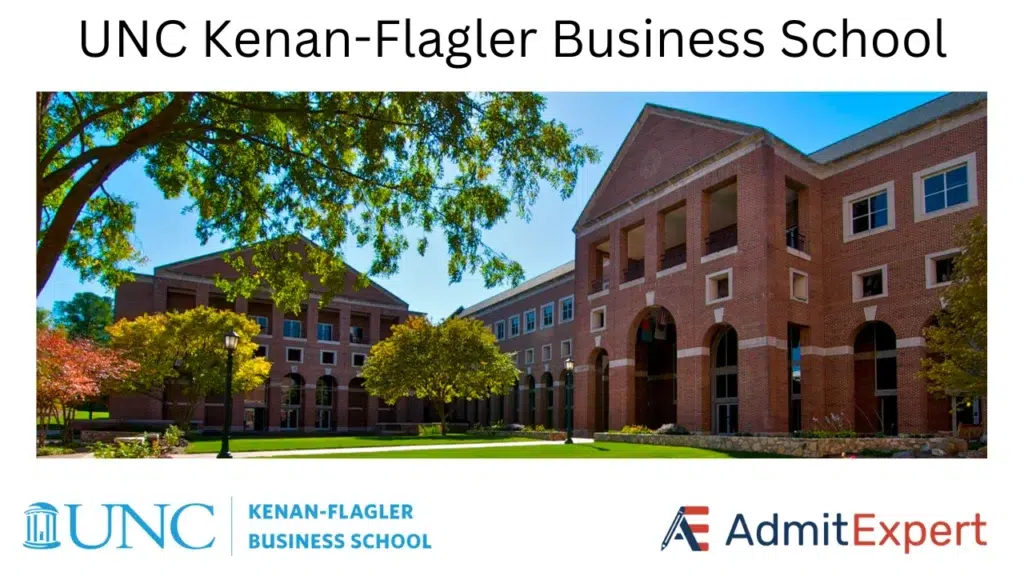
UNC Kenan-Flagler MBA at a Glance
| Metric | Latest official figure |
|---|---|
| University and location | University of North Carolina at Chapel Hill; Chapel Hill, North Carolina |
| Program | Two-year Full-Time MBA |
| Degree requirement | 62 credit hours |
| STEM designation | Yes |
| Latest detailed class profile | Class of 2027 |
| Class size | 206 |
| Average age | 28 |
| Average work experience | 5 years |
| Average undergraduate GPA | 3.4 |
| Average GMAT Focus | 652 |
| Average GRE total | 319 |
| Women | 32% |
| International students | 35% |
| U.S. military | 15% |
| Class of 2025 average base salary | $139,637 |
| Class of 2025 average signing bonus | $32,558 |
| Job offers and acceptances within 3 months | 88% of job-seeking graduates |
| Job acceptances within 6 months | 90% of job-seeking graduates |
| Class of 2026 internship acceptance | 99.1% |
| 2026–27 annual budget, North Carolina resident | $84,890 |
| 2026–27 annual budget, nonresident | $103,612 |
| Fellowship recipients | Nearly 50% of students receive some fellowship assistance |
| Next application deadline | Round 1 — September 30, 2026 |
UNC's current Full-Time MBA overview, Class of 2027 profile, curriculum, and Class of 2025 employment summary provide the underlying program and outcome data used throughout this guide.
What Makes the UNC Kenan-Flagler MBA Distinctive?
Several elements of the MBA interact especially strongly:
- a flexible first-year core that can be sequenced around recruiting;
- dedicated career-preparation and recruiting electives;
- a required applied work experience before year two;
- STAR client-consulting projects;
- unusually developed student-managed investment funds;
- deep pathways in real estate, healthcare, energy, finance, and consulting;
- a career-support model built around industry-specific coaching;
- access to the wider UNC-Chapel Hill university ecosystem.
The important word is interaction.
A concentration alone does not create a career switch.
A career coach alone does not create technical credibility.
A client project alone does not create a coherent story.
The program becomes more useful when those resources build on one another before the internship and full-time recruiting cycles.
The 62-Credit Curriculum Is Built Around Career Timing
UNC's current curriculum requires 62 credit hours across:
- core courses;
- electives;
- concentrations;
- independent study;
- applied work.
The first year is organized into modules rather than one long semester sequence.
That matters because students can make some academic choices according to recruiting needs.
The school explicitly describes the curriculum as designed for:
- internship readiness;
- career transformation;
- data and technology fluency;
- progressive specialization.
The best way to use that flexibility is not to maximize choice.
It is to put the right learning before the moment when employers need to see it.
Pre-Term Starts With Structured Problem Solving and Data Foundations
Before the conventional first module, students begin with:
- MBA Orientation;
- Structured Problem Solving;
- Data Foundations.
That is a revealing starting point.
UNC is treating analytical reasoning and data literacy as baseline management capabilities rather than optional specialist skills.
The Data Foundations course focuses on using data to:
- frame business problems;
- support decisions;
- communicate insights.
That is relevant even for students who do not intend to work in analytics.
A manager still needs to know what evidence supports a recommendation.
The First Module Builds the Traditional Business Foundation
Module 1 includes:
- Microeconomics;
- Financial Accounting;
- Financial Tools;
- Marketing.
These courses create a common base for students arriving from very different professional backgrounds.
A military officer may need formal finance and marketing frameworks.
An engineer may need accounting and customer economics.
A banker may need broader commercial thinking rather than more transaction experience.
The core is most valuable when it fills the parts of the business system the applicant has not yet had to manage.
Students Can Sequence Four Important Core Courses Around Recruiting
UNC currently gives students flexibility in when they take:
- Business Strategy;
- Finance;
- Operations;
- Strategic Cost Analysis.
Students take two in Module 2 and the other two in Module 3.
That may look like a small scheduling detail.
It can be strategically important.
A candidate pursuing finance can prioritize finance earlier.
A consultant may want strategy and cost analysis before case interviews.
An operations candidate can move operations forward.
The curriculum therefore asks the student to make a career decision earlier than many applicants expect.
Career Preparation Is Embedded Alongside the Academic Core
UNC's first-year roadmap includes:
- Career Kick-off;
- resume review;
- coach connections;
- self-reflection;
- Professional Presence;
- recruiting electives;
- interview preparation;
- Presenting with Impact.
Career preparation is therefore not a separate service students discover after classes begin.
It runs in parallel with the academic schedule.
That is especially relevant for career switchers because recruiting can start before students feel fully settled into the MBA.
UNC Offers Career-Specific Preparation Before the Internship
The current career-preparation menu includes courses such as:
- Introduction to Consulting Skills and Frameworks;
- Introduction to the Energy Value Chain;
- Marketing, Brand, and Product Management;
- Real Estate Process;
- The Business of Healthcare;
- Applied Impact Frameworks;
- Careers in Operations.
Recruiting electives include:
- Casing Fundamentals;
- Financial Services Career Accelerator.
This is one of the more decision-useful parts of the curriculum.
A career goal becomes stronger when there is a visible route from:
career target → preparation elective → recruiting process → internship
rather than only a concentration selected later.
Electives Begin Early
UNC says electives can begin as early as the first semester.
That matters because the useful question is often not:
"Does UNC offer this subject?"
It is:
"Can I learn it before the employer interview where I need to demonstrate it?"
Timing can make the same course much more valuable to a career changer.
UNC also says roughly 10% of electives are newly developed each year to reflect emerging business issues and research.
That helps explain why the curriculum now includes stronger data, AI, technology, and career-path content.
Decision Making with Data and AI Is a Hands-On Practicum
One of the newer core courses is Decision Making with Data and AI.
Students work through a business question by:
- identifying relevant data;
- assessing data quality;
- performing descriptive analysis;
- building predictive models;
- developing recommendations;
- communicating the result to decision-makers.
The course uses contemporary AI-assisted development tools.
That does not mean every UNC MBA is being trained as a machine-learning engineer.
The more important capability is learning to direct technical tools toward a business objective and judge the quality of the result.
AI Fluency Is Being Treated as a General-Management Skill
That distinction matters.
A consultant needs to understand when an AI-driven analysis is defensible.
A product manager needs to understand what data and model limitations mean for users.
A finance professional needs to recognize when automation changes analysis without eliminating judgment.
A healthcare leader needs to balance technical possibility with regulation and implementation.
The curriculum is therefore using AI as a management capability, not merely a technology-career elective.
Professional Presence and Presenting with Impact Address the Communication Gap
UNC's core also includes communication-focused coursework.
Professional Presence in Practice treats presence as a learnable leadership capability involving:
- self-awareness;
- verbal communication;
- nonverbal communication;
- audience adaptation;
- practice and feedback.
Presenting with Impact focuses on:
- audience analysis;
- message design;
- visuals;
- delivery;
- reflection.
These courses can be particularly useful for technically strong applicants whose main development need is not another analytical framework but the ability to influence senior stakeholders.
Concentrations Are Career Pathways, Not Credentials by Themselves
UNC offers concentrations spanning areas such as:
- Business Analytics & Management Science;
- Capital Markets & Investments;
- Consulting;
- Corporate Finance;
- Energy;
- Entrepreneurship;
- Healthcare;
- Managing People and Organizations;
- Marketing;
- Operations Management;
- Real Estate;
- Sustainable Enterprise;
- Technology Innovation and Product Management.
The school increasingly describes them as part of career pathways.
That is the more useful way to think about them.
A concentration should help sequence the skills and experiences needed for a target role.
It should not be treated as a credential that independently qualifies the student for that role.
The Applied Work Experience Is a Degree Requirement
Before beginning the second year, Full-Time MBA students must complete an Applied Work Experience.
UNC says qualifying experiences can include:
- company internships;
- entrepreneurial work;
- consulting engagements;
- faculty-directed research;
- other externally oriented experiential work.
This is more flexible than defining the requirement only as a traditional internship.
But the underlying principle is clear:
students are expected to apply the MBA in a real work setting before year two.
For a career changer, that experience can become the most important bridge between the pre-MBA resume and the post-MBA target.
STAR Turns Consulting Methods Into Client Work
STAR — Student Teams Achieving Results is UNC's major client-consulting platform.
MBA and undergraduate business students work in small teams on real problems for external organizations.
The projects run for roughly 15 weeks.
MBA students can serve as project leaders.
Teams work with:
- faculty advisers;
- outside experts;
- client organizations.
UNC says more than 20 STAR teams work on business problems each year.
STAR Is Useful Beyond Consulting Recruiting
The obvious use case is management consulting.
Students can practice:
- problem structuring;
- market research;
- hypothesis development;
- client management;
- synthesis;
- presentation.
But the experience can also help students moving into:
- corporate strategy;
- healthcare;
- energy;
- technology;
- operations;
- marketing.
The useful question is:
"What evidence will this project create that my current resume does not yet contain?"
MBA Students Can Lead Mixed STAR Teams
One detail makes STAR particularly relevant for leadership development.
MBA students can lead teams that include both MBA and undergraduate business students.
That changes the learning objective.
The student is not only solving the problem.
They may also need to:
- divide work;
- coach;
- resolve disagreement;
- synthesize different perspectives;
- manage quality;
- communicate with the client.
That can create a stronger leadership story than simply participating in another group assignment.
UNC's Student-Managed Funds Are Substantial Applied Finance Platforms
UNC's student-managed funds go well beyond simulated portfolio exercises.
The Applied Investment Management curriculum includes 13 student-run funds managing more than $18 million.
Students can gain experience in:
- investment analysis;
- portfolio management;
- risk-return analysis;
- financial modeling;
- investment decision-making.
The Capital Markets Lab provides additional infrastructure for market and portfolio work.
The Private Equity Fund Covers the Full Investment Cycle
UNC also operates a student-run private-equity fund with more than $6 million in committed capital under management.
Participants can work on:
- capital raising;
- deal sourcing;
- due diligence;
- investment decisions;
- presentations to advisers and the board.
That is meaningful experiential learning.
It should not be confused with a guarantee that every participant can move directly into private equity.
PE recruiting remains highly dependent on prior experience, deal exposure, networking, and employer-specific requirements.
Access to Private-Equity Experience Is Not the Same as Access to Private-Equity Jobs
This distinction matters whenever applicants evaluate experiential finance programs.
A student-managed fund can build:
- analytical skill;
- investment judgment;
- transaction vocabulary;
- communication experience.
It cannot erase every prior-experience requirement in a selective employment market.
The correct question is:
"Does this experience strengthen the career path I already have a plausible route into?"
not:
"Does participating guarantee access to the industry?"
Real Estate Is a Developed Academic and Career Ecosystem
UNC's Real Estate concentration is much more than a collection of electives.
The school says roughly 10–12% of Full-Time MBA students complete the concentration.
Students can build around:
- development;
- finance and investments;
- modeling;
- fund management;
- law;
- affordable housing;
- international real estate.
The program also has student-managed real-estate funds.
The Real Estate Development Process Is a True Capstone
The Real Estate Development Process course lets students work through a project from concept toward delivery.
That matters because development and real-estate investing require different skills.
A development candidate may need:
- site analysis;
- entitlement knowledge;
- construction economics;
- financing;
- project execution.
An investment candidate may need:
- underwriting;
- valuation;
- portfolio analysis;
- capital structure.
A strong UNC real-estate plan should specify which of those routes the applicant actually wants.
Healthcare Connects Kenan-Flagler to the Wider UNC System
Healthcare represents 14% of Class of 2025 industry placements, making it the third-largest industry in the current employment report.
The Healthcare concentration draws on expertise across UNC-Chapel Hill, including schools and resources in:
- medicine;
- pharmacy;
- public health;
- nursing;
- dentistry.
UNC also highlights proximity to the Research Triangle healthcare and life-sciences ecosystem.
That gives healthcare candidates a wider platform than business-school coursework alone.
UNC's Healthcare Path Covers Several Different Markets
The healthcare curriculum supports career paths across areas such as:
- biotechnology;
- pharmaceuticals;
- medical devices;
- providers;
- insurers;
- diagnostics;
- healthcare technology;
- startups;
- government.
The course list includes:
- healthcare analytics;
- healthcare consulting projects;
- drug development;
- health-insurance principles;
- healthcare marketing;
- global healthcare.
Again, "healthcare" is not a complete career goal.
The applicant should identify the function and subsector.
Energy Is a Broader Path Than Oil and Gas
UNC's Energy concentration spans the energy value chain, including:
- oil and gas;
- electric power;
- renewables;
- petrochemicals;
- emerging energy technologies;
- project finance;
- energy policy;
- energy consulting.
That breadth is useful because the energy transition creates very different career markets.
A renewable-development role requires a different combination of finance and project skills from an oil-and-gas corporate strategy role.
An energy banker needs different preparation again.
Energy Represents 8% of Current Industry Placements
Energy accounts for 8% of Class of 2025 reported placements, with a $128,000 median base salary in the employment report.
That makes energy a meaningful current pathway without making it the dominant identity of the program.
Candidates should use the academic depth and Energy Center as evidence of ecosystem strength, while still evaluating employer-level access for the role they want.
UNC's Career Support Is Built Around Industry-Specific Coaching
The Career Support model includes unlimited access to industry-specific career coaches.
Resources include:
- one-on-one career coaching;
- case-interview coaching;
- self-assessment tools;
- industry workshops;
- bootcamps;
- job postings;
- on-campus interviewing;
- employer events;
- alumni networking.
UNC also reports that more than 280 employers hire its students each year and more than 100 companies visit the school for internship and full-time recruiting.
The value is infrastructure.
The student still has to execute.
Career Services Cannot Replace Career Definition
A coach can improve:
- positioning;
- interview preparation;
- target-company research;
- networking;
- negotiation.
A coach cannot decide what the student genuinely wants.
That is why UNC's curriculum and career model both push students toward earlier career choices.
A vague target creates a problem before the first interview.
Leadership Development Runs Through the Whole MBA
UNC's leadership model emphasizes:
- self-awareness;
- teamwork;
- feedback;
- reflection;
- interpersonal effectiveness.
Leadership is practiced through:
- classroom work;
- simulations;
- experiential projects;
- student organizations;
- coaching.
The useful applicant question is not whether the school "teaches leadership."
It is:
"Which leadership behavior do I specifically need to improve?"
Vetter Dean's Fellows Adds a More Intensive Leadership Path
The Vetter Dean's Fellows Program combines:
- partial-to-full fellowship support;
- specialized leadership development;
- executive coaching;
- networking;
- a funded Global Capstone;
- recruiter engagement.
Applicants opt into consideration through the admissions application and complete additional short essays.
The program is therefore different from the automatic general fellowship process discussed later in this guide.
The Full-Time MBA Is STEM-Designated
UNC describes the entire Full-Time MBA as STEM-designated.
For eligible international graduates, STEM designation can support an application for the additional STEM OPT extension under current U.S. rules.
It does not guarantee:
- employment;
- sponsorship;
- H-1B selection;
- permanent work authorization.
That distinction becomes especially relevant when reading the current employment outcomes by work authorization.
The MBA Moved Into Bell Hall in 2026
In January 2026, the Full-Time MBA began classes in the new Steven D. Bell Hall.
The school describes the building as a technology-enabled learning environment with:
- new classrooms;
- collaboration areas;
- study rooms;
- shared community space.
A new building should not drive an MBA decision.
It is still useful context for applicants comparing the day-to-day learning environment they will actually enter.
UNC Kenan-Flagler MBA Class Profile: Class of 2027
UNC's latest detailed official class profile is the Class of 2027.
Class Composition
| Metric | Class of 2027 |
|---|---|
| Class size | 206 |
| Average age | 28 |
| Average work experience | 5 years |
| Women | 32% |
| Domestic students | 65% |
| International students | 35% |
| Countries represented | 18 |
| U.S. military | 15% |
| Dual-degree students | 10% |
The profile does not publish the number of applicants or admission offers.
That means a current acceptance rate cannot be calculated from the official class profile.
Five Years of Experience Is a Benchmark, Not a Requirement
The average student enters with five years of work experience.
UNC's admissions page explicitly says competitive applicants with different experience levels can apply.
The average should therefore not become a hidden admissions rule.
The better questions are:
- What have you been trusted to own?
- How has your responsibility increased?
- What impact can you demonstrate?
- What has your experience not yet taught you?
- Why is an MBA the right next step now?
Military Representation Is Material
Military students represent 15% of the class.
That is large enough to be a meaningful part of the MBA community.
Military applicants should still translate their experience.
A title or rank alone does not tell an admissions reader:
- team size;
- budget;
- operational complexity;
- decision authority;
- stakeholder environment;
- measurable outcome.
The application needs to make those dimensions visible.
More Than One-Third of the Class Is International
International students represent 35% of the Class of 2027 and the class includes students from 18 countries.
International applicants have additional planning questions around:
- work authorization;
- sponsorship;
- recruiting geography;
- English-language requirements;
- STEM OPT;
- application timing.
For the current admissions cycle, Round 3 is the final application deadline for international applicants.
Undergraduate Backgrounds Are Broad
| Undergraduate field | Share of class |
|---|---|
| Business and Economics | 46% |
| STEM | 39% |
| Arts and Humanities | 4% |
| Other | 9% |
The school currently displays these published categories, which may not sum to exactly 100% because of how the profile is grouped and reported.
The useful point is broader:
more than half the class comes from outside a pure business/economics undergraduate background.
A STEM applicant may need to prove commercial and interpersonal range.
A business applicant still needs to differentiate through impact and leadership.
UNC Kenan-Flagler GMAT, GRE, and GPA
The current profile reports averages:
| Academic metric | Average | Middle 80% |
|---|---|---|
| Undergraduate GPA | 3.4 | 2.9–3.9 |
| GMAT Focus | 652 | 605–715 |
| GRE total | 319 | 304–332 |
These are not minimum admission requirements.
A middle-80% range also leaves enrolled students outside the interval.
It is a description of the current class, not a cutoff table.
The Current GMAT Should Not Be Compared Raw With Legacy GMAT Scores
UNC now reports the GMAT Focus average.
Older class profiles used the previous GMAT scale.
A raw-score comparison across the two exam versions can create a false impression of movement.
Applicants should evaluate themselves against:
- current-format scores;
- current percentiles;
- the current class profile;
- the rest of the academic record.
UNC Offers a GMAT/GRE Waiver Process
New applicants can request a GMAT/GRE waiver through the application.
UNC identifies several kinds of evidence that can support the request, including:
- a 3.2+ GPA with analytical coursework from a U.S. institution;
- an advanced degree in a relevant field;
- five or more years of quantitative or analytical work;
- CFA or U.S. CPA credentials;
- strong scores on certain other professional or graduate admissions tests.
These are examples the committee considers.
They are not automatic waiver guarantees.
A Waiver Can Still Lead to Conditional Academic Preparation
UNC states that receiving a test waiver does not guarantee admission.
For some applicants, an admission offer can be conditioned on completing Business Foundations before the MBA begins.
That is an important reminder:
test waiver does not mean quantitative readiness stops mattering.
The waiver changes how readiness is demonstrated.
A Test Score Can Still Help in Recruiting
UNC's own waiver guidance notes that some employers use standardized-test scores in initial screening, particularly in:
- finance;
- consulting.
That means the waiver decision can have two audiences:
- admissions;
- future employers.
An applicant should therefore ask not only whether the score is necessary for UNC, but whether a strong score could still help the intended recruiting path.
UNC Kenan-Flagler MBA Application Requirements 2026–27
The current application includes:
- application form;
- transcripts;
- resume;
- GMAT/GRE or approved waiver;
- two required essays;
- optional essay;
- video essay;
- one professional recommendation;
- interview if invited;
- English-language evidence where required;
- $150 application fee unless waived.
UNC says there are no required prerequisite courses, but applicants should have working knowledge of:
- financial accounting;
- statistics;
- economics;
- calculus.
Three-Year Bachelor's Degree Holders Can Apply
UNC explicitly states that applicants who earned a bachelor's degree through a three-year undergraduate program can apply.
They must provide the required academic record and evidence of degree conferral.
This is useful because applicants should not infer a four-year-degree-only rule from U.S. educational conventions.
Essay 1 Connects Goals With Background and Perspective
The first required essay has a 250-word maximum.
It asks applicants to explain their MBA goals or intended path and connect that direction to the background or perspective they bring.
The strongest response should not treat these as two separate questions.
The useful logic is:
what I have experienced → what I now want → why the MBA is necessary
A generic career-goals essay misses the perspective component.
For detailed prompt strategy, use Admit Expert's UNC Kenan-Flagler MBA essay analysis.
Essay 2 Tests One of UNC's Four Core Values
The second required essay is also capped at 250 words.
UNC asks applicants to choose the core value that most strongly connects to their professional journey:
- impact;
- innovation;
- inclusion;
- integrity.
The useful part of the prompt is the example.
Saying "integrity matters to me" is a claim.
Showing a situation in which integrity changed a real decision is evidence.
The best story usually includes a trade-off.
The Optional Essay Has a Broad Purpose
The optional essay allows up to 250 words.
UNC explicitly suggests several possible uses:
- personal or professional accomplishments;
- interests;
- passions;
- work gaps;
- academic context;
- recommender-choice context;
- a fun fact.
That makes the section broader than a conventional "additional information only" essay.
Applicants should still use it only when it adds something meaningful that the rest of the application does not already communicate.
Reapplicants Submit a Separate 100-Word Update
Applicants who previously applied to any UNC MBA format submit an additional response of no more than 100 words.
The purpose is to explain what has changed, such as:
- new test scores;
- promotion;
- strengthened experience;
- other improvements.
That is not simply a statement of continued interest.
It should show why the new application is materially stronger.
The Video Essay Uses Two Questions and Two Minutes
The current video essay presents two questions at the same time.
Applicants receive:
- 20 seconds of preparation;
- two minutes total to answer both;
- two recording attempts;
- one final submission.
The candidate controls how the two minutes are divided.
The best preparation is not scripting.
It is practicing concise thinking under time pressure.
UNC Requires One Professional Recommendation
UNC requires one professional recommendation.
The school prefers someone such as:
- current supervisor;
- former supervisor;
- another professional who can assess achievements and leadership potential.
If the applicant has no full-time post-graduate experience, UNC can accept a recommender from a part-time role or internship.
Academic recommendations are not preferred.
The Recommendation Uses the GMAC Common Form
UNC uses the GMAC Common Letter of Recommendation.
The school also allows a 10-business-day grace period after the application deadline for the recommendation to arrive.
The trade-off is processing time.
A late recommendation can delay the application review.
The safest approach is still to manage the recommender well before the deadline.
Interviews Are Invitation-Only
Select candidates are invited to interview after submitting a complete application.
Interviews can be:
- in person;
- virtual.
UNC says it has no preference between those formats.
The interview should therefore be chosen for logistical convenience, not because one format is believed to signal greater commitment.
UNC Kenan-Flagler MBA Application Deadlines 2026–27
| Round | Application deadline | GMAT/GRE waiver deadline | Decision release | Deposit deadline |
|---|---|---|---|---|
| Round 1 | September 30, 2026 | September 9, 2026 | December 9, 2026 | February 10, 2027 |
| Round 2 | January 6, 2027 | December 9, 2026 | March 10, 2027 | April 14, 2027 |
| Round 3 | March 3, 2027 | February 10, 2027 | April 21, 2027 | May 12, 2027 |
| Round 4 | April 21, 2027 | April 7, 2027 | May 19, 2027 | June 9, 2027 |
Applications are due by 11:59 p.m. Eastern Time.
As of September 28, 2026, the next deadline is:
Round 1 — September 30, 2026
The Round 1 test-waiver deadline has already passed.
A candidate who still needs a waiver should plan for a later application round rather than assume a late request will be processed for Round 1.
Round 3 Is the Final Deadline for International Applicants
UNC explicitly identifies March 3, 2027 as the final international deadline.
Round 4 is not an additional regular option for international candidates.
That makes the international application calendar shorter than the domestic calendar.
Applicants should plan testing, English-language requirements, and visa preparation accordingly.
The $150 Application Fee Has Several Waiver Routes
The standard application fee is $150.
UNC currently provides fee waivers for eligible candidates including:
- U.S. military members and veterans;
- Peace Corps participants;
- AmeriCorps participants;
- Teach for America participants;
- selected Forté participants;
- MLT Fellows;
- qualifying Access participants.
Applicants should use the application itself to establish whether they qualify rather than paying first and expecting a refund later.
UNC Kenan-Flagler MBA Employment Report: Class of 2025
UNC's official Class of 2025 employment report separates:
- employment timing;
- work authorization;
- industry;
- function;
- geography;
- internship outcomes.
Those distinctions are essential to reading the report correctly.
Overall Employment Outcomes
| Employment measure | Class of 2025 |
|---|---|
| Job offers within 3 months | 88% |
| Job acceptances within 3 months | 88% |
| Job acceptances within 6 months | 90% |
| Class of 2025 internship acceptance, summer 2024 | 99.6% |
| Class of 2026 internship acceptance, summer 2025 | 99.1% |
| Mean base salary | $139,637 |
| Mean signing bonus | $32,558 |
The report footnote describes the employment population as graduates seeking full-time employment.
The signing-bonus figure applies to students who reported receiving a bonus.
These denominators should not be collapsed into one classwide measure.
The Six-Month Result Adds Context Without Replacing the Three-Month Result
At three months, 88% of job-seeking graduates had accepted offers.
At six months, the figure was 90%.
The later number shows that some searches continued after the conventional reporting checkpoint.
It should not be used to rewrite the three-month result as 90%.
For financial planning, even a modest increase matters because it means not every successful search finished by the earlier date.
Work Authorization Created a Meaningful Gap
The report breaks the three-month "job offers and accepts" measure into:
- 91% for students with U.S. work authorization
- 81% for students without U.S. work authorization
That difference is material for international applicants.
It does not predict an individual outcome.
It does show why international candidates should evaluate:
- target employers;
- sponsorship;
- industry;
- geography;
- STEM OPT;
- timing.
The overall 88% figure does not tell the entire story.
Mean Base Salary Is Not Median Salary
UNC reports a $139,637 mean base salary for the Class of 2025.
That is the arithmetic average.
The industry and function tables, by contrast, report median salaries within categories.
Those statistics should not be compared as though they were the same measure.
The report also states that 153 MBA students reported base salaries.
The salary average therefore reflects salary reporters, not an automatically complete census of every person in the class.
Employment by Industry
| Industry | Share of reported placements | Median base salary |
|---|---|---|
| Financial Services | 25% | $175,000 |
| Consulting | 18% | $175,000 |
| Healthcare | 14% | $132,000 |
| Technology | 13% | $142,000 |
| Energy | 8% | $128,000 |
| Real Estate | 8% | $125,000 |
| Consumer Packaged Goods | 5% | $128,000 |
| Retail | 3% | $130,000 |
| Other | 7% | $117,500 |
Finance and consulting have the highest large-category median salaries in the table.
That affects the overall compensation mix.
A healthcare or real-estate candidate should not use a $175,000 banking or consulting median as a personal planning assumption.
Financial Services Is the Largest Current Industry
Financial services accounts for 25% of reported Class of 2025 placements.
That makes it the largest industry destination.
But the function table provides a more useful view for finance candidates.
Industry tells us what type of employer hired the graduate.
Function tells us what work the graduate actually performs.
Finance Is 40% by Function
UNC reports 40% of functions in finance.
The finance function breaks down as:
| Finance function | Share of reported placements | Median base salary |
|---|---|---|
| Investment Banking | 15% | $175,000 |
| Real Estate | 7% | $130,000 |
| Industry Finance | 6% | $122,500 |
| Capital Markets & Investment Management | 3% | $150,000 |
| Private Wealth Management | 2% | $125,000 |
| Banking, non-investment banking | 1% | $130,000 |
| Private Equity | 1% | $125,000 |
| Finance, all reported functions | 40% | $140,000 |
This is much more informative than saying "UNC is strong in finance."
The finance market contains several different recruiting systems.
Investment Banking Is a Major UNC Finance Path
Investment banking alone accounts for 15% of reported functions.
Its median base salary is $175,000.
That makes banking a substantial structured pathway.
Candidates still need to prepare for:
- technical interviews;
- networking;
- internship recruiting;
- deal discussions;
- office preferences.
The Financial Services Career Accelerator is especially relevant because it starts early in the first year.
Private Equity Is Visible in the Curriculum but Small in the Employment Table
Private equity represents 1% of reported Class of 2025 functions.
UNC offers unusually strong experiential exposure through its private-equity fund.
Those two facts should be read together.
The school can provide excellent learning.
The employment market itself remains small.
That is exactly why applicants should not infer job probability from the existence of a fund.
Consulting Is the Second-Largest Industry
Consulting accounts for 18% of industry placements and 17% of functions.
The median base salary is $175,000.
UNC supports consulting preparation through:
- Consulting concentration;
- Introduction to Consulting Skills and Frameworks;
- Casing Fundamentals;
- STAR;
- case-interview coaching;
- Consulting Club;
- employer recruiting.
For a career changer, the combination of structured interview preparation and client work can be particularly useful.
Healthcare Is the Third-Largest Industry
Healthcare represents 14% of Class of 2025 industry placements.
The median base salary is $132,000.
Healthcare applicants should view that outcome together with:
- the healthcare concentration;
- Center for the Business of Health;
- UNC's health-sciences schools;
- STAR Healthcare projects;
- Research Triangle access.
The ecosystem is broader than a single concentration.
Technology Represents 13% of Current Industry Placements
Technology accounts for 13% of the industry table.
The median base salary is $142,000.
That is a meaningful share.
But "technology" is not a function.
A technology company can hire MBA graduates into:
- finance;
- marketing;
- general management;
- operations;
- information technology;
- product roles.
Applicants should research the function rather than use the 13% industry share as a proxy for product management.
Energy and Real Estate Each Account for 8%
Both energy and real estate account for 8% of reported industry placements.
Those shares are large enough to make the dedicated academic pathways meaningful.
They also show that UNC's employment market is not simply finance plus consulting.
The strongest fit cases often come from applicants who can connect a specialized UNC ecosystem to a specific role.
Employment by Function
| Function | Share of reported placements | Median base salary |
|---|---|---|
| Finance | 40% | $140,000 |
| Consulting | 17% | $175,000 |
| General Management | 15% | $130,000 |
| Marketing / Sales | 13% | $125,000 |
| Operations / Logistics | 11% | $137,500 |
| Information Technology | 3% | $146,000 |
| Other | 4% | $162,500 |
Industry and function can produce very different headline numbers.
A healthcare employer may hire a finance manager.
A technology company may hire someone into marketing.
An energy company may hire a general manager.
That is why post-MBA goals should ideally specify:
function + industry + geography
General Management Is a Meaningful Current Route
General management accounts for 15% of functions.
That makes UNC relevant to more than specialist finance and consulting careers.
The route can be particularly useful for candidates pursuing:
- leadership-development programs;
- rotational programs;
- P&L responsibility;
- corporate strategy;
- broader operating roles.
Candidates from military or technical backgrounds may find this route especially compatible with a transition from broad responsibility into corporate leadership.
Operations and Marketing Also Represent Significant Shares
Operations/logistics accounts for 11% of functions.
Marketing/sales accounts for 13%.
Those are not minor residual categories.
A candidate should therefore avoid assuming that UNC's career market is dominated only by high-profile finance and consulting pipelines.
The employment table supports several functional routes.
Employment by Geography
| Region | Share of reported placements | Median base salary |
|---|---|---|
| South | 42% | $130,000 |
| Northeast | 20% | $175,000 |
| West | 11% | $142,500 |
| Mid-Atlantic | 10% | $140,000 |
| Midwest | 7% | $131,000 |
| Southwest | 6% | $134,500 |
| International | 4% | Not published in the regional table |
The South is the largest destination.
But 58% of reported placements are outside the South, including international roles.
That makes the geographic story more balanced than calling UNC either a purely regional MBA or a completely geography-neutral program.
The Northeast Salary Reflects Career Mix as Well as Geography
The Northeast median in the report is $175,000.
That should not be interpreted as evidence that geography itself causes higher pay.
The Northeast may contain a different mix of:
- investment banking;
- consulting;
- employer types;
- roles.
Salary comparisons across regions therefore combine geography with job mix.
Internship Acceptance Is Extremely High
UNC reports:
- 99.6% internship acceptance for the Class of 2025 in summer 2024;
- 99.1% internship acceptance for the Class of 2026 in summer 2025.
That supports the importance of the program's applied-work model.
It should not be confused with the full-time employment rate.
Internship recruiting and post-graduation recruiting are different markets at different points in the MBA.
The Internship Is Part of the Degree Architecture
UNC's Applied Work Experience requirement makes the summer more than a career-center recommendation.
Students are expected to apply their learning in an externally oriented experience before beginning year two.
For many career changers, the path therefore becomes:
first-year core → recruiting electives → internship → second-year specialization → full-time role
That sequence is central to understanding the value of the two-year MBA.
Is UNC Kenan-Flagler a Good MBA for Finance?
Finance is one of the clearest current career pathways.
The Class of 2025 report shows:
- 25% financial-services industry share;
- 40% finance function share;
- 15% investment banking;
- 7% real-estate finance function;
- 3% capital markets and investment management.
The curriculum adds:
- finance core;
- Financial Services Career Accelerator;
- Capital Markets & Investments;
- Corporate Finance;
- student-managed investment funds;
- private-equity fund.
The important qualifier is that each finance market is different.
Is UNC Kenan-Flagler a Good MBA for Consulting?
Consulting accounts for:
- 18% of industries;
- 17% of functions.
The current preparation pathway includes:
- consulting coursework;
- Casing Fundamentals;
- STAR;
- case coaching;
- employer access;
- student-club preparation.
For a career changer, STAR can be particularly useful because it creates a real client story before graduation.
Is UNC Kenan-Flagler a Good MBA for Healthcare?
Healthcare is the third-largest current industry at 14%.
UNC's healthcare pathway is strengthened by the wider university's schools and research infrastructure.
That can be particularly relevant for applicants interested in:
- pharmaceuticals;
- biotechnology;
- providers;
- payers;
- medical devices;
- healthcare consulting;
- health technology.
The applicant still needs to specify the function.
Is UNC Kenan-Flagler a Good MBA for Real Estate?
Real estate represents 8% of industries and 7% of finance functions in the Class of 2025 report.
The academic ecosystem includes:
- development track;
- finance/investment track;
- development capstone;
- real-estate modeling;
- fund management;
- student-managed real-estate funds;
- Wood Center resources.
That makes real estate one of UNC's more developed specialist pathways.
Is UNC Kenan-Flagler a Good MBA for Energy?
Energy represents 8% of Class of 2025 industry placements.
UNC's Energy concentration spans both traditional and transition-oriented parts of the sector.
Candidates can study:
- power;
- renewables;
- oil and gas;
- project finance;
- policy;
- emerging energy technologies.
That makes the pathway relevant to several different career models rather than only one legacy energy sector.
Is UNC Kenan-Flagler a Good MBA for Technology?
Technology accounts for 13% of current industry placements.
The curriculum increasingly includes:
- data;
- AI;
- technology-enabled marketing;
- Technology Innovation and Product Management;
- analytics.
Applicants should still define the role.
Product management, corporate finance, operations, and marketing inside a technology company are different recruiting paths.
Who Should Consider UNC Kenan-Flagler Most Seriously?
UNC deserves close consideration if you value:
- a flexible first-year core;
- early career-specific electives;
- finance;
- consulting;
- healthcare;
- real estate;
- energy;
- applied client work;
- student-managed investment funds;
- a traditional summer internship;
- industry-specific career coaching;
- data and AI preparation;
- a STEM-designated MBA;
- Chapel Hill and access to the wider UNC ecosystem.
Applicants should think more carefully if they strongly prefer:
- a completely fixed first-year curriculum;
- a very large MBA class;
- a school whose recruiting is concentrated overwhelmingly in one single industry;
- an MBA where experiential work plays a smaller role.
The strongest UNC fit is usually a sequence, not a slogan.
How to Decide Whether UNC Kenan-Flagler Fits Your MBA Goals
1. Define the exact post-MBA role
Specify:
- function;
- industry;
- geography;
- employer type.
"Finance" is too broad.
"Investment banking in New York" is much more useful.
2. Identify what is missing today
Is the gap:
- accounting?
- finance?
- analytical evidence?
- industry knowledge?
- leadership?
- client work?
- employer access?
- network?
- internship experience?
The MBA should close a real gap.
3. Build a first-year pathway
Map the gap to:
- core sequencing;
- career-preparation elective;
- recruiting elective;
- early elective;
- career coach;
- interview preparation.
This is where UNC's flexible first year becomes especially useful.
4. Choose the applied experience that creates evidence
That could be:
- internship;
- STAR;
- investment fund;
- real-estate project;
- healthcare project;
- entrepreneurial work.
Ask what the experience will allow you to prove to an employer.
5. Read employment data at the correct level
Do not use the 25% financial-services industry figure to claim 25% investment banking.
Investment banking is 15% by function.
Do not use the 13% technology-industry share to justify an unspecified product-management goal.
Do not use the South's 42% placement share to assume identical access across every Southern city.
6. Model the financial commitment
Include:
- confirmed residency classification;
- annual tuition and fees;
- living expenses;
- confirmed fellowship;
- financing;
- foregone salary;
- summer expenses;
- a reserve for a longer post-MBA search.
The financial decision should use your likely career path, not the highest salary in the employment report.
UNC Kenan-Flagler MBA Tuition and Cost of Attendance 2026–27
UNC currently publishes the following estimated annual budget:
| Expense | North Carolina resident | Nonresident |
|---|---|---|
| Tuition and mandatory fees | $55,470 | $74,192 |
| Living and other budgeted expenses | $29,420 | $29,420 |
| Total estimated annual budget | $84,890 | $103,612 |
These are academic-year estimates, not fixed two-year prices.
UNC says tuition is finalized before each fall term and currently expects annual tuition increases of roughly 3%–10%.
That makes simply doubling the current annual figure a weak way to estimate the eventual two-year total.
The Nonresident Difference Comes From Tuition, Not Living Costs
The published living budget is the same for residents and nonresidents.
The difference in the annual totals comes from tuition and mandatory fees.
Current annual tuition-and-fee estimates differ by:
$18,722
between North Carolina residents and nonresidents.
That makes residency status financially significant.
Moving to Chapel Hill Does Not Automatically Create Resident Tuition
North Carolina residency for tuition purposes is determined separately from admission.
UNC directs students to the state's Residency Determination Service.
An applicant should therefore model the cost using the residency classification they actually qualify for, not the assumption that moving to North Carolina for school will automatically reduce tuition.
The Living Budget Is a Planning Allowance
UNC's current annual living-cost estimate is:
| Living expense | Academic-year estimate |
|---|---|
| Books | $474 |
| Food | $6,702 |
| Health insurance | $3,606 |
| Housing | $13,788 |
| Miscellaneous | $3,100 |
| Direct Loan fee | $262 |
| Travel | $1,488 |
| Total | $29,420 |
Actual spending can differ.
Housing arrangement, family structure, insurance coverage, travel, and personal choices can materially change the student's real cash need.
Orientation and MBA Association Charges Should Not Be Double-Counted
UNC's cost-page footnote identifies:
- $345 orientation fee;
- $1,030 MBA Student Association dues.
The school includes these in its discussion of mandatory fees while noting that they cannot be included in the financial-aid budget.
That makes it especially important not to casually add the charges again on top of UNC's published tuition-and-fee total.
The final university bill and financial-aid budget should govern the actual treatment.
The Published Budget Does Not Include Opportunity Cost
A full-time MBA also costs the salary and benefits the student gives up while studying.
For a candidate leaving:
- finance;
- consulting;
- technology;
- healthcare;
- military service;
- another professional role;
foregone compensation can be one of the largest components of the investment.
The more useful comparison is:
net direct cost + financing cost + foregone earnings
against
the skills, access, network, and long-term trajectory created by the MBA.
The Employment Timeline Belongs in the Financial Plan
At three months after graduation, 88% of job-seeking graduates had accepted offers.
At six months, 90% had.
That means some graduates were still searching after the earlier reporting window.
A prudent budget does not assume that graduation day is automatically the first day of post-MBA earnings.
UNC Kenan-Flagler MBA Fellowships and Scholarships
UNC says nearly 50% of students receive some fellowship assistance.
General UNC Kenan-Flagler fellowships do not require a separate application.
Every Full-Time MBA applicant is automatically considered during admissions.
Recipients are notified with the admission decision.
General Fellowships Are Designed for the Two-Year Program
UNC says admission-time fellowships are awarded for the duration of the two-year MBA, provided the fellowship criteria continue to be met.
The school does not make new general fellowship awards in the second year.
That matters for financial planning.
An applicant should not assume that arriving without a fellowship creates a routine opportunity to win a new general award later.
Premier Fellowships Can Cover Partial to Full Annual Tuition and Fees
UNC's current fellowship page describes premier fellowships as providing:
partial to full annual tuition and fees
The exact award varies.
The school also offers separate full-tuition fellowships that cover tuition and fees.
That distinction is important because "premier fellowship" is not synonymous with "every recipient gets full tuition plus a stipend."
The award letter establishes the actual economics.
Full-Tuition Fellowships Are Open Across Citizenship and Academic Backgrounds
UNC says its full-tuition fellowships are open to students of all citizenships and academic backgrounds.
Selection can consider:
- academic distinction;
- work experience;
- personal qualities.
International applicants should therefore not assume that merit fellowships are limited to U.S. citizens.
Partial-Tuition Fellowships Can Reflect Career Direction
UNC also awards partial-tuition fellowships.
The school says these are based on academic achievement and, in some cases, career-related criteria.
That makes fit relevant to some awards.
Applicants should still avoid tailoring the entire application around guessing which scholarship name might apply.
The primary application has to work as an admissions case first.
Partner Fellowship Routes Include Consortium, Forté, and ROMBA
UNC participates in several partner fellowship ecosystems.
These include:
- Consortium;
- Forté;
- ROMBA.
Each has its own criteria and process.
The UNC fellowship page currently states that ROMBA Fellows receive a minimum scholarship amount through that partnership.
Applicants should use the current fellowship terms rather than assume all partner awards work the same way.
MBA Veterans Scholarships Can Support Non-Tuition Costs
UNC also offers MBA Veterans Scholarships designed to help cover costs such as:
- housing;
- board;
- books;
- computers.
That matters because a tuition fellowship and a living-cost scholarship solve different parts of the MBA budget.
Applicants should compare the actual net cost after all confirmed support rather than only the face value of a tuition award.
Vetter Dean's Fellows Requires an Opt-In Application
Vetter is different from the general fellowship pool.
Applicants must select the Vetter option in the Full-Time MBA application and complete three additional short essays.
The school then selects a small cohort.
Every selected Vetter Fellow receives partial-to-full fellowship support.
Vetter Adds Leadership Development Beyond Funding
Vetter Fellows also receive access to:
- specialized leadership programming;
- executive coaching;
- recruiter interactions;
- networking;
- professional-development support;
- a funded Global Capstone.
That makes Vetter a leadership program with scholarship funding rather than simply a named merit award.
A strong application should therefore explain both:
- demonstrated leadership;
- the leadership capability the applicant still wants to develop.
Plan Around Confirmed Funding
The nearly-50% fellowship statistic tells you that funding is common.
It does not tell you:
- whether you will receive an award;
- how large it will be;
- whether it covers tuition or living costs;
- what conditions apply.
The safest base financial plan is:
no unconfirmed fellowship
and then update the model when the admission and funding offer arrives.
UNC Kenan-Flagler MBA FAQs
What is the latest UNC Kenan-Flagler Full-Time MBA class profile?
The latest detailed official profile currently published is the Class of 2027, with 206 students.
What is the average GMAT at UNC Kenan-Flagler?
The Class of 2027 reports a 652 average GMAT Focus score, with a 605–715 middle-80% range.
What is the average GRE at UNC Kenan-Flagler?
The current profile reports an average GRE total of 319, with a 304–332 middle-80% range.
What is the average GPA at UNC Kenan-Flagler?
The Class of 2027 reports an average undergraduate GPA of 3.4, with a 2.9–3.9 middle-80% range.
How much work experience do UNC MBA students have?
The current class averages five years of work experience.
That is a class statistic, not a formal minimum.
Does UNC Kenan-Flagler offer a GMAT/GRE waiver?
Yes.
New Full-Time MBA applicants can request a GMAT/GRE waiver through the application, subject to the separate waiver deadline for the selected round.
What evidence can support a UNC test waiver?
UNC identifies evidence such as strong analytical coursework and GPA, relevant advanced degrees, significant quantitative work experience, CFA or U.S. CPA credentials, and strong scores on certain other examinations.
Approval remains case-by-case.
Can employers still care about a test score after UNC waives it?
Yes.
UNC specifically notes that some employers use standardized-test scores during screening, particularly in consulting and finance.
What are the UNC Kenan-Flagler MBA essays?
The current application includes:
- two required 250-word essays;
- one optional 250-word essay;
- a 100-word reapplicant essay where applicable;
- a required video response.
Applicants seeking Vetter Dean's Fellows consideration complete additional short essays.
How does the UNC video essay work?
Applicants answer two questions within two minutes total after a 20-second preparation period.
Two recording attempts are allowed, and one is submitted.
How many recommendations does UNC require?
UNC requires one professional recommendation.
A current or former supervisor is preferred where possible.
Is the UNC MBA interview required?
Interviews are invitation-only.
Invited candidates can interview in person or virtually, and UNC says it has no format preference.
What is the UNC Kenan-Flagler MBA application fee?
The standard nonrefundable fee is $150, with waivers available to several eligible applicant groups.
What is the next UNC MBA deadline?
As of September 28, 2026, the next deadline is:
Round 1 — September 30, 2026 at 11:59 p.m. Eastern Time
What is the final deadline for international applicants?
The final international deadline is:
Round 3 — March 3, 2027
Round 4 is not a regular international application round.
Is the UNC Kenan-Flagler MBA STEM-designated?
Yes.
UNC identifies the Full-Time MBA as STEM-designated.
What is the average salary after the UNC MBA?
For the Class of 2025, UNC reports a $139,637 mean base salary.
The school also reports a $32,558 mean signing bonus among students who reported receiving a signing bonus.
What percentage of UNC MBA job seekers receive offers?
For the Class of 2025, 88% of job-seeking graduates received offers within three months.
The school reports the same 88% for offer acceptance at three months and 90% acceptance at six months.
How did international students fare in the Class of 2025 job market?
UNC's report lists the three-month "job offers and accepts" measure at 91% for students with U.S. work authorization and 81% for students without U.S. work authorization.
Which industry hires the most UNC MBAs?
Financial services is the largest current industry at 25%, followed by consulting at 18%, healthcare at 14%, and technology at 13%.
What is the largest UNC MBA job function?
Finance is the largest function at 40%.
Investment banking alone accounts for 15% of reported functions.
How common are UNC MBA internships?
UNC reports 99.1% internship acceptance for the Class of 2026 in summer 2025.
The school also requires an Applied Work Experience before students begin the second year.
Where do UNC MBA graduates work?
The South is the largest reported region at 42%, followed by the Northeast at 20%, West at 11%, Mid-Atlantic at 10%, Midwest at 7%, Southwest at 6%, and international locations at 4%.
How much does the UNC MBA cost?
For 2026–27, UNC estimates an annual budget of:
- $84,890 for North Carolina residents
- $103,612 for nonresidents
These are academic-year estimates rather than fixed two-year prices.
How much is UNC MBA tuition?
For 2026–27, UNC lists tuition and mandatory fees of:
- $55,470 for North Carolina residents
- $74,192 for nonresidents
The school says final tuition is approved before the academic year and currently expects future annual increases.
How many UNC MBA students receive fellowships?
UNC says nearly 50% of students receive some fellowship assistance.
Do applicants need a separate fellowship application?
Not for the general UNC Kenan-Flagler fellowship pool.
All Full-Time MBA applicants are automatically considered.
Vetter Dean's Fellows is different and requires applicants to opt in and complete additional essays.
Are international applicants eligible for full-tuition fellowships?
Yes.
UNC states that its full-tuition fellowships are open to students of all citizenships and academic backgrounds.
What is Vetter Dean's Fellows?
Vetter is a selective leadership-development program that includes:
- partial-to-full fellowship support;
- executive coaching;
- leadership programming;
- networking;
- recruiter access;
- a funded Global Capstone.
Applicants apply for consideration as part of the MBA application.
Final Thoughts
UNC Kenan-Flagler is best understood as a career-sequenced MBA.
The current first year is not simply a block of general-management courses.
It combines:
- structured problem solving;
- data foundations;
- core business disciplines;
- communication;
- AI-enabled decision-making;
- career coaching;
- recruiting electives;
- early electives.
Students can also control the timing of several core courses so that the academic sequence better supports internship recruiting.
The program then requires applied work before year two.
That can come through a traditional internship or another qualifying externally oriented experience.
The school's experiential platforms deepen that model.
STAR creates real client work.
The Applied Investment Management curriculum gives students access to 13 funds managing more than $18 million.
The private-equity fund exposes selected students to the investment cycle.
Real estate includes development, finance, and student-managed funds.
Healthcare connects to UNC's broader health-sciences ecosystem.
Energy spans traditional and transition-oriented parts of the value chain.
The employment report shows why those choices matter.
Financial services is the largest current industry at 25%, but finance is much larger by function at 40%.
Investment banking alone is 15%.
Healthcare, technology, energy, and real estate are all meaningful destinations.
The South is the largest geographic market, but most reported placements are outside the South.
International applicants also need to read the work-authorization split rather than rely only on the 88% overall three-month outcome.
The financial decision requires the same precision.
$55,470 and $74,192 are current annual tuition-and-fee estimates for residents and nonresidents.
$84,890 and $103,612 are annual budgets including living expenses.
UNC expects tuition to change in future academic years.
And while nearly half of students receive fellowship assistance, only the award in your actual admission letter belongs in your financial model.
The strongest reason to apply is therefore not:
"UNC has strong finance, consulting, healthcare, and real-estate options."
It is:
"This is the role I want, these are the capabilities and experiences I still need, and UNC's flexible first-year curriculum, career pathways, applied work requirement, experiential platforms, coaching, and network give me a concrete way to build them before I recruit."
If UNC Kenan-Flagler is on your target list, continue with Admit Expert's UNC Kenan-Flagler MBA essay guide and MBA application deadlines tracker.
Related Articles

Deferred MBA Programs: 2027 Deadlines, Eligibility & Top Schools
Compare the leading deferred MBA programs for college seniors and eligible graduate students, including HBS 2+2, Stanford, Wharton, Booth, Kellogg, MIT Sloan, Columbia, Haas and Darden, with current 2027 deadlines and rules.
Read Article →
M7 Business Schools: 2026–2027 Guide to Rankings, Admissions, Costs & Careers
A current comparison of Harvard, Stanford, Wharton, Chicago Booth, Kellogg, MIT Sloan and Columbia covering 2026 rankings, Class of 2027 profiles, GMAT/GRE scores, 2027 application deadlines, MBA costs and Class of 2025 career outcomes.
Read Article →
Stanford GSB MBA Guide 2026–27: Admissions, Class Profile, Curriculum, Employment, Fees & Scholarships
A complete guide to the Stanford Graduate School of Business MBA covering admissions, the latest class profile, GMAT and GRE scores, curriculum, application deadlines, employment outcomes, tuition, cost of attendance, scholarships, and financial aid.
Read Article →