

CMU Tepper MBA Guide 2026–27: Admissions, Class Profile, Curriculum, Employment, Fees & Scholarships
A complete guide to Carnegie Mellon Tepper’s Full-Time MBA, covering analytics and leadership, the Class of 2027 profile, 2026–27 admissions, career outcomes, costs, scholarships, and applicant fit.
Carnegie Mellon University's Tepper School of Business is often described as an "analytics MBA."
That description is directionally correct, but incomplete.
Tepper's real proposition is not that managers should become data scientists. It is that business leaders should be able to frame a problem analytically, use evidence intelligently, make decisions under uncertainty, communicate those decisions, and lead people through execution.
That distinction matters.
An engineer who already works comfortably with data may not need an MBA simply to become "more quantitative." They may need to become better at customer judgment, organizational influence, strategy, finance, or leadership.
A marketer or operator may have the opposite development need: strong commercial instincts, but less confidence with models, data, optimization, or technology-driven decision-making.
Tepper is designed to bring those capabilities together.
The school's latest employment data also challenges the idea that Tepper is simply a technology MBA.
Technology accounts for 25% of Class of 2025 accepted jobs by industry, but consulting is larger at 35.7%. Financial services accounts for 9.8%, while the function table shows finance at 19.8%.
That makes the useful question not:
"Do I want an analytical MBA?"
It is:
"Can Tepper help me combine analytical rigor, business judgment, leadership, and the recruiting access required for the specific role I want?"
This guide focuses on Tepper's standard two-year Full-Time MBA in Pittsburgh, not the Online Hybrid MBA or the Accelerated Full-Time MBA.
It uses Tepper's latest detailed official Class of 2027 profile, 2026–27 admissions cycle, Class of 2025 employment report, and current 2026–27 student budget and scholarship information.
CMU Tepper MBA at a Glance
| Metric | Latest official figure |
|---|---|
| University and location | Carnegie Mellon University; Pittsburgh, Pennsylvania |
| Program | Standard two-year Full-Time MBA |
| Program length | Four semesters / approximately 21 months |
| Latest detailed class profile | Class of 2027 |
| Students enrolled | 144 |
| International students | 38% |
| Average age | 29 |
| Average work experience | 5.2 years |
| Median work experience | 5 years |
| Average undergraduate GPA | 3.33 |
| Median undergraduate GPA | 3.38 |
| Average / median GMAT Focus | 659 / 655 |
| Average / median legacy GMAT | 707 / 710 |
| Average GRE | 159 Verbal / 163 Quantitative |
| Median GRE | 159 Verbal / 164 Quantitative |
| STEM designation | Yes |
| Concentrations | 14; at least one concentration is required |
| Optional tracks | 5 |
| Class of 2025 median base salary | $160,000 |
| Class of 2025 mean base salary | $154,846 |
| Job offers within 3 months | 82.7% of job seekers |
| Job acceptances within 3 months | 80.6% of job seekers |
| Job offers within 6 months | 89% |
| 2026–27 annual tuition | $84,186 |
| 2026–27 published single-student budget | $120,798 |
| Standard application fee | $200 |
Tepper's latest Full-Time MBA class profile remains the Class of 2027.
That is the cohort used for the admissions-profile statistics in this guide rather than assuming that a newer class necessarily has the same composition.
What Makes the Tepper MBA Distinctive?
Five parts of the program reinforce one another:
- a quantitatively rigorous management core;
- a four-mini-semester structure that allows earlier customization;
- 14 concentrations plus five optional career-oriented tracks;
- leadership development through the Accelerate Leadership Center;
- access to Carnegie Mellon's wider technology, engineering, computing, and entrepreneurship ecosystem.
The value comes from how those pieces combine.
A technology professional may use Tepper to become more commercially and organizationally effective.
A consultant may use the analytical curriculum to move toward product, operations, or technology strategy.
A finance candidate may combine quantitative electives with recruiting preparation and a relevant capstone.
A founder may use Tepper together with Carnegie Mellon's technical community and the Swartz Center for Entrepreneurship.
The strongest fit is usually specific.
Standard Full-Time MBA or Accelerated MBA?
Tepper now gives applicants more than one on-campus Full-Time MBA route.
The standard Full-Time MBA runs across four semesters and includes a traditional summer internship period.
The Accelerated MBA is designed for applicants who already completed substantial undergraduate business coursework.
The accelerated route can be completed:
- in 16 months with a summer internship;
- or in 12 months without one.
Students earn the same Carnegie Mellon MBA degree.
The Internship Question Should Drive the Format Decision
The useful distinction is not simply:
two years versus less time
It is:
"How much academic preparation and recruiting runway does my career transition require?"
A candidate changing function or industry may benefit significantly from:
- more time to recruit;
- more electives before graduation;
- a conventional internship;
- additional leadership and extracurricular opportunities;
- a second academic year to convert the internship into a full-time path.
A candidate staying close to an existing function and industry may place more value on reducing opportunity cost.
The shorter format is not automatically better because it is faster.
The standard format is not automatically better because it is longer.
The career transition determines which structure creates more value.
Tepper Treats Analytics as a Management Discipline
Tepper's MBA curriculum combines analytical methods with the traditional management disciplines:
- accounting;
- economics;
- finance;
- marketing;
- operations;
- organizational behavior;
- strategy.
The goal is not simply technical proficiency.
A strong manager has to ask:
- What question are we actually trying to answer?
- Is the data appropriate?
- Which assumptions drive the result?
- What uncertainty remains?
- Which operational constraint makes the mathematically "best" answer impractical?
- How should the recommendation change when people, incentives, and implementation are considered?
That is why Tepper's analytical identity matters outside explicitly quantitative jobs.
An Analytical MBA Can Serve Technical and Nontechnical Applicants Differently
For an engineer, data scientist, or quantitative analyst, the biggest MBA gains may come from:
- finance;
- customer insight;
- communication;
- strategy;
- leadership;
- organizational judgment.
For someone from marketing, public service, the military, or a less quantitative function, the program may provide:
- statistical confidence;
- modeling literacy;
- structured problem-solving;
- technology fluency;
- evidence-based decision-making.
Both students can fit the same program for opposite reasons.
The application should identify which side of the gap the candidate actually needs to close.
BaseCamp Establishes a Common Starting Point
Before the academic year fully begins, students complete BaseCamp.
The current curriculum describes BaseCamp as a combination of:
- analytical preparation;
- communication development;
- team activities;
- community building;
- interaction with faculty and coaches.
That matters in a class where students can arrive from engineering, finance, consulting, healthcare, military service, humanities, and other backgrounds.
The objective is not to make everyone identical.
It is to create enough common language that later quantitative and team-based work can move quickly.
Tepper Uses Four Mini-Semesters Per Academic Year
One of the program's structural differences is its four-mini format.
Instead of treating each academic year as only two long semesters, Tepper divides coursework into shorter blocks.
That creates more decision points for:
- electives;
- sequencing;
- concentrations;
- career preparation.
For applicants, the format is valuable mainly because it can allow relevant coursework to happen earlier.
A course that supports an internship interview in the first year is more strategically useful than the same course taken after the recruiting process is over.
Shorter Academic Blocks Reward Preparation
The mini-semester structure also means students have less room to drift.
A candidate who arrives without a reasonably clear career hypothesis may spend valuable early recruiting time trying to decide among too many options.
That does not mean every student must know their final career on day one.
It does mean the MBA becomes more valuable when the student can identify:
- one primary path;
- one realistic alternative;
- the skills required by each;
- which first-year courses and experiences support them.
Tepper Requires at Least One Concentration
Tepper currently offers 14 concentrations through its concentration directory:
- Accounting
- AI for Business
- Business Technologies
- Communications
- Economics
- Entrepreneurship
- Finance
- Health Care Analytics
- Marketing
- Operations Management
- Operations Research
- Organizational Behavior
- Strategy
- Sustainability
Students are required to complete at least one concentration.
Tepper says most students complete three or four.
That is a meaningful difference from programs where concentrations are entirely optional.
A Tepper Concentration Is Based on Course Depth
Students do not simply declare a concentration by checking a box.
Tepper says concentrations are earned through sufficient elective depth in the subject—typically three or more relevant electives.
That makes the label a reflection of actual course selection.
The useful planning sequence is:
career need → elective choices → concentration
not:
concentration title → career assumption
AI for Business Reflects Tepper's Current Management Focus
The AI for Business concentration is one of the clearest examples of Tepper updating its analytical identity.
The relevant question for an MBA is not whether the student can train the most sophisticated model.
It is whether they can understand:
- business use cases;
- data requirements;
- model limitations;
- adoption challenges;
- organizational implications;
- governance;
- value creation.
A manager who understands AI as a business system can make better investment and implementation decisions even without being the person writing production code.
Business Technologies Connects Tepper With Carnegie Mellon's Wider Technical Ecosystem
The Business Technologies concentration can draw on courses beyond Tepper, including eligible offerings from other Carnegie Mellon units.
That cross-campus access matters because CMU has deep expertise in:
- computer science;
- software;
- engineering;
- information systems;
- human-computer interaction;
- robotics;
- artificial intelligence.
A technology-focused MBA applicant should still ask a more precise question:
Which capability do I need from the technical ecosystem that business-school coursework alone would not provide?
Cross-registration is most useful when it solves a clear gap.
Concentrations and Tracks Serve Different Purposes
Tepper also offers five optional tracks through its MBA track structure:
- Business Analytics
- Energy and Sustainability
- Entrepreneurship
- Management of Innovation and Product Development
- Technology Strategy and Product Management
Tracks are more structured than a basic concentration.
They typically combine:
- a larger set of electives;
- related coursework;
- an applied capstone.
That can be valuable when the student's goal cuts across several academic disciplines.
Business Analytics Goes Beyond Describing Tepper as "Quantitative"
The Business Analytics track combines a structured set of analytics courses with a capstone.
The pathway can include work involving:
- predictive models;
- optimization;
- business intelligence;
- machine learning;
- analytical decision-making.
The important distinction is between analytics as a tool and analytics as the job.
A product manager may use analytics heavily without becoming an analyst.
A consultant may use data to structure recommendations.
A supply-chain leader may use optimization.
The track can support several careers because the underlying capability is transferable.
Technology Strategy and Product Management Has an Experience Requirement
The Technology Strategy and Product Management track is more specialized.
Tepper says the pathway is intended for students with:
- an undergraduate background in computer science or engineering;
- or comparable professional experience in high technology.
That condition is important.
Applicants should not assume that choosing the track after enrollment automatically solves a technical-background gap.
The pathway is designed to build on existing technical familiarity.
Product Management Requires More Than a Technology Label
A candidate targeting product management may need to combine:
- technology understanding;
- customer insight;
- analytics;
- product design;
- business strategy;
- influence without authority;
- cross-functional communication.
Tepper's track can help organize that development.
The employment data still needs to be read at the function level.
Technology is a major industry destination, but not every technology hire is a product manager.
The Entrepreneurship Track Has Two Different Career Models
Tepper's Entrepreneurship track supports multiple entrepreneurial paths, including:
- high-growth entrepreneurship;
- entrepreneurship through acquisition.
Those are materially different.
A startup founder needs to test:
- customer demand;
- product;
- team;
- financing;
- go-to-market.
An entrepreneurship-through-acquisition candidate instead needs to understand:
- sourcing;
- valuation;
- deal structure;
- operations;
- ownership transition.
The track becomes more useful once the applicant has identified which entrepreneurial model they mean.
Carnegie Mellon's Swartz Center Expands the Founder Ecosystem
Tepper students can use the wider Swartz Center for Entrepreneurship and Carnegie Mellon startup ecosystem.
The university environment can provide access to:
- technical collaborators;
- researchers;
- founders;
- competitions;
- workshops;
- investors;
- startup programming.
That does not guarantee a cofounder, financing, or successful launch.
The advantage is density of potential collaborators and ideas.
Capstones Turn Coursework Into Applied Decision-Making
Tepper's capstone options include major applied experiences.
Two important examples are:
- Management Game
- Strategic Management of the Enterprise
These are not interchangeable.
They develop different kinds of evidence.
Management Game Simulates Running a Multinational Company
In Management Game, teams operate a simulated multinational manufacturing company across a multi-year competitive environment.
Students take executive roles and make integrated decisions involving areas such as:
- finance;
- operations;
- marketing;
- strategy;
- organization.
They also report to boards.
The value comes from integration.
A student cannot optimize finance while ignoring operations or customer demand.
The exercise forces trade-offs.
Strategic Management of the Enterprise Uses Real Client Problems
Strategic Management of the Enterprise is a company-sponsored consulting experience.
Students work on real business problems with corporate partners and external input.
For a career changer, that can create evidence of:
- problem framing;
- client interaction;
- analysis;
- recommendation development;
- executive communication.
The experience becomes most valuable when the project resembles the type of work the student wants to perform after the MBA.
Global Capstones Add Cross-Border Complexity
Tepper also offers global study and capstone opportunities.
These company-sponsored projects can add:
- unfamiliar markets;
- international customers;
- different institutional environments;
- cultural differences;
- cross-border decision-making.
The trip itself is not the main value.
The value is learning to make a recommendation when the operating context is less familiar.
Leadership Development Is Not an Add-On at Tepper
Tepper's analytical identity can overshadow another important part of the MBA: leadership development.
The Accelerate Leadership Center provides one-on-one coaching from in-house leadership professionals.
Development areas include:
- self-awareness;
- confidence;
- decision-making;
- emotional intelligence;
- conflict navigation;
- team dynamics;
- organizational dynamics.
That matters because analytical quality and managerial effectiveness are not the same thing.
A Correct Answer Can Still Fail If Nobody Acts on It
This is one of the central reasons leadership belongs beside analytics.
A manager can build the best model in the room and still fail because they cannot:
- persuade;
- listen;
- delegate;
- handle resistance;
- adapt the message;
- build trust.
An applicant who already has strong technical credentials should therefore avoid presenting Tepper merely as a way to become "more quantitative."
The development case may be the opposite:
turning technical credibility into organizational influence
Communication Coaching Makes Leadership More Specific
Tepper also uses communication coaching, including support from selected second-year MBA students.
Students can work on areas such as:
- presentations;
- interview communication;
- networking;
- message strategy;
- executive presence.
This is especially useful when the candidate knows the underlying material but struggles to communicate it efficiently.
MBA recruiting often exposes that gap quickly.
The Masters Career Center Provides Individual Coaching
The Masters Career Center supports students with one-on-one career coaching.
Coaches help with:
- career targeting;
- industry research;
- employer research;
- resume and LinkedIn;
- networking;
- behavioral interviews;
- case interviews;
- recruiting strategy.
The useful question is not whether Tepper has career services.
Nearly every major MBA does.
The question is how well the support connects to the student's specific search.
Career Services Are Infrastructure, Not Placement
A coach can improve execution.
They cannot guarantee:
- an interview;
- an internship;
- a return offer;
- sponsorship.
A strong applicant should enter with at least a provisional career hypothesis.
The better the target, the more useful the coaching becomes.
The Tepper Quad Reinforces Cross-Disciplinary Interaction
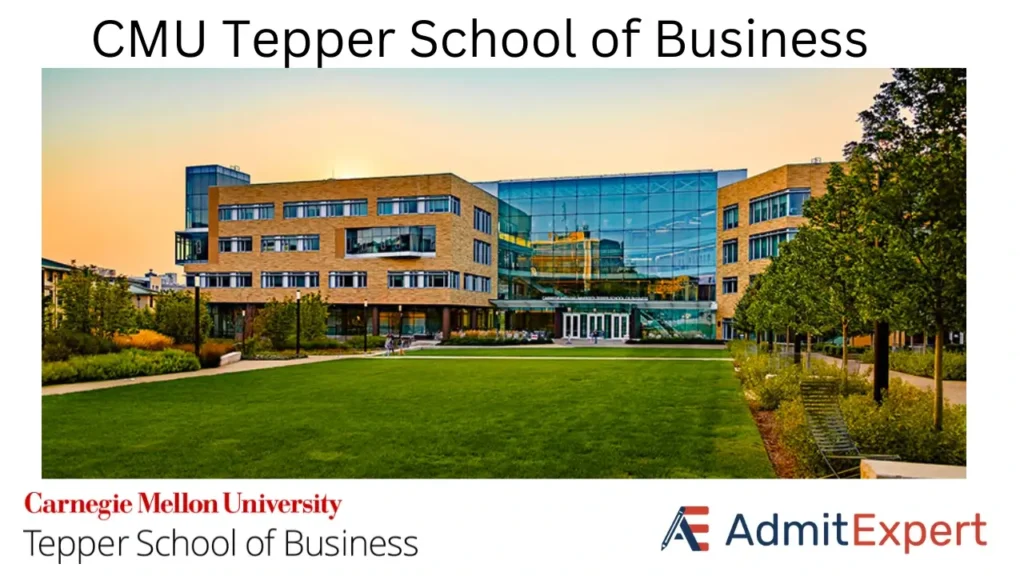
The MBA is based in the Tepper Quad at Carnegie Mellon's Pittsburgh campus.
The physical setting puts business students inside a wider university known for technology, computing, design, and engineering.
That can make informal interdisciplinary exposure easier.
But proximity alone is not an academic plan.
The candidate should be able to explain how they would use Carnegie Mellon beyond saying:
"CMU is strong in technology."
More Than 40 Student Clubs Extend the MBA Beyond Class
Tepper's MBA ecosystem includes 40+ student clubs and organizations.
They cover:
- career interests;
- affinity communities;
- entrepreneurship;
- technology;
- finance;
- consulting;
- social activities;
- leadership.
The clubs matter most when they change what a student can do.
A consulting club may help with:
- cases;
- firm research;
- alumni;
- peer practice.
A technology club may help with:
- role education;
- employer access;
- product preparation.
Membership itself is not the outcome.
Tepper MBA Class Profile: Class of 2027
The latest detailed official profile contains 144 students.
Class Composition
| Metric | Class of 2027 |
|---|---|
| Students enrolled | 144 |
| International students | 38% |
| Countries represented | 21 |
| U.S. military / veterans | 14% |
| Average age | 29 |
| Middle 80% age | 25–33 |
| Average work experience | 5.2 years |
| Median work experience | 5 years |
| Middle 80% work experience | 2.7–8.5 years |
Tepper's military figure covers U.S. citizens and permanent residents in the relevant reporting category.
The age and experience ranges show meaningful variation around the average.
Five Years of Experience Is Context, Not an Admissions Rule
The class median is five years.
The middle 80% runs from 2.7 to 8.5 years.
That is a more useful benchmark than the average alone.
Applicants should not wait until they reach exactly five years if the career logic already makes sense.
The better questions are:
- What responsibility have I earned?
- How has my scope changed?
- What impact can I demonstrate?
- Why is the MBA useful now?
- What will I be ready to do after it?
GPA, GMAT, GRE, and Executive Assessment
| Academic measure | Average | Median | Middle 80% |
|---|---|---|---|
| Undergraduate GPA | 3.33 | 3.38 | 2.80–3.79 |
| GMAT Focus | 659 | 655 | 595–715 |
| Legacy GMAT | 707 | 710 | 700–740 |
| GRE Verbal | 159 | 159 | 152–166 |
| GRE Quantitative | 163 | 164 | 156–170 |
| Executive Assessment | 155 | 156 | 152–158 |
These figures describe enrolled students who used the relevant academic evidence.
They are not published minimum scores.
Current and Legacy GMAT Scores Must Stay Separate
The 659 GMAT Focus average and 707 legacy GMAT average use different scales.
They should not be interpreted as a raw-score decline.
An applicant taking the current test should compare:
- current-format scores;
- percentiles;
- the current profile;
- the complete academic record.
Old advice built around legacy raw scores needs to be translated carefully.
GRE Section Scores Should Not Be Turned Into an Invented "Average GRE"
Tepper reports separate GRE Verbal and Quantitative statistics.
The average is:
- 159 Verbal;
- 163 Quantitative.
The median is:
- 159 Verbal;
- 164 Quantitative.
Adding them together would create a combined score that the school itself does not publish in the class profile.
That would be a derived figure, not an official class statistic.
Executive Assessment Is a Real Admissions Route
Tepper accepts the Executive Assessment in addition to GMAT and GRE.
The current class profile reports:
- 155 average;
- 156 median;
- 152–158 middle 80%.
The admissions page also indicates that successful EA applicants generally demonstrate substantial quantitative preparation through academic or professional experience.
The test route therefore needs to fit the candidate's broader evidence.
Engineering Is the Largest Undergraduate Background
| Undergraduate field | Share |
|---|---|
| Engineering | 41% |
| Business / Commerce | 23% |
| Economics | 10% |
| Other | 9% |
| Mathematics / Physical Sciences | 6% |
| Arts / Humanities | 6% |
| Social Sciences | 5% |
Engineering is clearly the largest single category.
But 59% of the class studied something else.
Tepper's analytical reputation should therefore not be confused with an engineering-only student body.
Non-Engineering Applicants Need Evidence, Not an Engineering Identity
A humanities or social-sciences applicant does not need to imitate an engineer.
They do need to show that they can handle an analytically demanding curriculum.
That evidence can come from:
- coursework;
- test scores;
- professional responsibilities;
- certifications;
- later quantitative study.
An engineer has a different burden.
Technical readiness may already be obvious, so the application needs to make:
- leadership;
- communication;
- commercial judgment;
- contribution
equally visible.
Tepper MBA Admissions Requirements 2026–27
The current Full-Time MBA application includes:
- application form;
- transcripts;
- one- to two-page resume;
- GMAT, GRE, EA, or approved waiver;
- one required written essay;
- one required video essay;
- one professional recommendation;
- interview if invited;
- English-language evidence where required;
- $200 application fee unless waived.
Tepper also has a specific quantitative prerequisite that applicants should not overlook.
College-Level Calculus Is a Matriculation Requirement
Tepper expects students to have completed one semester of college-level calculus with a grade of B or better.
Applicants without that background can still apply.
But they must successfully complete Tepper's Calculus Fundamentals requirement before matriculation.
That distinction matters.
Calculus is not simply an optional way to strengthen the application.
It is part of readiness for the MBA curriculum.
Tepper Accepts GMAT, GRE, and Executive Assessment
Applicants can submit:
- GMAT / GMAT Focus;
- GRE;
- Executive Assessment.
The right choice should depend on:
- the applicant's academic background;
- the target career;
- the quality of the resulting score;
- whether employers in the target industry may later care about standardized testing.
The existence of multiple tests does not mean they communicate exactly the same thing for every candidate.
Tepper Offers a Test-Waiver Process
Tepper allows applicants to seek a standardized-test waiver.
An eligibility tool can help a candidate assess whether a request may be reasonable.
But the formal waiver decision is made only after a complete application is submitted.
Tepper says waiver responses are generally provided within 10 business days after the application deadline.
That is an important scheduling detail.
A Preliminary Eligibility Indication Is Not the Final Waiver Decision
Applicants should not interpret an initial waiver-eligibility result as:
- formal approval;
- an admission signal;
- a reason to abandon all testing preparation.
The admissions committee evaluates the completed file.
Tepper may also recommend or require additional academic preparation before enrollment.
The waiver changes the evidence package.
It does not eliminate academic-readiness evaluation.
A Test Waiver Does Not Remove Scholarship Eligibility
Tepper explicitly says applicants admitted with an approved waiver remain eligible for merit scholarship consideration.
That is a useful distinction because applicants sometimes assume that not submitting a standardized score automatically means giving up scholarship opportunities.
At Tepper, the school says that is not the case.
The Written Essay Offers Two Different Ways to Show Fit
The current application asks applicants to choose one of two essay prompts, with a maximum of 500 words.
Option 1: Decisions Under Complexity and Uncertainty
This prompt asks about making a consequential decision without having all the answers.
It is a strong fit with Tepper's analytical philosophy.
The best response is not necessarily the most quantitative story.
It should show:
- what was uncertain;
- what evidence existed;
- what was missing;
- how the applicant made the decision;
- how they handled risk;
- what happened;
- what they learned.
The admissions committee can see how the candidate actually exercises judgment.
Option 2: Transformation
This prompt asks how the applicant wants to transform professionally and personally through the MBA.
The risk is writing a generic goals essay.
A stronger response identifies:
- current capability;
- future responsibility;
- specific development gaps;
- how Tepper addresses them;
- what personal growth matters alongside career advancement.
For detailed prompt strategy, use Admit Expert's Tepper MBA essay analysis.
The Video Essay Forces Career Specificity
The required video essay focuses on post-MBA goals.
Applicants receive up to two minutes.
Tepper asks candidates to be specific about factors such as:
- industry;
- company type;
- function;
- career criteria;
- relationship between short- and long-term goals.
That makes vague answers especially weak.
"I want to work in technology" does not define a job.
A stronger answer specifies what the applicant wants to do and why the role follows from prior experience.
The Written Essay and Video Should Not Duplicate Each Other
The written essay has more room to show:
- judgment;
- transformation;
- reflection.
The video is better suited to showing:
- direction;
- clarity;
- communication;
- career logic.
Repeating the same story in both wastes application real estate.
Tepper Requires One Professional Recommendation
The Full-Time MBA requires one professional recommendation.
A current or former supervisor is typically the most useful choice because they can assess:
- performance;
- leadership;
- professional growth;
- collaboration;
- response to feedback.
Tepper uses the GMAC Common Letter of Recommendation framework.
The strongest recommender is the person with the best evidence, not necessarily the most senior title.
Interviews Are Invitation-Only and Evaluative
Tepper interviews selected candidates after application review.
The interview is conducted by the MBA admissions team and is evaluative.
Applicants should expect behavioral questions around:
- leadership;
- teamwork;
- success;
- failure;
- career goals;
- transition plan;
- fit with Tepper.
The interview should connect the application rather than introduce a completely different career story.
Employment and Recommendation Information Can Be Verified After Admission
Tepper uses Re Vera for post-admission verification of relevant application information for candidates who accept an offer.
That makes consistency important across:
- resume;
- employment history;
- titles;
- dates;
- recommendation context.
The point is not to write defensively.
It is to make sure the application is accurate.
Tepper MBA Application Deadlines 2026–27
| Round | Application deadline | Decision release |
|---|---|---|
| Round 1 | September 30, 2026 | December 9, 2026 |
| Round 2 | January 8, 2027 | March 10, 2027 |
| Round 3 | March 3, 2027 | April 22, 2027 |
| Round 4 | May 5, 2027 | Rolling |
| Round 4 final deadline | June 15, 2027 | Rolling |
Round 3 is the final application round for international Full-Time MBA applicants.
The later Round 4 process is therefore not an additional normal international round.
Round 4 Is a Rolling Process
Round 4 begins with a May 5 application date and has a June 15 final deadline, with decisions released on a rolling basis.
That should not be treated as identical to an earlier round.
Later applicants may face:
- less class capacity;
- different scholarship availability;
- tighter relocation timing;
- tighter visa timing where relevant.
A later round can still be appropriate.
It should be chosen deliberately.
Tepper Also Offers Deferred Admission
Carnegie Mellon has a Future Business Leaders deferred-admission pathway for eligible college seniors.
Admitted candidates can defer enrollment for up to four consecutive academic years while building professional experience.
The value of deferred admission is not simply securing an MBA seat early.
The intervening period should be used to develop:
- stronger professional judgment;
- greater responsibility;
- clearer goals;
- experience that makes the eventual MBA more valuable.
Current future-cycle deadlines should be checked directly because deferred-admission dates run on a separate calendar.
Tepper MBA Employment Report: Class of 2025
Tepper's detailed Class of 2025 Full-Time MBA employment report covers 169 graduates.
Employment Status
| Employment category | Class of 2025 |
|---|---|
| Total graduates | 169 |
| Seeking employment | 139 |
| Not seeking employment | 26 |
| No recent employment information | 4 |
Among the 26 graduates not seeking employment:
- 17 were company-sponsored or already employed;
- 8 were starting a new business;
- 1 was in another non-seeking category.
This is why employment rates need the correct denominator.
A graduate starting a company is not automatically an unemployed job seeker.
Job Offers and Acceptances Should Stay Separate
Among the 139 job-seeking graduates:
| Outcome | By graduation | Within 3 months |
|---|---|---|
| Received an offer | 94 / 139 (67.6%) | 115 / 139 (82.7%) |
| Accepted an offer | 88 / 139 (63.3%) | 112 / 139 (80.6%) |
Tepper's current career summary also reports 89% receiving an offer within six months.
The six-month figure is a later-stage offer measure.
It should not be substituted for the three-month acceptance rate.
The Six-Month Figure Shows That Some Searches Continued
The offer rate rises from:
- 82.7% within three months;
- to 89% within six months.
That matters for financial planning.
Applicants should not assume:
graduation = immediate full-time income
A prudent MBA budget includes some capacity for the search to extend after commencement.
Work Authorization Did Not Create a Large Three-Month Gap in This Cohort
The detailed report separates the 139 job seekers into:
- 71 with permanent work authorization;
- 68 without permanent work authorization.
Using Tepper's published counts, three months after graduation:
| Outcome | Permanent work authorization | Non-permanent work authorization |
|---|---|---|
| Offers | 58 / 71 (81.7%) | 57 / 68 (83.8%) |
| Acceptances | 57 / 71 (80.3%) | 55 / 68 (80.9%) |
That is a notable result.
In this specific graduating class, the three-month offer and acceptance rates were very similar across the two groups.
It should not be interpreted as proof that sponsorship or work authorization never affects MBA recruiting.
Employer policies, industries, economic conditions, and future cohorts can differ.
But it does show why broad assumptions about international outcomes should be checked against the actual school data.
Tepper MBA Salary and Signing Bonus
| Compensation metric | Class of 2025 |
|---|---|
| Mean base salary | $154,846 |
| Median base salary | $160,000 |
| Base-salary low | $54,000 |
| Base-salary high | $207,000 |
| Mean signing bonus | $38,610 |
| Median signing bonus | $30,000 |
| Signing-bonus low | $4,500 |
| Signing-bonus high | $217,000 |
Tepper reports salary information for the graduates who supplied compensation data.
The median and mean answer different questions.
The $160,000 median is the midpoint of reported salaries.
The $154,846 mean is the arithmetic average.
Signing Bonus Should Not Be Added Mechanically to Base Salary
The signing-bonus statistics use a different reporting population from the full salary population.
It would therefore be misleading to calculate:
$160,000 median salary + $30,000 median signing bonus = $190,000 median compensation
The two medians do not necessarily describe the same person.
Tepper separately publishes total-compensation statistics on its compensation highlights page, which should be treated as a different measure rather than reconstructed from unrelated medians.
Employment by Industry
| Industry | Share of accepted jobs | Median base salary |
|---|---|---|
| Consulting | 35.7% | $184,000 |
| Technology | 25.0% | $144,000 |
| Other | 10.7% | $130,000 |
| Financial Services | 9.8% | $175,000 |
| Biotechnology / Healthcare / Pharmaceuticals | 6.2% | $135,000 |
| Manufacturing | 5.4% | $135,000 |
| Energy | 3.6% | $145,000 |
| Consumer Products | 2.7% | $120,000 |
| Government / Nonprofit | 0.9% | Insufficient data |
Consulting and technology together account for 60.7% of accepted jobs.
That is the dominant current employment story.
Consulting Is Tepper's Largest Industry
Consulting accounts for 35.7% of accepted jobs.
Its median base salary is $184,000.
That makes Tepper a significant consulting MBA, not simply a technology school.
For career changers, consulting can provide a relatively structured recruiting route through:
- summer internships;
- case interviews;
- repeat MBA hiring;
- office-specific recruiting.
Tepper's analytical curriculum can support that path.
Candidates still need to succeed in the actual recruiting process.
Consulting Is Also the Largest Function
Consulting represents 35.1% of reported functions.
The median base salary is also $184,000.
The closeness of the industry and function percentages indicates that much of Tepper's consulting employment is in conventional consulting roles at consulting employers.
That differs from schools where internal strategy or advisory work creates a much larger function share than industry share.
Technology Is the Second-Largest Industry
Technology accounts for 25% of accepted jobs.
The median base salary is $144,000.
The detailed industry data is heavily influenced by internet and e-business employers.
Technology is therefore clearly a major Tepper destination.
But "technology" still does not define the role.
Technology Industry Does Not Mean Product Management
A graduate can work at a technology company in:
- finance;
- marketing;
- operations;
- strategy;
- general management;
- product;
- information systems.
Applicants should therefore avoid saying:
"25% go into technology, so Tepper is strong for product management."
The product-management case needs to be built from:
- relevant track eligibility;
- coursework;
- capstone;
- clubs;
- internship employers;
- alumni in the target function.
Financial Services Is Smaller by Industry Than Finance Is by Function
Financial services accounts for 9.8% of industries.
Finance accounts for 19.8% of functions.
Those figures are not contradictory.
A graduate can perform a finance job inside:
- technology;
- healthcare;
- manufacturing;
- another non-financial company.
The function table is therefore especially important for finance candidates.
Finance Functions Are More Diverse Than the Industry Headline
The detailed employment data includes finance roles across areas such as:
- corporate finance / analysis / treasury;
- investment banking;
- asset management;
- other finance functions.
Investment banking represents a smaller share than corporate-finance-oriented roles.
That should shape applicant expectations.
Tepper can support banking.
Its current finance outcome is broader than banking.
Healthcare and Manufacturing Are Smaller but Visible Pathways
Biotechnology, healthcare, and pharmaceuticals account for 6.2% of accepted jobs.
Manufacturing accounts for 5.4%.
These shares are smaller than consulting and technology but meaningful enough to support targeted searches.
Applicants should investigate:
- employer names;
- functions;
- geography;
- internship access.
A small industry share does not automatically mean a weak program.
It may simply reflect student demand and cohort size.
Employment by Function
| Function | Share of reported functions | Median base salary |
|---|---|---|
| Consulting | 35.1% | $184,000 |
| Finance | 19.8% | $141,400 |
| General Management | 12.6% | $130,000 |
| Marketing | 12.6% | $165,000 |
| Production / Operations Management | 11.7% | $142,800 |
| Other | 4.5% | $120,000 |
| Information Systems / Information Technology | 3.6% | $160,000 |
The function table covers 111 reported functions.
The industry table covers 112 accepted jobs.
That small denominator difference is a good example of why tables from the same employment report should not be forced into identical totals.
Marketing Has a High Median Relative to Its Share
Marketing represents 12.6% of functions and reports a $165,000 median base salary.
That is higher than several larger functional categories.
The number should still be treated carefully.
A smaller reporting group can be more sensitive to:
- employer mix;
- role mix;
- geography;
- cohort composition.
One class does not establish a permanent salary hierarchy.
General Management and Operations Are Meaningful Routes
General management and production/operations management together account for nearly a quarter of reported functions.
That matters for applicants who associate Tepper only with:
- consulting;
- technology;
- finance.
The analytical curriculum can be particularly relevant to operating roles where managers must make decisions around:
- capacity;
- supply chains;
- process;
- cost;
- implementation.
73% of Accepted Full-Time Offers Were School-Facilitated
Among graduates reporting the source of accepted jobs within three months, 73% came through school-facilitated channels.
The report breaks those channels into areas such as:
- internship conversions from school-sourced internships;
- school job postings;
- school-facilitated networking;
- school interviews;
- other career-center activity.
That is one of the most decision-useful measures in the entire report.
The economic value of an MBA is not only the curriculum.
It also includes recruiting infrastructure.
Internship Conversion Is a Major Full-Time Offer Source
The largest individual school-facilitated source in the employment report is:
conversion of an internship that was originally sourced through school resources
That category alone accounts for 38.7% of reported accepted jobs within three months.
That makes the internship central to the standard two-year format.
The typical career-changing pathway can look like:
first-year preparation → summer internship → performance → return offer
That is exactly why the two-year versus accelerated-format decision deserves careful thought.
Class of 2026 Internship Data Shows Technology Leading the Summer Market
Tepper's employment reporting also includes the Class of 2026 summer internship mix.
Internship by Industry
| Industry | Share |
|---|---|
| Technology | 28.3% |
| Consulting | 22.9% |
| Financial Services | 17.5% |
| Pharmaceuticals | 5.5% |
| Manufacturing | 4.0% |
| Energy | 3.1% |
| Medical Products | 3.1% |
| Consumer Products | 2.4% |
| Biotechnology | 1.6% |
| Other industries | Remaining share |
Technology is larger in the internship table than in the Class of 2025 full-time industry mix.
That does not prove a permanent shift.
The tables describe different cohorts and different stages of recruiting.
Internship by Function
| Function | Share |
|---|---|
| Consulting | 29.1% |
| Finance | 24.5% |
| Marketing | 15.7% |
| Production / Operations Management | 11.9% |
| General Management | 11.8% |
| Information Systems / Information Technology | 1.6% |
| Other | Remaining share |
The internship mix confirms that Tepper's career market is broader than technology alone.
Consulting and finance remain major pathways even when technology is the largest internship industry.
Summer Internship Compensation Is Substantial
For the Class of 2026 summer internships, Tepper reports:
- mean monthly base salary: $10,427
- median monthly base salary: $10,053
Internship compensation should not be treated as guaranteed income.
It does matter to the economics of the two-year program because a paid internship can offset part of the summer opportunity cost.
72.5% of Accepted Internship Offers Were School-Facilitated
Tepper reports that 72.5% of accepted summer internship offers in 2025 came through school-facilitated sources.
That closely mirrors the full-time offer-source pattern.
The consistency reinforces the importance of:
- career coaching;
- employer relationships;
- school postings;
- structured recruiting;
- alumni.
Again, school-facilitated does not mean automatic.
It means the infrastructure is actively used.
Tepper Employment Is Geographically Diverse
The detailed Class of 2025 report records 97.3% of reported destinations in North America and 2.7% in Asia.
Among U.S. regional destinations, the leading shares are:
| U.S. region | Share of reported destinations | Median base salary |
|---|---|---|
| Mid-Atlantic | 21.8% | $182,500 |
| Midwest | 20.9% | $160,000 |
| Northeast | 20.9% | $172,500 |
| West | 16.4% | $151,400 |
| Southwest | 8.2% | $151,000 |
| South | 5.5% | $127,500 |
No single U.S. region dominates the way it does at some business schools.
That is one of the most useful geographic conclusions from the report.
Pittsburgh Is the School Location, Not the Employment Boundary
Tepper's employment footprint is clearly broader than Pittsburgh.
The current data shows substantial placement across:
- Mid-Atlantic;
- Midwest;
- Northeast;
- West.
For an applicant, the relevant question is therefore not:
"Will I have to stay in Pittsburgh?"
It is:
"How strong is the Tepper network and recruiting path in the city and office I actually want?"
Regional Salary Differences Should Not Be Treated as Pure Geography Effects
The Mid-Atlantic median is $182,500.
The South median is $127,500.
That does not prove that changing geography alone changes a Tepper graduate's salary by $55,000.
Each region can have a different mix of:
- consulting;
- finance;
- technology;
- operations;
- employers.
Industry and function composition affect the regional salary numbers.
Is Tepper a Good MBA for Consulting?
Consulting is the largest current industry and function.
The Class of 2025 report shows:
- 35.7% consulting by industry;
- 35.1% consulting by function;
- $184,000 median base salary.
The Class of 2026 internship data also shows 22.9% consulting by industry and 29.1% by function.
That makes consulting one of Tepper's clearest structured recruiting pathways.
Is Tepper a Good MBA for Technology?
Technology accounts for 25% of Class of 2025 accepted jobs and 28.3% of Class of 2026 internships by industry.
Tepper also offers:
- AI for Business;
- Business Technologies;
- Technology Strategy and Product Management;
- Management of Innovation and Product Development;
- Carnegie Mellon's wider technical ecosystem.
The school clearly supports technology careers.
The candidate still needs to define the function.
Is Tepper a Good MBA for Product Management?
Tepper has a dedicated Technology Strategy and Product Management track.
That is a meaningful academic advantage for qualified students.
But the track has a technical-background expectation.
Applicants without computer science, engineering, or comparable high-tech experience should not assume the track automatically creates product-management credibility.
They should investigate:
- current eligibility;
- relevant courses;
- internships;
- alumni;
- employer expectations.
Is Tepper a Good MBA for Finance?
Finance accounts for 19.8% of current reported functions, while financial services accounts for 9.8% of industries.
The outcome is therefore broader than Wall Street banking.
Finance applicants can combine:
- Finance concentration;
- analytical coursework;
- relevant electives;
- career coaching;
- internship recruiting.
The exact path matters.
Corporate finance and investment banking are different markets.
Is Tepper a Good MBA for Entrepreneurship?
Tepper's entrepreneurship resources include:
- Entrepreneurship concentration;
- optional Entrepreneurship track;
- high-growth entrepreneurship;
- entrepreneurship through acquisition;
- Swartz Center programming;
- Carnegie Mellon technical talent.
Applicants should distinguish among:
- founding a company;
- buying and operating a company;
- joining a startup;
- investing in startups.
Each uses the ecosystem differently.
Who Should Consider Tepper Most Seriously?
Tepper deserves close consideration if you value:
- analytical decision-making;
- consulting;
- technology;
- finance;
- operations;
- product and innovation;
- AI and business technology;
- Carnegie Mellon's technical ecosystem;
- leadership coaching;
- early academic customization;
- a traditional summer internship;
- geographically diversified recruiting.
Applicants should think more carefully if they strongly prefer:
- a largely qualitative MBA curriculum;
- minimal quantitative work;
- a highly fixed academic sequence with little customization;
- a career path where neither analytics nor technology fluency is likely to matter.
The strongest Tepper applicant can explain why analytical rigor and leadership development both matter for the next job.
How to Decide Whether Tepper Fits Your MBA Goals
1. Define the post-MBA role precisely
Specify:
- function;
- industry;
- geography;
- employer type.
"Technology" is not enough.
"Product strategy at a B2B software company" is much more useful.
2. Identify the decision-making gap
Ask:
- Do I need more quantitative depth?
- Better financial judgment?
- Product knowledge?
- Customer insight?
- leadership?
- communication?
- employer access?
- technical fluency?
The MBA should solve a real capability problem.
3. Build the academic pathway
Map the gap to:
- core;
- concentration;
- optional track;
- cross-campus course;
- capstone.
A coherent plan is stronger than a long list of electives.
4. Build the leadership pathway
Identify the behavior that needs development:
- delegation;
- conflict;
- executive communication;
- influence;
- confidence;
- self-awareness.
Then connect it to Accelerate Leadership Center coaching and opportunities to practice.
5. Test the employment data at the correct level
Do not use 25% technology industry share to justify an unspecified product role.
Do not use the 19.8% finance function share to imply 19.8% investment banking.
Do not use a regional salary median as though geography alone caused the number.
Research the specific route.
6. Decide whether you need the standard two-year format
If the transition depends on:
- internship conversion;
- more electives;
- major function change;
- major industry change;
the standard Full-Time MBA may provide more value.
If not, compare the Accelerated MBA's reduced opportunity cost.
7. Model the financial commitment
Include:
- current tuition;
- future tuition risk;
- fees;
- living expenses;
- health insurance where applicable;
- laptop;
- confirmed scholarship;
- financing;
- foregone salary;
- post-graduation job-search reserve.
Tepper MBA Tuition and Cost of Attendance 2026–27
Carnegie Mellon's 2026–27 Full-Time MBA student budget publishes the following estimate for a single student:
| Expense | 2026–27 estimate |
|---|---|
| Tuition | $84,186 |
| Housing | $10,350 |
| Food | $5,176 |
| Books and supplies | $1,450 |
| Transportation | $3,220 |
| Personal expenses | $10,524 |
| Student activities fee | $248 |
| Transportation fee | $302 |
| Technology fee | $490 |
| Health insurance | $3,352 |
| Federal loan fees, where applicable | $1,500 |
| Total published budget | $120,798 |
This is an annual planning budget.
It is not the guaranteed two-year price of the MBA.
Tuition Is $84,186—Not $120,798
The annual tuition figure is:
$84,186
The published total budget is:
$120,798
The difference includes living expenses, insurance, university fees, books, transportation, personal expenses, and estimated federal loan fees.
Those numbers should not be labeled interchangeably.
The Standard Full-Time MBA Requires Four Semesters
Carnegie Mellon's financial-services page distinguishes:
- standard Full-Time MBA — four semesters;
- Accelerated Full-Time MBA — three semesters.
That matters when applicants compare program costs.
A shorter accelerated format should not be used to estimate the cost of the standard MBA.
Future Tuition Can Change
Carnegie Mellon states that tuition and fees are evaluated annually and are subject to change.
That means simply doubling the 2026–27 $84,186 tuition figure would create a planning estimate, not a guaranteed two-year bill.
The second academic year's rates may differ.
The Laptop Allowance Is Separate
The university lists a $1,500 laptop allowance separately from the published $120,798 annual total.
That distinction matters when reconstructing the budget.
The laptop amount should not be assumed to be already inside the displayed total.
Federal Loan Fees Do Not Apply to Every Student
The $1,500 federal-loan-fee estimate is relevant to students using the applicable federal borrowing.
It is not necessarily an expense for every MBA student.
The university publishes it within the standard budget for planning purposes.
Applicants should adjust the personal cash-flow model to the financing actually being used.
Health Insurance May Be Waived With Qualifying Coverage
The budget includes $3,352 for health insurance.
Students with qualifying existing coverage may be able to opt out under Carnegie Mellon's rules.
That means the listed insurance amount is not automatically an unavoidable net cost for every student.
Opportunity Cost Belongs in the MBA Price
A full-time MBA also costs the income the student gives up.
For someone leaving:
- consulting;
- engineering;
- technology;
- finance;
- operations;
foregone compensation can exceed many of the line items in the university budget.
The useful comparison is:
net direct cost + financing cost + lost earnings
against
the skills, access, network, and career trajectory created by Tepper.
The Job-Search Timeline Should Be in the Budget
Only 80.6% of job-seeking Class of 2025 graduates had accepted an offer within three months.
Tepper reports 89% receiving offers within six months.
That means a prudent financial model should leave room for a search that continues after graduation.
The highest salary in the report is not enough to answer whether the MBA is affordable.
Tepper MBA Scholarships and Financial Aid
Tepper considers Full-Time MBA applicants for merit scholarships through the admissions process.
There is no separate general merit-scholarship application.
Awards are communicated with the admission decision.
That makes the application itself the main scholarship case.
A Test Waiver Does Not Eliminate Merit Consideration
Tepper explicitly states that applicants using an approved test waiver remain eligible for scholarship consideration.
Applicants should therefore separate two decisions:
- what academic evidence makes the strongest admission file;
- what scholarship the school ultimately awards.
They are related, but waiver use is not an automatic scholarship disqualifier.
Named Scholarships Reflect Different Priorities
Tepper lists several named scholarships and funds connected to areas such as:
- leadership;
- finance;
- professional achievement;
- citizenship or geographic background;
- service.
Examples include:
- James R. Swartz Leadership Scholarship;
- McGrath Scholars Fund;
- Booz & Company Scholars Fund;
- David A. Tepper Scholarship Fund.
Named awards should not be treated as a menu from which an applicant can simply select funding.
Eligibility and selection vary.
Forté Fellowship Combines School Funding With Partner Benefits
Tepper participates in the Forté fellowship network.
The fellowship designation is made through the admission and scholarship process.
It combines the school's merit support with access to Forté programming and community benefits.
The financial amount is determined by the actual Tepper award.
Consortium Membership and Fellowship Are Different Concepts
Applicants using the relevant Consortium process can be considered for Tepper merit support ranging from $10,000 to full tuition under current school rules.
At Tepper, students receiving a full-tuition merit award through that route are designated Consortium Fellows.
That distinction matters because:
- Consortium membership;
- admission to Tepper;
- merit scholarship;
- full-tuition fellowship
are not automatically the same thing.
ROMBA Fellowship Does Not Add Money to the Underlying Tepper Scholarship
Tepper's current Reaching Out MBA policy is particularly important for budgeting.
To qualify for the ROMBA Fellowship designation, a student must already have a qualifying Tepper merit scholarship of at least $10,000 per year.
The fellowship designation does not increase the existing scholarship amount.
That means applicants should not add:
Tepper scholarship + imagined separate ROMBA cash award
unless the actual award letter says so.
Yellow Ribbon Support Should Be Checked for the Current Year
Tepper participates in the Yellow Ribbon program for eligible veterans.
Participation levels can change.
Applicants should use the current scholarship and veterans guidance rather than relying on an old annual cap from a previous academic year.
Some Specialized Awards Require Additional Eligibility
Tepper also lists more targeted awards, including programs with specific background or financial-need criteria.
For example, the Murat Ozyegin Fellowship can provide support to a qualifying Full-Time MBA student from Turkey who meets the current eligibility conditions.
These awards can materially change the economics for the right applicant.
They should not be generalized to the full class.
Plan From the Award Letter Backward
The most reliable scholarship number is not:
- the largest award mentioned on the website;
- a partner fellowship label;
- another student's package.
It is:
the amount in your actual admission and scholarship letter
From there, calculate:
- tuition remaining;
- fees;
- living costs;
- insurance;
- financing;
- foregone earnings.
That produces a more useful affordability comparison.
Tepper MBA FAQs
What is the latest Tepper Full-Time MBA class profile?
The latest detailed official profile currently published is the Class of 2027, with 144 students.
How large is the Tepper MBA class?
The Class of 2027 contains 144 students.
What is the average GMAT at Tepper?
The current class reports a 659 average GMAT Focus score and a 655 median.
Tepper separately reports a 707 average and 710 median on the legacy GMAT scale.
What is the GRE average at Tepper?
Tepper reports separate averages of:
- 159 GRE Verbal
- 163 GRE Quantitative
It does not publish a combined average score on the current class-profile table.
What is the average GPA at Tepper?
The Class of 2027 reports:
- 3.33 average undergraduate GPA
- 3.38 median undergraduate GPA
How much work experience do Tepper MBA students have?
The Class of 2027 averages 5.2 years of work experience, with a five-year median.
The middle 80% range is 2.7–8.5 years.
Does Tepper require calculus?
Tepper expects one semester of college-level calculus with a grade of B or better.
Students who have not met the requirement can complete Tepper's Calculus Fundamentals before matriculation.
Which standardized tests does Tepper accept?
Tepper accepts:
- GMAT / GMAT Focus;
- GRE;
- Executive Assessment.
Does Tepper offer a test waiver?
Yes.
Applicants can request a waiver, but the formal decision is made after the complete application is submitted.
Tepper says waiver decisions are generally communicated within 10 business days after the application deadline.
Does a test waiver reduce scholarship eligibility?
Tepper states that using an approved test waiver does not remove merit-scholarship eligibility.
What is the Tepper MBA essay?
Applicants choose one of two 500-word prompts:
- making a consequential decision under complexity and uncertainty;
- or explaining the professional and personal transformation they want from the MBA.
There is also an optional additional-information response.
What is the Tepper video essay?
The video essay asks about post-MBA career goals.
Applicants have up to two minutes and are expected to be specific about the intended industry, company type, function, and relationship between short- and long-term goals.
How many recommendations does Tepper require?
Tepper requires one professional recommendation.
Is the Tepper MBA interview required?
Interviews are invitation-only and evaluative.
Selected candidates interview with the MBA admissions team.
What is the Tepper MBA application fee?
The standard application fee is $200.
Tepper offers qualifying fee-waiver opportunities, including some event-based waivers.
What is the next Tepper MBA deadline?
For the 2026–27 cycle, Round 1 is:
September 30, 2026
Round 2 is January 8, 2027 and Round 3 is March 3, 2027.
What is the final Tepper deadline for international applicants?
Round 3 on March 3, 2027 is the final Full-Time MBA application round for international applicants in this cycle.
Does Tepper offer deferred admission?
Yes.
Carnegie Mellon's Future Business Leaders pathway allows eligible final-year college students to apply for deferred admission and build work experience before enrolling.
Is the Tepper MBA STEM-designated?
Yes.
Tepper identifies the MBA as STEM-designated.
What is the median salary after the Tepper MBA?
For the Class of 2025, Tepper reports:
- $160,000 median base salary
- $154,846 mean base salary
What percentage of Tepper MBA job seekers receive offers?
Among 139 Class of 2025 job seekers:
- 82.7% had received an offer within three months;
- 80.6% had accepted an offer within three months.
Tepper's career summary reports 89% receiving offers within six months.
How did graduates without permanent U.S. work authorization perform?
Using Tepper's published counts, three-month offer and acceptance rates were very similar between graduates with and without permanent U.S. work authorization in the Class of 2025.
That is one cohort's outcome and should not be treated as a guarantee for future international students.
Which industry hires the most Tepper MBAs?
Consulting is the largest Class of 2025 industry at 35.7%.
Technology is second at 25%.
Is Tepper mainly a technology MBA?
No.
Technology is a major destination, but consulting is currently larger.
The Class of 2025 also placed graduates into finance, healthcare, manufacturing, energy, consumer products, and other sectors.
How much does the Tepper MBA cost?
For 2026–27:
- annual tuition is $84,186;
- the published single-student annual budget is $120,798.
The budget includes tuition plus living and other estimated expenses.
Is the laptop included in Tepper's published annual budget?
No.
Carnegie Mellon lists a $1,500 laptop allowance separately from the displayed $120,798 total.
Are Tepper applicants automatically considered for merit scholarships?
Yes.
Applicants are considered for the general Tepper scholarship process through admission without a separate general merit application.
Does the Tepper ROMBA Fellowship add scholarship money?
Not under the current Tepper structure.
The ROMBA Fellowship designation requires an existing qualifying Tepper merit scholarship and does not increase that award.
Final Thoughts
Tepper is most compelling when analytics is understood as a leadership capability rather than a branding phrase.
The curriculum asks students to combine:
- data;
- models;
- economics;
- finance;
- operations;
- strategy;
- customer understanding;
- organizational behavior.
The four-mini structure allows earlier customization.
Concentrations create depth.
Tracks create more structured cross-functional pathways.
Capstones turn coursework into real or simulated executive decisions.
The Accelerate Leadership Center addresses the interpersonal capabilities that quantitative analysis alone cannot solve.
And Carnegie Mellon's wider technical ecosystem gives students unusual access to computing, engineering, product, and entrepreneurship resources.
The career data reinforces that breadth.
Consulting is the largest current industry and function.
Technology is the second-largest industry.
Finance is nearly one-fifth of functions even though financial services is less than 10% of industries.
The Class of 2025 also placed graduates across several U.S. regions rather than concentrating overwhelmingly in Pittsburgh.
The internship pathway is especially important: school-sourced internship conversion is the single largest reported source of accepted full-time jobs, while nearly three-quarters of both full-time and internship accepted offers are school-facilitated.
The financial decision requires the same precision.
$84,186 is current annual tuition.
$120,798 is the published annual single-student budget.
A separate laptop allowance exists.
The standard Full-Time MBA spans four semesters, and future tuition can change.
Scholarship labels also need to be read carefully: general merit consideration is automatic, while partner designations such as ROMBA do not necessarily create additional cash beyond the underlying Tepper award.
The strongest reason to apply is therefore not:
"Tepper is quantitative and Carnegie Mellon is strong in technology."
It is:
"This is the role I want, these are the analytical, managerial, and leadership capabilities I still need, and Tepper's curriculum, tracks, capstones, coaching, recruiting infrastructure, internship pathway, and Carnegie Mellon ecosystem give me a concrete way to build them."
If Tepper is on your target list, continue with Admit Expert's Tepper MBA essay guide and MBA application deadlines tracker.
Related Articles

Deferred MBA Programs: 2027 Deadlines, Eligibility & Top Schools
Compare the leading deferred MBA programs for college seniors and eligible graduate students, including HBS 2+2, Stanford, Wharton, Booth, Kellogg, MIT Sloan, Columbia, Haas and Darden, with current 2027 deadlines and rules.
Read Article →
M7 Business Schools: 2026–2027 Guide to Rankings, Admissions, Costs & Careers
A current comparison of Harvard, Stanford, Wharton, Chicago Booth, Kellogg, MIT Sloan and Columbia covering 2026 rankings, Class of 2027 profiles, GMAT/GRE scores, 2027 application deadlines, MBA costs and Class of 2025 career outcomes.
Read Article →
Stanford GSB MBA Guide 2026–27: Admissions, Class Profile, Curriculum, Employment, Fees & Scholarships
A complete guide to the Stanford Graduate School of Business MBA covering admissions, the latest class profile, GMAT and GRE scores, curriculum, application deadlines, employment outcomes, tuition, cost of attendance, scholarships, and financial aid.
Read Article →