

USC Marshall MBA Guide 2026–27: Admissions, Class Profile, Curriculum, Employment, Fees & Scholarships
A complete guide to USC Marshall’s Full-Time MBA, covering the Fall 2025 class profile, Career Launchpad, curriculum, 2026–27 admissions, career outcomes, costs, scholarships, and applicant fit.
USC Marshall's Full-Time MBA is often evaluated through one obvious advantage:
Los Angeles.
That matters.
USC sits inside one of the largest and most varied business markets in the United States, with unusually visible access to entertainment and media, technology, consumer businesses, real estate, healthcare, consulting, finance, sports, gaming, and entrepreneurship.
But "I want to study in Los Angeles" is not a career plan.
The useful question is:
"How would I use Marshall's curriculum, Career Launchpad, client projects, PRIME, electives, career advisers, clubs, and Trojan network to become credible for the particular role I want?"
That distinction becomes especially important because Marshall's current employment data is broader than its entertainment reputation.
The Class of 2025 summary reports average starting salaries of:
- $167,211 in consulting
- $148,744 in financial services
- $136,056 in technology
- $117,667 in entertainment
The school does not currently publish a detailed 2025 industry-placement distribution alongside those salaries, so those figures should not be turned into claims about which sector hired the largest share of the class.
Marshall's academic model is similarly broader than location.
The first year uses a five-term core, students begin electives during the spring, teams complete a Los Angeles consulting project, and the year culminates in the global PRIME experience. The second year is largely elective and can include coursework across Marshall and, with approval, other USC graduate schools.
Career preparation begins even earlier.
For the incoming Class of 2028, Marshall expanded its Career Launchpad into a three-week program with tracks in consulting, finance, technology, entertainment, and entrepreneurship and innovation.
This guide focuses on the two-year, in-person Full-Time MBA at USC Marshall. It uses the latest detailed public Fall 2025 / Class of 2027 profile, the 2026–27 admissions cycle, Class of 2025 career outcomes, the expanded 2026 Career Launchpad, and the currently published 2026–27 tuition and scholarship information.
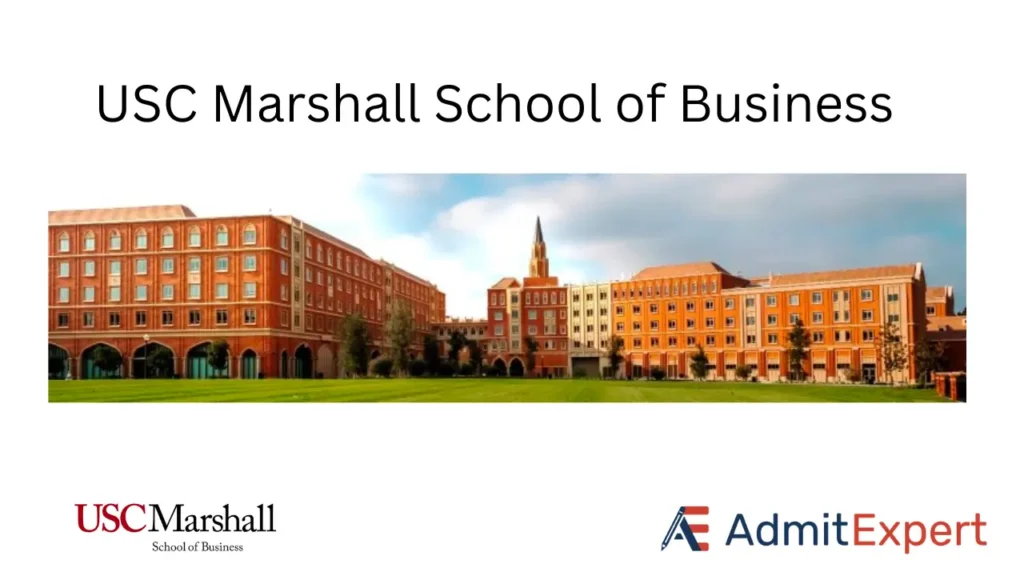
USC Marshall MBA at a Glance
| Metric | Latest official information |
|---|---|
| University | University of Southern California |
| School | USC Marshall School of Business |
| Location | Los Angeles, California |
| Program | Two-year, in-person Full-Time MBA |
| Degree requirement | 63 units |
| STEM designation | Yes |
| Latest detailed public entering-class profile | Fall 2025 / Class of 2027 |
| Applications received | 1,914 |
| School-reported acceptance rate | 31% |
| Class size | 176 |
| Average undergraduate GPA | 3.55 |
| Average GMAT | 742; exam version not separately identified on the profile |
| Average GRE | 322 |
| Average age | 28 |
| Average work experience | 6 years |
| Women | 31% |
| International students | 43% |
| Class of 2025 employed within 90 days | 71%; denominator not defined in the public summary |
| Class of 2025 average salary | $142,184 |
| Class of 2025 average signing bonus | $35,896 |
| 2026–27 first-year university charges | $99,055 |
| 2026–27 second-year university charges | $84,481 |
| Application fee | None |
| Recommendations | Neither required nor accepted |
| GMAT / GRE | Optional |
| Next application deadline | Round 1 — October 15, 2026 |
Marshall's current Full-Time MBA class profile still publishes detailed admissions statistics for Fall 2025.
USC has already welcomed the Class of 2028, and current 2026 news coverage describes its orientation and Career Launchpad, but Marshall has not yet replaced the public detailed class-profile table with a new Class of 2028 profile.
That distinction matters.
A Class of 2028 career-program announcement should not be used to relabel Class of 2027 admissions statistics.
What Makes the USC Marshall MBA Distinctive?
Several parts of the MBA reinforce one another:
- Los Angeles access across entertainment, technology, consulting, finance, consumer businesses, real estate, and entrepreneurship;
- a first-year curriculum that combines business fundamentals with data science, communication, and applied problem solving;
- early career exploration through Career Launchpad;
- a required Los Angeles client-consulting experience;
- PRIME and global business exposure;
- roughly 100 MBA electives plus limited cross-registration elsewhere at USC;
- the Trojan alumni network;
- specialized student clubs and leadership-development programs.
The strongest Marshall fit is therefore rarely just:
"I want to work in entertainment."
A stronger fit might be:
"I want entertainment strategy, I need stronger finance and market-analysis skills, I need direct industry relationships, and Marshall gives me a Los Angeles recruiting ecosystem plus the courses and projects to close those gaps."
The same logic applies to technology, consulting, finance, entrepreneurship, and other careers.
Los Angeles Is Most Valuable When the Applicant Defines the Function
Los Angeles contains major employers and professional networks across:
- entertainment;
- media;
- technology;
- gaming;
- consumer products;
- healthcare;
- real estate;
- consulting;
- finance;
- sports;
- startups.
But an industry is not a function.
"Entertainment" could mean:
- corporate strategy;
- finance;
- distribution;
- marketing;
- product;
- talent management;
- operations;
- content strategy.
"Technology" could mean:
- product management;
- finance;
- strategy;
- operations;
- marketing;
- sales;
- business development.
The closer the applicant gets to the actual job, the easier it becomes to judge whether Marshall's Los Angeles location is truly useful.
The Trojan Network Is Large—but Size Alone Is Not the Advantage
USC Marshall reports a network of more than 100,000 alumni.
That scale matters.
But alumni-count headlines do not tell an applicant whether the network will help with a specific career.
A network becomes useful when the student knows:
- who works in the target role;
- which office matters;
- which alumni have made similar transitions;
- what questions to ask;
- how to contribute rather than only request help.
Marshall's recent Class of 2028 orientation coverage is useful because alumni did not describe the Trojan network merely as a database. They described repeated access through panels, outreach, referrals, and ongoing relationships.
That is a more useful way to evaluate a network.
The Class of 2028 Career Launchpad Was Expanded to Three Weeks
Marshall's 2026 Career Launchpad gave the Class of 2028 three weeks of career exploration before the main academic year.
Students selected one of five tracks:
- consulting;
- finance;
- technology;
- entertainment;
- entrepreneurship and innovation.
The program uses:
- alumni;
- workshops;
- panels;
- classes;
- networking;
- industry leaders.
This is a meaningful expansion from the generic one-week Launchpad description that still appears elsewhere on Marshall's program pages.
For current applicants, the Class of 2028 implementation is the more useful evidence of how Marshall is using Launchpad now.
Career Launchpad Helps Students Test a Career Hypothesis Before Recruiting Accelerates
An MBA applicant often arrives with a broad statement such as:
- "I want tech";
- "I want consulting";
- "I want entertainment."
Launchpad can force that idea to become more precise.
A student interested in technology may discover that:
- product management;
- technology strategy;
- corporate finance;
- go-to-market;
- business operations
require different skills and recruiting processes.
A finance candidate may discover the gap between:
- investment banking;
- corporate finance;
- private equity;
- asset management.
Early career exploration is valuable because changing direction is much easier before the student has committed months of networking and interview preparation to the wrong target.
Launchpad Is Preparation, Not Placement
A three-week career program does not guarantee:
- an internship;
- an interview;
- a return offer;
- a full-time role.
Its value is earlier information and earlier preparation.
Students still need to:
- build relevant skills;
- network;
- prepare technical interviews or cases;
- perform during internship recruiting;
- manage setbacks.
Marshall's recent alumni stories are particularly useful here because several graduates describe career paths that changed during or after the MBA.
That is normal.
A strong MBA career model should make adaptation possible.
The Full-Time MBA Requires 63 Units
Marshall's current Full-Time MBA curriculum requires at least 63 units.
The broad structure is:
| Stage | Curriculum structure |
|---|---|
| Year 1 | 24 core units + 9 elective units |
| Summer | Internship course option; up to 1.5 units can apply to the degree |
| Year 2 | 30 elective units |
| Total | 63 units |
The first-year core is delivered across five terms.
That creates a structured foundation before the program becomes increasingly customizable.
The First-Year Core Builds Across Business Functions
Marshall's core includes courses in areas such as:
- microeconomics;
- strategy;
- organizational behavior;
- leadership;
- marketing;
- accounting;
- finance;
- communication;
- data science;
- operations;
- problem solving and decision-making;
- global business.
The purpose is not simply exposure.
A career changer needs enough understanding across the business system to see how one decision affects another.
A product decision changes:
- customer economics;
- operating requirements;
- financial returns;
- competitive positioning.
A manager has to combine those views.
Data Science for Business Is Part of the Core
Marshall includes Data Science for Business in the required curriculum.
That is significant because Marshall is not treating analytics as a specialist elective available only to technology candidates.
A modern manager needs to be able to:
- interpret data;
- question assumptions;
- understand model limitations;
- communicate evidence;
- use analytical output in a business decision.
The development need differs by applicant.
An engineer may need better commercial interpretation.
A marketer may need stronger quantitative fluency.
The Core Also Includes Communication and Leadership
Marshall's first-year curriculum includes communication and organizational-behavior work alongside the analytical core.
That combination matters.
A technically correct recommendation can still fail if a manager cannot:
- explain it;
- persuade stakeholders;
- handle disagreement;
- adapt to different audiences;
- manage a team.
This is especially important for applicants who already have strong quantitative backgrounds.
For them, Tepper-like quantitative depth is not the only relevant development opportunity at Marshall; influence and organizational execution may matter more.
Term 4 Includes a Los Angeles Client Consulting Project
In the fourth term, students work in teams on a real business problem for a Los Angeles-area company.
This is one of the most useful ways the city enters the curriculum.
Students can apply:
- market analysis;
- finance;
- strategy;
- data;
- operations;
- communication
to a live client problem.
That is different from discussing an already-resolved case in class.
The Client Project Is Career Evidence Only If the Student Can Explain the Work
The project name on a resume is not enough.
A strong interview story should explain:
- the business problem;
- what information was available;
- what the student personally owned;
- how the analysis changed;
- which trade-offs mattered;
- what recommendation was made;
- how the client responded.
That is especially valuable for career changers who need evidence in a field where their pre-MBA resume is thin.
Electives Begin During the First Year
Marshall says Full-Time MBA students can take 7.5 elective units during the spring of year one.
That timing matters.
A student targeting a summer internship can begin adding role-specific knowledge before the internship.
The useful question is not:
"Does Marshall offer the elective?"
It is:
"Can I take the relevant course before the recruiting moment when I need the skill?"
The Second Year Is Largely Customizable
Students complete the remaining 30 elective units in year two.
Marshall offers close to 100 MBA electives in a typical year.
Students can use those units to:
- deepen a functional area;
- combine multiple business disciplines;
- complete an independent project;
- pursue approved coursework elsewhere at USC.
That creates significant freedom.
It also creates a need for academic discipline.
A random collection of interesting courses is not necessarily a strong career plan.
Students Can Take Up to Nine Approved Units Outside Marshall
Full-Time MBA students can take up to nine elective units at another USC graduate school, subject to program rules and approval.
Potentially relevant USC units include areas such as:
- cinematic arts;
- engineering;
- public policy;
- real estate;
- communication.
This is particularly attractive in Los Angeles because several career markets cross traditional business-school boundaries.
The cross-registration option should still be used deliberately.
A cinema course is valuable for an entertainment candidate only if it builds relevant industry understanding or capability.
PRIME Adds Required Global Business Exposure
Marshall's PRIME experience is tied to the Global Context of Business course.
The current PRIME program materials describe a 10-day overseas experience.
Students engage with:
- companies;
- multinational organizations;
- institutions;
- executives;
- local market conditions.
Projects can involve real business questions.
For example, recent students studying media traveled to Seoul and Hong Kong and presented consulting work to company executives.
PRIME Should Be Evaluated as Applied Global Learning, Not Tourism
The strongest value comes from operating in a market where the student has to consider:
- culture;
- regulation;
- politics;
- customers;
- finance;
- competitive dynamics.
The trip becomes useful when it changes the quality of the business judgment.
An applicant should be able to explain what they want to learn internationally that cannot be learned as well from a domestic case.
PRIME Has a Separate First-Year Fee
The current 2026–27 fee schedule includes a $3,850 PRIME fee in the first year.
That amount is already part of Marshall's published first-year cost table.
It should therefore not be forgotten when comparing tuition with another school.
It also should not be added again after using Marshall's published first-year total.
The Standard Two-Year MBA Includes a Summer Internship Period
Marshall's curriculum includes an internship course during the summer between academic years.
Students can receive up to 1.5 degree-applicable units for the internship course.
The internship is not just a line between year one and year two.
For many career changers, it is the bridge from:
pre-MBA experience → target function → full-time offer
That is why the timing of Launchpad, first-year electives, client consulting, clubs, and career preparation matters.
The Internship Can Also Reveal That the Initial Career Target Was Wrong
An MBA internship is valuable even when it does not convert.
A student may learn:
- the function is not a fit;
- the industry is less attractive than expected;
- another office or employer would be better;
- a different role uses their strengths more effectively.
The second-year elective flexibility then becomes valuable because the student still has time to adjust.
Marshall Leadership Fellows Develop Through Coaching First-Year Teams
The Marshall Leadership Fellows Program is a one-year leadership-development program for Full-Time MBA students.
Selected second-year Fellows complete classroom and experiential leadership work and coach first-year core teams.
The curriculum page describes the program as a two-semester, 3-unit elective experience.
For the Fellow, the work develops:
- coaching;
- feedback;
- leadership;
- team diagnosis.
For first-year teams, it adds structured peer coaching to the core experience.
Leadership Fellows Is Most Relevant to Applicants Who Can Name a Leadership Gap
"Become a better leader" is too vague.
A stronger development need might be:
- giving difficult feedback;
- delegating;
- managing conflict;
- influencing peers;
- leading without authority;
- coaching others.
A leadership program becomes more useful when the applicant already knows which behavior needs practice.
Marshall Also Offers a Society and Business Fellowship
Marshall's curriculum includes a selective MBA Society and Business Fellowship Program through the Brittingham Social Enterprise Lab.
The fellowship is designed for students pursuing business careers connected to issues such as:
- homelessness;
- education;
- global health;
- poverty alleviation.
Benefits include:
- mentoring;
- networking;
- internship and full-time career guidance;
- professional development;
- priority course access;
- possible summer-internship subsidy of up to $2,500 for an eligible nonprofit internship.
This is a good example of a program that serves a specific career direction rather than the entire MBA class.
USC's Entrepreneurship Ecosystem Extends Beyond the MBA Core
Marshall's entrepreneurship environment includes the Lloyd Greif Center and wider USC startup ecosystem.
The Class of 2028 Launchpad also has a dedicated entrepreneurship and innovation track.
Students interested in entrepreneurship should still distinguish among:
- founding a company;
- joining a startup;
- venture investing;
- building new businesses inside an established company.
Each path needs different evidence and uses USC differently.
Entertainment Is a Real Marshall Differentiator—but "Entertainment" Is Not a Job
Marshall's location and USC's wider cinematic-arts ecosystem give the MBA an unusually visible entertainment and media context.
Career Launchpad has a dedicated entertainment track.
Marshall's representative employer list includes media and entertainment organizations.
USC also allows approved cross-registration outside Marshall.
Those are real advantages.
But entertainment contains very different careers.
An applicant should define:
- finance;
- strategy;
- marketing;
- distribution;
- product;
- content;
- operations;
- talent;
- gaming.
The industry label is only the beginning.
The Latest Detailed Public Class Profile Is Fall 2025
Marshall's Fall 2025 class profile reports:
| Metric | Fall 2025 entering class |
|---|---|
| Applications received | 1,914 |
| School-reported acceptance rate | 31% |
| Students enrolled | 176 |
| Average undergraduate GPA | 3.55 |
| Average GMAT | 742 |
| Average GRE | 322 |
| Average age | 28 |
| Average work experience | 6 years |
| Women | 31% |
| International students | 43% |
| Underrepresented students | 22% of the domestic pool |
The underrepresented-student percentage uses the domestic pool as its denominator.
It is not 22% of all 176 students.
The 31% Acceptance Rate Is School-Reported
Marshall publishes the acceptance rate directly.
That means applicants do not need to estimate it from class size.
Dividing:
176 enrolled ÷ 1,914 applications
would create an enrollment-to-application ratio, not the admission rate.
Some admitted students enroll elsewhere.
Offers and enrollment are different stages.
The Public Profile Does Not Identify the GMAT Version Behind 742
Marshall labels the figure simply:
Average GMAT: 742
The page does not separately state:
- current GMAT / Focus;
- legacy GMAT.
That matters because the numerical scales differ.
This guide therefore preserves Marshall's label and does not call 742 a current-GMAT average or convert it into another score.
The GRE Figure Is a Combined Average
Marshall publishes 322 average GRE.
That is different from schools that publish:
- Verbal average;
- Quantitative average;
- separate medians.
Those figures should not be treated as directly interchangeable.
Countries of Origin Are Not an Entering-Class Count
Marshall's class-profile page lists countries of origin but notes:
first- and second-year classes
That means the list spans the broader Full-Time MBA population.
It should not be used to say the Fall 2025 entering class alone represented a particular number of countries.
This is exactly the kind of denominator issue that can quietly distort a class profile.
Six Years of Work Experience Is a Benchmark, Not a Requirement
The Fall 2025 entering class averages six years of work experience.
Marshall's admissions FAQ says the school recommends a minimum of two years, but does not impose a universal work-experience requirement.
Applicants should therefore focus on:
- progression;
- responsibility;
- impact;
- judgment;
- why now.
Six years without meaningful growth is not automatically more compelling than three or four years with significant responsibility.
USC Marshall MBA Admissions Requirements 2026–27
The current Full-Time MBA admissions page requires:
- bachelor's degree or equivalent;
- professional resume;
- essay(s);
- copies of official academic transcripts;
- English-proficiency testing where applicable;
- GMAT/GRE only if the applicant chooses to submit scores.
Two other features make the application unusually streamlined:
- no application fee
- no recommendation letters
Marshall Does Not Accept Recommendation Letters
This is more important than simply saying recommendations are optional.
Marshall's FAQ states:
recommendation letters are neither required nor accepted.
That means applicants cannot use a supervisor letter to explain:
- promotion;
- leadership;
- comparative performance;
- response to feedback.
Those stories have to appear elsewhere in the application.
The resume, essays, interview, and other materials therefore carry more responsibility.
The Application Has No Fee
Marshall currently charges no Full-Time MBA application fee.
The school explicitly says this policy is intended to allow serious candidates to be assessed regardless of ability to pay an application fee.
That removes one small financial barrier from school-list strategy.
It does not reduce the importance of submitting a polished application.
GMAT and GRE Are Optional
Applicants can apply without a GMAT or GRE score.
Marshall still expects candidates to demonstrate readiness for a rigorous MBA.
The useful test-optional question is not:
"Can I avoid testing?"
It is:
"Does the rest of my academic and professional record already prove enough quantitative and analytical readiness?"
A Strong Score Can Still Add Useful Evidence
A test score can be helpful when the academic record is:
- older;
- quantitatively light;
- difficult to interpret;
- weaker than the applicant's current capability.
It can also give the admissions committee another standardized academic signal.
Test-optional should therefore be treated as an applicant-specific strategy rather than a universal recommendation to skip testing.
Marshall Does Not Publish a Minimum GPA or Test Score
The current FAQ states:
- no minimum GPA;
- no minimum GMAT/GRE.
The Fall 2025 averages describe the enrolled class.
They are not admission cutoffs.
An applicant should evaluate the full academic story:
- transcript;
- rigor;
- quantitative work;
- professional evidence;
- optional test score.
Marshall Recommends At Least Two Years of Work Experience
The school says most students have prior work experience and recommends at least two years.
That is a recommendation rather than a strict universal eligibility rule.
The applicant still needs to show why the MBA is valuable at their career stage.
Applicants From Any Undergraduate Major Can Apply
Marshall requires a bachelor's degree or equivalent.
It does not prescribe a specific undergraduate major.
That makes the MBA accessible to candidates from:
- business;
- engineering;
- humanities;
- sciences;
- arts;
- public service;
- other fields.
The application still has to demonstrate academic readiness.
Applicants With a Previous MBA Can Apply
Marshall explicitly permits applicants who already hold an MBA.
The school asks those candidates to explain in the optional essay why they are pursuing a second MBA.
That explanation needs to be particularly strong.
A second MBA should solve a problem the first degree did not solve.
International Applicants Need TOEFL or IELTS Unless Exempt
Most international applicants need an English-proficiency test.
Marshall accepts:
- TOEFL;
- IELTS.
The Full-Time MBA also gives an additional exemption to applicants whose bachelor's-equivalent degree was completed at a non-U.S. institution where the sole medium of instruction was English, provided the applicant can document that fact.
International applicants should confirm the university-level English policy for their exact situation.
USC Marshall MBA Essays: Use the Live Application as the Source of Truth
Marshall's current public Full-Time MBA admissions page confirms that essays are part of the application but does not publish the operative Full-Time essay wording on the public page.
Applicants should therefore use the live application portal as the source of truth for the current prompts and word limits.
For strategic guidance once the live prompts are visible, use Admit Expert's USC Marshall MBA essay guide.
That is preferable to recycling old prompts from a prior admissions cycle.
The Essays Carry More Weight Because There Is No Recommender
Without recommendation letters, the application needs to establish leadership and impact directly.
A weak statement is:
"I am a collaborative leader."
A stronger story shows:
- the situation;
- the disagreement or challenge;
- the applicant's action;
- the effect on other people;
- the result.
Evidence becomes particularly important when no third-party recommender is available to validate the claim.
USC Marshall MBA Application Deadlines 2026–27
| Round | Application deadline | Decision by |
|---|---|---|
| Round 1 | October 15, 2026 | December 15, 2026 |
| Round 2 | January 5, 2027 | March 31, 2027 |
| Round 3 | March 1, 2027 | May 15, 2027 |
| Round 4 | April 15, 2027 | June 15, 2027 |
| Round 5 | After April 15, 2027 | Rolling, first-come / space available |
As of September 28, 2026, the next deadline is:
Round 1 — October 15, 2026
Marshall says applications submitted after April 15, 2027 are reviewed on a first-come, first-served and space-available basis.
Rolling Admission Is Not Equivalent to an Earlier Round
A rolling Round 5 can be useful when circumstances require a later application.
It should not be assumed to provide the same environment as Round 1 or Round 2.
Later applicants can face:
- less remaining class capacity;
- less scholarship availability;
- tighter relocation timing;
- tighter visa timing.
Apply when the application is genuinely strong, but do not delay without a reason.
The Consortium Uses a Separate Application Route
USC Marshall is a member of The Consortium for Graduate Study in Management.
Eligible applicants applying through The Consortium should use the Consortium common application rather than submitting an unnecessary duplicate Marshall application.
Marshall's current admissions page says Consortium applicants can be considered for a fellowship covering full tuition and mandatory fees under the Consortium process.
Membership and fellowship selection remain subject to the program's eligibility and selection rules.
USC Marshall MBA Career Outcomes: Class of 2025
Marshall's current class-profile and career-outcomes page publishes the following headline outcomes for the Class of 2025:
| Metric | Class of 2025 |
|---|---|
| Employed within 90 days of graduation | 71% |
| Average salary | $142,184 |
| Average signing bonus | $35,896 |
The 71% figure needs careful handling.
Marshall labels it "employed within 90 days of graduation" but does not define the denominator on that public summary.
It should therefore not be silently relabeled as:
- job-offer rate;
- job-acceptance rate;
- percentage of job seekers;
- percentage of the total graduating class.
Marshall's Current Public Career Reporting Is Less Granular Than Some Peer Schools
The current public 2025 summary does not provide a fully detailed:
- employment-status denominator;
- industry-placement share;
- function distribution;
- geography distribution.
That limits the claims an article can responsibly make.
It is better to preserve that limitation than import an older employment table and label it as Class of 2025 data.
The Salary Is an Average, Not a Median
Marshall reports:
$142,184 average salary
That should not be called the median salary.
Likewise:
$35,896 average signing bonus
does not mean every graduate received a signing bonus.
Without a public 2025 bonus-reporting denominator, the bonus should remain a separately reported average.
Do Not Add Average Salary and Average Signing Bonus
It would be incorrect to calculate:
$142,184 + $35,896 = $178,080 average compensation for every graduate
The populations reporting salary and bonus may differ.
A signing bonus is also generally a one-time payment rather than recurring base pay.
Marshall Publishes Average Starting Salaries for Four Industries
The current profile page provides:
| Industry | Average starting salary |
|---|---|
| Consulting | $167,211 |
| Financial Services | $148,744 |
| Technology | $136,056 |
| Entertainment | $117,667 |
These are average starting salaries, not median salaries.
Marshall does not publish the corresponding 2025 placement percentages on the same current page.
That means the table can show differences in reported pay without telling us how much of the class entered each sector.
Consulting Has the Highest Published Industry Average
Consulting reports the highest average among the four published categories at $167,211.
That does not mean consulting is necessarily the largest Marshall career path.
Salary and placement share are different questions.
The correct conclusion is narrower:
among the four industries for which Marshall currently publishes an average salary, consulting has the highest reported average.
Entertainment Has a Lower Published Base Salary Than the Other Three Categories
Entertainment reports an average starting salary of $117,667.
That difference is useful when building an MBA financial model.
A candidate targeting entertainment should not use:
- consulting salary;
- financial-services salary;
- classwide average
as though it were a likely entertainment outcome.
The compensation structure of entertainment roles can differ materially from consulting or banking.
Technology Is a Meaningful Marshall Career Market—but the Current Page Does Not Publish Its Share
Marshall reports a $136,056 average starting salary for technology.
Career Launchpad also has a dedicated technology track.
The representative employer list includes companies such as:
- Adobe;
- Amazon;
- Microsoft.
Those facts demonstrate a real technology recruiting market.
They do not establish the percentage of the Class of 2025 that entered technology.
Entertainment Is One of Marshall's Most Distinctive Recruiting Ecosystems
Entertainment is one of the five Class of 2028 Launchpad tracks.
USC's location and wider university ecosystem also create access to alumni and organizations across media, gaming, content, talent, and entertainment technology.
The current profile reports an average entertainment starting salary of $117,667.
Applicants should still define the function.
"Entertainment" alone is too broad for a serious career plan.
Consulting Has Received Additional Career Resources
Marshall has expanded consulting preparation through:
- dedicated career support;
- alumni;
- consulting-focused Launchpad programming;
- case preparation;
- employer relationships.
Recent Marshall reporting describes increased access to pre-MBA consulting programs and additional industry connections.
For a career changer, consulting can provide a relatively structured path.
The candidate still needs to prepare for:
- case interviews;
- networking;
- office selection;
- internship recruiting.
Finance at Marshall Includes More Than Investment Banking
The finance Launchpad track introduces students to the broader finance market.
Los Angeles itself contains careers in:
- banking;
- asset management;
- corporate finance;
- private capital;
- real estate finance.
Applicants should therefore avoid using "finance" as the final career label.
The target function drives the preparation.
Industry Practice Groups Organize Marshall's Career Support
Marshall's graduate career services use an industry-practice-group model.
Career advising, employer relationships, alumni, and student preparation can be organized around areas such as:
- consulting;
- finance;
- entertainment;
- technology and entrepreneurship;
- specialty careers.
That structure can make recruiting more specific.
The student still needs to use it.
Representative Employers Show Breadth, Not Hiring Volume
Marshall's current representative-employer list includes organizations such as:
- Adobe;
- Amazon;
- Amgen;
- Bain;
- BlackRock;
- Capital One;
- Deloitte;
- JPMorgan Chase;
- Mattel;
- Microsoft;
- The Walt Disney Company.
The list is useful evidence that Marshall has relationships across several career markets.
It does not tell us:
- how many graduates each hired;
- which functions they hired for;
- whether they will hire the same number next year;
- whether every role sponsors international students.
Employer names should therefore be a starting point for research, not the end of it.
The Trojan Network Can Be Especially Valuable During Career Pivots
Marshall's recent alumni stories show graduates using USC relationships when:
- changing industries;
- changing functions;
- responding to delayed offers;
- looking for new opportunities.
One Class of 2025 graduate, for example, publicly described using the network after a consulting start date was unexpectedly delayed.
The lesson is not that the network guarantees a backup job.
It is that relationships can become more valuable when the recruiting path changes unexpectedly.
Is USC Marshall a Good MBA for Consulting?
Marshall currently reports:
- $167,211 average starting salary in consulting;
- a dedicated consulting Launchpad track;
- expanded consulting-career resources;
- representative employers including major consulting firms.
That creates a meaningful consulting pathway.
The school does not currently publish a verified Class of 2025 consulting placement percentage on the public profile page, so the case should not be exaggerated beyond the available data.
Is USC Marshall a Good MBA for Technology?
Technology is one of the Career Launchpad tracks.
Marshall reports a $136,056 average starting salary for technology and lists representative employers such as Adobe, Amazon, and Microsoft.
The larger USC ecosystem also creates relevant cross-disciplinary opportunities.
Applicants should still specify:
- product;
- strategy;
- finance;
- marketing;
- operations;
- sales.
Is USC Marshall a Good MBA for Entertainment?
Entertainment is one of Marshall's clearest location-specific advantages.
The school offers:
- dedicated Launchpad exposure;
- Los Angeles proximity;
- entertainment-focused student communities;
- access to the wider USC ecosystem;
- alumni across media and entertainment.
The Class of 2025 page reports a $117,667 average starting salary for entertainment.
A strong applicant will define the function rather than simply say they want to "work in Hollywood."
Is USC Marshall a Good MBA for Finance?
Financial services reports a $148,744 average starting salary.
Career Launchpad includes a finance track, and Los Angeles offers finance roles across banking, real estate, asset management, private capital, and corporate finance.
A finance candidate should investigate which specific employers and functions recruit through Marshall.
Is USC Marshall a Good MBA for Entrepreneurship?
Marshall offers:
- entrepreneurship coursework;
- Greif Center resources;
- Launchpad entrepreneurship and innovation track;
- Los Angeles startup access;
- USC-wide collaborators.
The candidate should distinguish among:
- founding a company;
- joining a startup;
- investing in startups;
- building innovation inside a larger company.
Those paths need different evidence.
Who Should Consider USC Marshall Most Seriously?
Marshall deserves close consideration if you value:
- Los Angeles;
- entertainment and media;
- technology;
- consulting;
- finance;
- entrepreneurship;
- a STEM-designated MBA;
- early industry exploration;
- client consulting;
- required international exposure;
- broad elective flexibility;
- access to the wider USC university;
- a large alumni network.
Applicants should think more carefully if they strongly prefer:
- a highly prescribed second year;
- a recruiting market concentrated primarily in another geography;
- a school that currently publishes a very detailed employment report with industry/function shares;
- an MBA where Los Angeles-specific networks are less important to the plan.
The strongest Marshall fit is usually function-specific and action-specific.
How to Decide Whether Marshall Fits Your MBA Goals
1. Define the target role
Specify:
- function;
- industry;
- geography;
- employer type.
"Entertainment" is not enough.
"Corporate strategy at a streaming or gaming company in Los Angeles" is much more useful.
2. Identify the capability gap
Ask what prevents the move today.
Is it:
- finance?
- analytics?
- industry knowledge?
- client experience?
- leadership?
- network?
- employer access?
The MBA should solve something concrete.
3. Use Career Launchpad to test the hypothesis
The Launchpad track should help answer:
- Do I understand the role?
- Do I understand the recruiting process?
- Does my background translate?
- What skills do I still need?
- What alternative paths are realistic?
4. Build the first-year academic and project sequence
Connect the gap to:
- core;
- first-year electives;
- Los Angeles consulting project;
- club preparation;
- PRIME;
- internship.
The sequence matters more than the number of resources.
5. Use the second year for depth
Build around:
- remaining electives;
- cross-school coursework;
- independent study;
- leadership development;
- full-time recruiting.
6. Read the employment data conservatively
Do not turn:
- 71% employed within 90 days into a job-seeker offer rate;
- average salary into median salary;
- industry salary into industry placement share;
- representative employers into guaranteed hiring.
Ask the career team for the most recent detailed outcome data relevant to your target.
7. Model the full financial commitment
Include:
- tuition;
- program fees;
- PRIME;
- health insurance;
- housing;
- food;
- transportation;
- confirmed scholarship;
- financing;
- foregone earnings;
- a reserve for a longer post-graduation search.
USC Marshall MBA Tuition and Fees 2026–27
Marshall's current 2026–27 Full-Time MBA cost page publishes:
| University charge | First year | Second year |
|---|---|---|
| Tuition | $86,295 | $78,450 |
| USC Central Services and Health Fees | $1,922 | $1,844 |
| MBA Program Fees | $3,000 | $400 |
| PRIME Fee | $3,850 | — |
| Student Health Insurance | $3,988 | $3,787 |
| Published total | $99,055 | $84,481 |
The two published totals sum to:
$183,536
That is a useful planning figure.
It is not a complete two-year cost of attendance.
$183,536 Does Not Include Housing or Living Costs
Marshall explicitly says the tuition-and-fee summary excludes housing and living expenses.
A realistic budget therefore still needs:
- rent;
- utilities;
- food;
- books and materials not otherwise covered;
- local transportation;
- recruiting travel where relevant;
- relocation;
- personal expenses.
Los Angeles living costs can materially change the investment.
First-Year and Second-Year Tuition Are Different
The current schedule lists:
- $86,295 first-year tuition;
- $78,450 second-year tuition.
That difference partly reflects the unit structure across the two years.
Applicants should not assume every year of a two-year MBA has identical academic charges.
Tuition and Fees Can Rise
Marshall says the 2026–27 cost page is an estimate based on current rates and that tuition historically increases roughly 3%–5% per year.
That means the published two-column table should not be interpreted as a fixed-price guarantee for a future fall 2027 entrant.
It is the best current official planning reference.
Health Insurance May Be Waived With Qualifying Coverage
The current budget includes:
- $3,988 first-year student health insurance;
- $3,787 second-year student health insurance.
Students with qualifying alternative coverage can apply for a waiver under USC policy.
That means the listed amount is not necessarily an unavoidable net cost for every student.
Opportunity Cost Is Part of the MBA Price
A two-year Full-Time MBA also costs the income the student gives up while studying.
For someone leaving:
- technology;
- finance;
- consulting;
- entertainment;
- another professional role;
foregone earnings can be one of the largest parts of the investment.
The useful comparison is:
net direct cost + financing cost + lost income
against:
the access, capability, network, and long-term career trajectory created by Marshall.
The 71% Employment Headline Makes a Cash Reserve Important
Marshall's public Class of 2025 summary reports 71% employed within 90 days of graduation.
Because the public page does not define the denominator, that figure should not be overinterpreted.
It is still sufficient to make one practical point:
Not every graduate should assume immediate post-MBA income.
A conservative financing plan includes a reserve for the job-search period.
USC Marshall MBA Scholarships
Marshall says all admitted Full-Time MBA candidates are automatically considered for its general merit scholarships.
Scholarship decisions are communicated with the admission decision.
No separate general merit application is required.
That makes the admission application itself the main scholarship case.
Automatic Consideration Does Not Mean Automatic Funding
Marshall does not publish one guaranteed merit amount for every admit.
Applicants should therefore compare:
- actual scholarship;
- duration;
- conditions;
- remaining tuition;
- living costs.
A scholarship headline from another student is not a reliable forecast.
The Consortium Has a Separate Application and Fellowship Process
Applicants pursuing The Consortium route apply through the Consortium common application.
Marshall states that the process can include consideration for a fellowship covering:
full tuition and mandatory fees
That is different from ordinary automatic Marshall merit consideration.
Applicants should use the Consortium process if eligible rather than submit a duplicate Marshall application.
Schoen Family Scholarships Have Specific Veteran Eligibility Rules
Newly admitted Full-Time MBA students can apply for the Schoen Family Scholarship Program for Veterans.
Marshall's current scholarship page requires candidates to have:
- an honorable discharge from the U.S. Armed Forces;
- at least three years of continuous full-time active duty in the relevant recent service window.
This is a separate process.
It should not be described as automatic general merit aid.
ROMBA Fellowship Requires an Interest Form
Marshall's current scholarship page says candidates seeking the Reaching Out MBA Fellowship complete the ROMBA Fellowship Interest Form.
That makes the process different from automatic general scholarship consideration.
The public page does not state one universal Marshall ROMBA dollar amount.
Applicants should use the actual award terms if selected.
Marshall Participates in Yellow Ribbon
USC participates in the Yellow Ribbon GI Education Enhancement Program.
Veteran applicants should combine:
- VA eligibility;
- Yellow Ribbon support;
- Marshall merit aid;
- any specific veteran scholarship
only after confirming how the benefits interact.
Do not assume every source stacks automatically.
Social-Impact Funding Can Support Certain Nonprofit Internships
Marshall's Society and Business Fellowship can include priority consideration for a subsidy of up to $2,500 for an eligible nonprofit summer internship.
That is not a general MBA scholarship.
It is targeted support tied to a particular professional-development path.
This distinction matters when building the full financial plan.
Plan From the Actual Award Letter
The most reliable scholarship number is:
the amount Marshall offers you
not:
- the largest fellowship named on the site;
- a friend's scholarship;
- the fact that automatic consideration exists.
The final affordability model should begin with confirmed aid.
USC Marshall MBA FAQs
What is the latest USC Marshall Full-Time MBA class profile?
The latest detailed public class profile currently available is the Fall 2025 entering class / Class of 2027, with 176 enrolled students.
USC has welcomed the Class of 2028, but Marshall has not yet replaced the detailed public profile with Class of 2028 admissions statistics.
What is USC Marshall's MBA acceptance rate?
Marshall reports a 31% acceptance rate for the Fall 2025 entering class.
It also reports 1,914 applications and 176 enrolled students.
Enrollment divided by applications is not the acceptance rate.
What is the average GPA at USC Marshall?
The Fall 2025 profile reports an average undergraduate GPA of 3.55.
Marshall does not publish a minimum GPA.
What is the average GMAT at USC Marshall?
The current detailed profile reports an average GMAT of 742.
The public page does not separately identify the GMAT exam version behind that figure, so it should not be relabeled as a current-GMAT score or mechanically converted.
What is the average GRE at USC Marshall?
The Fall 2025 profile reports an average GRE of 322.
The school publishes it as a combined average rather than separate Verbal and Quantitative figures on the current profile page.
How much work experience do USC Marshall MBA students have?
The Fall 2025 entering class reports six years of average work experience.
Marshall recommends at least two years but does not make that a universal minimum eligibility requirement.
Is USC Marshall test-optional?
Yes.
GMAT and GRE submission is optional for the Full-Time MBA.
Applicants should decide whether a score strengthens the evidence of academic readiness.
Does USC Marshall require recommendation letters?
No.
Marshall neither requires nor accepts recommendation letters for the Full-Time MBA.
Does USC Marshall charge an application fee?
No.
The current Full-Time MBA application has no application fee.
Can I apply to USC Marshall if I already have an MBA?
Yes.
Marshall asks candidates pursuing a second MBA to explain the reason in the optional essay.
What are the current USC Marshall MBA essays?
Marshall's public admissions page confirms that essays are required but does not currently display the operative Full-Time MBA prompt wording.
Applicants should use the live application portal for the current prompts and word limits.
What is the next USC Marshall MBA deadline?
As of September 28, 2026, the next deadline is:
Round 1 — October 15, 2026
Is the USC Marshall Full-Time MBA STEM-designated?
Yes.
Marshall's MBA program comparison identifies the standard Full-Time MBA as STEM-designated.
How many units are required for the USC Marshall MBA?
The Full-Time MBA requires at least 63 units.
How many electives does USC Marshall offer?
Marshall says it offers close to 100 MBA electives in a typical year.
Students may also take up to nine approved elective units at another USC graduate school.
What is PRIME?
PRIME is Marshall's required global-business experience linked to the Global Context of Business course.
The current experience includes approximately 10 days overseas engaging with companies and completing applied global-business work.
What is the latest USC Marshall MBA salary?
Marshall reports a $142,184 average salary for the Class of 2025.
The public summary does not publish a median on the current page.
What is the USC Marshall signing bonus?
The current public summary reports a $35,896 average signing bonus for the Class of 2025.
It should not be added mechanically to average salary and presented as average total compensation.
What percentage of USC Marshall MBA graduates were employed within 90 days?
Marshall's current public summary reports 71% employed within 90 days of graduation for the Class of 2025.
The public summary does not define the denominator, so the figure should not be relabeled as a job-seeker offer or acceptance rate.
What is the average consulting salary at USC Marshall?
The current profile reports $167,211 average starting salary in consulting.
It does not publish a current consulting placement share alongside that salary.
What is the average technology salary at USC Marshall?
Marshall reports $136,056 average starting salary in technology.
What is the average entertainment salary at USC Marshall?
Marshall reports $117,667 average starting salary in entertainment.
How much does the USC Marshall MBA cost?
Marshall currently publishes:
- $99,055 first-year university charges
- $84,481 second-year university charges
The two figures total $183,536, excluding housing and living expenses.
Is PRIME included in the Marshall cost table?
Yes.
The first-year published total includes a $3,850 PRIME fee.
Do not add the fee a second time after using Marshall's total.
Are applicants automatically considered for Marshall scholarships?
Yes.
All admitted candidates are automatically considered for general merit scholarships.
The Consortium, Schoen Family Scholarship for Veterans, and ROMBA Fellowship have their own additional processes.
Does Marshall offer veteran scholarships?
Yes.
The Schoen Family Scholarship Program is available to qualifying newly admitted Full-Time MBA veterans under the school's current service requirements.
USC also participates in Yellow Ribbon.
Final Thoughts
USC Marshall is most useful when Los Angeles is treated as a career operating environment, not a slogan.
The city can matter enormously for:
- entertainment;
- technology;
- consulting;
- finance;
- entrepreneurship;
- real estate;
- consumer businesses.
But the applicant still needs to define the job.
The program's structure supports that process unusually early.
For the Class of 2028, Career Launchpad expanded into three weeks across five career tracks.
The first-year core then develops:
- economics;
- strategy;
- leadership;
- marketing;
- accounting;
- finance;
- communication;
- data science;
- operations;
- problem solving.
Students begin electives before the summer internship, complete a Los Angeles client project, and add international applied learning through PRIME.
The second year becomes far more customizable, with roughly 100 Marshall electives and the possibility of limited approved coursework elsewhere at USC.
Leadership development can continue through Marshall Leadership Fellows, while social-impact candidates have a separate Society and Business Fellowship path.
The current class profile needs equally careful interpretation.
Marshall's latest detailed numbers are still Fall 2025 / Class of 2027.
The school reports a 31% acceptance rate, 3.55 average GPA, 742 average GMAT, 322 average GRE, six years of work experience, and 43% international representation.
But the GMAT version is not separately labeled, and the country list covers both first- and second-year students.
The employment data is even more important to handle precisely.
Marshall's latest public Class of 2025 summary reports:
- 71% employed within 90 days;
- $142,184 average salary;
- $35,896 average signing bonus.
It also publishes average starting salaries for consulting, financial services, technology, and entertainment.
What it does not currently publish on that page is a complete current industry, function, and geography distribution.
A strong article should not fill that gap with an old employment report.
The financial decision has the same need for precision.
$99,055 and $84,481 are university charges for the first and second years under the current 2026–27 schedule.
Their $183,536 sum does not include Los Angeles housing or living costs.
Scholarship consideration is automatic for general merit aid, but separate programs have separate processes.
The strongest reason to apply is therefore not:
"USC has a great network and I want to be in Los Angeles."
It is:
"This is the role I want, these are the capabilities and relationships I still need, and Marshall's Career Launchpad, core curriculum, Los Angeles client work, PRIME experience, electives, career infrastructure, and Trojan network give me a concrete way to build them."
If USC Marshall is on your target list, continue with Admit Expert's USC Marshall MBA essay guide and MBA application deadlines tracker.
Related Articles

Deferred MBA Programs: 2027 Deadlines, Eligibility & Top Schools
Compare the leading deferred MBA programs for college seniors and eligible graduate students, including HBS 2+2, Stanford, Wharton, Booth, Kellogg, MIT Sloan, Columbia, Haas and Darden, with current 2027 deadlines and rules.
Read Article →
M7 Business Schools: 2026–2027 Guide to Rankings, Admissions, Costs & Careers
A current comparison of Harvard, Stanford, Wharton, Chicago Booth, Kellogg, MIT Sloan and Columbia covering 2026 rankings, Class of 2027 profiles, GMAT/GRE scores, 2027 application deadlines, MBA costs and Class of 2025 career outcomes.
Read Article →
Stanford GSB MBA Guide 2026–27: Admissions, Class Profile, Curriculum, Employment, Fees & Scholarships
A complete guide to the Stanford Graduate School of Business MBA covering admissions, the latest class profile, GMAT and GRE scores, curriculum, application deadlines, employment outcomes, tuition, cost of attendance, scholarships, and financial aid.
Read Article →