

M7 Business Schools: 2026–2027 Guide to Rankings, Admissions, Costs & Careers
A current comparison of Harvard, Stanford, Wharton, Chicago Booth, Kellogg, MIT Sloan and Columbia covering 2026 rankings, Class of 2027 profiles, GMAT/GRE scores, 2027 application deadlines, MBA costs and Class of 2025 career outcomes.
Last updated: September 25, 2026.
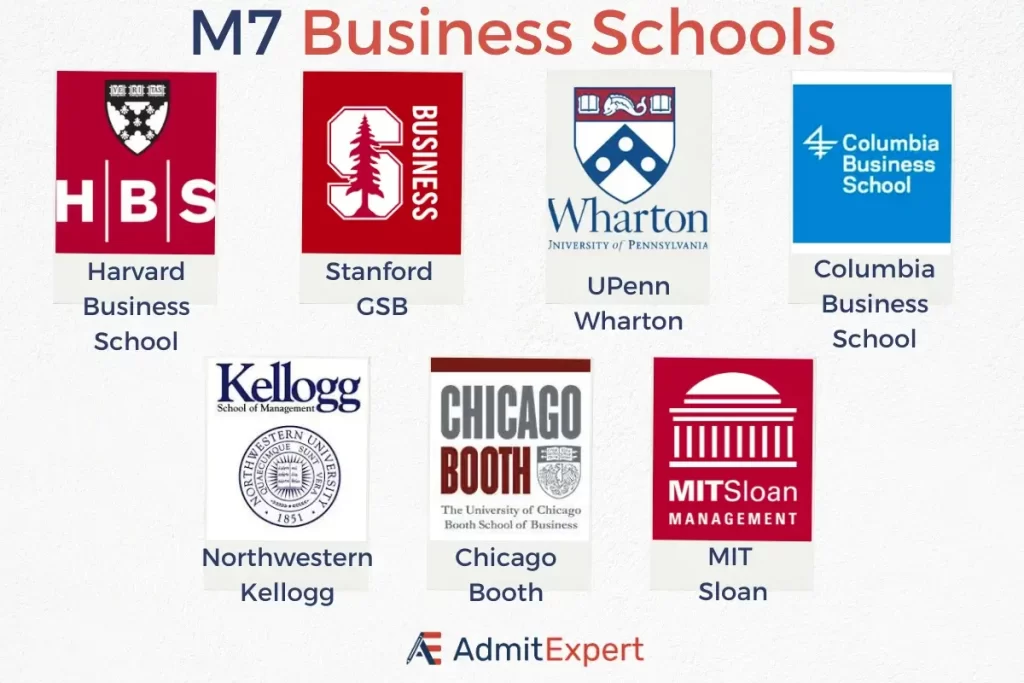
The M7 business schools are seven U.S. MBA programs that have become shorthand for a particular group of highly selective, globally influential business schools:
- Harvard Business School
- Stanford Graduate School of Business
- The Wharton School
- Chicago Booth School of Business
- Northwestern Kellogg School of Management
- MIT Sloan School of Management
- Columbia Business School
"M7" is commonly expanded as the Magnificent Seven or Magic Seven.
But it is important to understand what M7 actually means.
M7 is not a ranking, accreditation, or admissions category.
It is an informal peer group of seven business schools whose deans have historically met to discuss issues in graduate management education. Membership does not change when a school moves up or down in a ranking.
That distinction is especially visible in 2026.
MIT Sloan is #1 in both the latest Financial Times global MBA ranking and the newly published QS Global MBA 2027 ranking. Stanford is #1 in the 2026 U.S. News MBA ranking but is not ranked in the 2026 Financial Times list. Booth is #3 in U.S. News but #20 in the FT ranking.
None of those movements changed which schools are M7.
So the useful question is not:
Which M7 school is objectively the best?
It is:
Which M7 program gives you the strongest combination of career access, learning environment, culture, geography and financial fit for the MBA transition you want to make?
This guide uses the latest available data to help you answer that question.
What Are the M7 Business Schools?
| M7 business school | University | Location | Full-time MBA format |
|---|---|---|---|
| Harvard Business School | Harvard University | Boston, Massachusetts | 2 years |
| Stanford GSB | Stanford University | Stanford, California | 2 years |
| Wharton | University of Pennsylvania | Philadelphia, Pennsylvania | 2 years |
| Chicago Booth | University of Chicago | Chicago, Illinois | ~21 months |
| Kellogg | Northwestern University | Evanston, Illinois | 2-year flagship plus 1-year and other full-time formats |
| MIT Sloan | Massachusetts Institute of Technology | Cambridge, Massachusetts | 2 years |
| Columbia Business School | Columbia University | New York City | August entry: ~20 months; January entry: ~16 months; four terms |
All seven offer globally recognized full-time MBAs, but the student experience and recruiting ecosystems are not interchangeable.
The differences become clearer when you examine:
- curriculum design,
- class size,
- geography,
- employer access,
- entrepreneurship,
- finance exposure,
- consulting pipelines,
- teaching style,
- internship structure,
- cost.
Why Are They Called the M7?
The label developed around an informal network of seven elite U.S. business schools.
The deans have historically met periodically to discuss topics affecting graduate management education, with administrators from the schools also connecting in their respective functional areas.
That means the M7 is better understood as an institutional peer group than a ranking.
Ranking movements do not add or remove schools from the M7 group.
This is why schools such as:
- Berkeley Haas,
- Dartmouth Tuck,
- Yale SOM,
- NYU Stern,
- UVA Darden,
- Duke Fuqua
can rank above individual M7 schools in a particular methodology without becoming part of the M7.
Likewise, an M7 label does not automatically make one program a better personal choice than every non-M7 MBA.
M7 Business School Rankings in 2026
Rankings are useful when you understand what they measure.
They are much less useful when treated as a universal hierarchy.
The three current rankings below illustrate why methodology matters.
| M7 School | U.S. News MBA 2026 | QS Global MBA 2027 | Financial Times Global MBA 2026 |
|---|---|---|---|
| MIT Sloan | #6 | #1 | #1 |
| Harvard Business School | T-4 | #2 | #10 |
| Stanford GSB | #1 | #3 | NR |
| Wharton | #2 | #4 | #3 |
| Chicago Booth | #3 | #10 | #20 |
| Kellogg | T-4 | #13 | #11 |
| Columbia Business School | T-7 | #14 | NR |
NR = not ranked in that edition. An NR should not be interpreted as a numerical position below the ranked schools; participation and survey-response requirements can affect inclusion.
What should an applicant learn from this?
The takeaway is not that one ranking has identified a universally "better" school. Different rankings measure different things.
For example:
- U.S. News emphasizes measures related to quality assessment, placement success and student selectivity.
- The Financial Times includes salary growth, alumni career progress, international measures, research and other factors.
- QS uses measures including employability, entrepreneurship/alumni outcomes, ROI, thought leadership and diversity.
A school can therefore perform very differently across rankings without changing its curriculum, recruiters or alumni network overnight.
Use rankings to discover and benchmark programs. Do not let a one- or two-position difference make the school decision for you.
Read our broader guide on how to choose a business school for a more useful decision framework.
Latest M7 Class Profiles: Class of 2027
The MBA Class of 2027 is the latest broadly comparable cohort across the M7. Most students in these classes matriculated in 2025; Columbia's January-entry students began in 2026.
Schools do not report every metric in the same way. In particular, definitions of "international" can differ, and Kellogg does not currently publish every demographic field it reported in prior years. Treat the table as a comparison of reported class characteristics, not as an admissions formula.
| School | Class size | Applications | Women | International | GPA | Avg. work experience |
|---|---|---|---|---|---|---|
| HBS | 943 | 9,409 | 44% | 37% | 3.76 avg. | 4.9 yrs |
| Stanford GSB | 434 | 7,259 | 45% | 38% | 3.76 avg. | 5.3 yrs |
| Wharton | 888 | 7,613 | 44% | 26% | 3.70 avg. | 5.0 yrs |
| Kellogg | 534 | Not reported | Not reported | 37% | 3.68 avg. | 5.1 yrs |
| Chicago Booth | 635 | 5,876 | 41% | 37% | 3.60 avg. | 5.0 yrs |
| MIT Sloan | 450* | Not reported | 47% | 42% | 3.69 median | 5.0 yrs |
| Columbia | 982 | 7,477 | 46% | 41% | 3.60 avg. | 5.0 yrs |
MIT Sloan's figure includes LGO students. Kellogg's figures in this comparison refer to the incoming Two-Year MBA class.
What the profile data actually tells you
A class profile describes who enrolled. It does not tell you the minimum profile required for admission.
A 3.76 average GPA does not mean applicants below 3.76 are rejected. Five years of average work experience does not mean every successful applicant needs five years. An average or median GMAT score is not a cutoff.
Use these figures to understand the academic and professional context of each class, then evaluate your application as a complete profile.
Acceptance Rate vs Enrollment Rate: Know the Difference
MBA admissions statistics are easy to misread because acceptance rate, yield and the share of applicants who ultimately enroll are different measures.
Acceptance rate = admission offers ÷ applications
Yield = enrolled students ÷ admission offers
Enrollment-to-application ratio = enrolled students ÷ applications
Only the first measure is the acceptance rate.
HBS, for example, reports the underlying figures for its current class:
- 9,409 applications
- 12% acceptance rate
- 85% yield
- 943 enrolled students
If a school publishes applications and enrollment but not the number of admission offers or an official acceptance rate, you cannot derive a valid acceptance rate from those two numbers alone.
This distinction matters because yield can vary substantially across schools.
Read our MBA acceptance rates and yield rates guide for a broader comparison.
Current GMAT Scores at M7 Business Schools
The GMAT now uses a 205–805 total-score scale, while the legacy exam used 200–800.
That makes old advice such as:
"You need a 730+ GMAT for M7"
materially outdated.
A 685 on the current GMAT and a 730 on the legacy exam are therefore different scores on different scales; the raw numbers should not be compared directly.
Here is how the Class of 2027 is currently reported:
| M7 school | Current GMAT benchmark | Metric |
|---|---|---|
| HBS | 685 | Median |
| Stanford GSB | 689 | Average |
| Wharton | 676 | Average |
| Kellogg | 687 | Average |
| Chicago Booth | 675 | Median; average 670 |
| MIT Sloan | 675 | Median |
| Columbia | 690 | Average |
Several schools also continue to publish legacy GMAT data because students in the current class applied during the transition between exam versions.
Examples:
- HBS legacy median: 730
- Stanford GSB legacy average: 738
- Wharton legacy average: 735
- Kellogg legacy average: 733
- Booth legacy median: 740
- MIT Sloan legacy median: 720
- Columbia legacy average: 734
Do you need to beat the M7 GMAT average?
No. There is no universal M7 rule requiring you to exceed a school's average or median.
HBS explicitly states that it has no minimum GMAT or GRE score and no test preference.
Booth similarly describes test performance as one part of a holistic review.
Your test score can play different roles depending on your profile.
A stronger score may be particularly useful when:
- undergraduate GPA is weaker,
- quantitative coursework is limited,
- academic history is older,
- you come from a highly competitive applicant pool,
- you want another recent signal of academic readiness.
But a test score does not prove:
- leadership,
- career clarity,
- contribution,
- self-awareness,
- interpersonal skill.
Read our current average GMAT scores at business schools before setting a target.
GRE Scores at M7 Business Schools
GRE is a fully established MBA admissions route across the M7.
Current Class of 2027 benchmarks include:
| School | GRE Verbal | GRE Quant |
|---|---|---|
| HBS | 164 median | 164 median |
| Stanford GSB | 164 avg. | 164 avg. |
| Wharton | 162 avg. | 163 avg. |
| Kellogg | 162 avg. | 162 avg. |
| Chicago Booth | 161 avg. | 163 avg. |
| MIT Sloan | Not reported | Middle 80%: 159–170 |
| Columbia | 163 avg. | 163 avg. |
Do not assume GMAT is inherently more prestigious for MBA admissions.
The better test is usually the one on which you can produce the strongest credible result, provided it meets the school's current testing requirements.
Read our average GRE scores at top MBA programs.
M7 MBA Application Deadlines: 2026–2027 Cycle
As of September 25, 2026, Round 1 has closed at six of the seven M7 schools. MIT Sloan is the exception: its Round 1 deadline is September 29, 2026.
| M7 school | Round 1 | Round 2 | Round 3 |
|---|---|---|---|
| HBS | Sep. 9, 2026 — closed | Jan. 5, 2027 | No regular R3 |
| Stanford GSB | Sep. 9, 2026 — closed | Jan. 6, 2027 | Apr. 7, 2027 |
| Wharton | Sep. 8, 2026 — closed | Jan. 5, 2027 | Mar. 31, 2027 |
| Kellogg | Sep. 9, 2026 — closed | Jan. 6, 2027 | Mar. 31, 2027 |
| Chicago Booth | Sep. 15, 2026 — closed | Jan. 7, 2027 | Apr. 1, 2027 |
| MIT Sloan | Sep. 29, 2026 — open | Jan. 12, 2027 | No regular R3 |
| Columbia — August entry | Sep. 9, 2026 — closed | Jan. 5, 2027 | Mar. 29, 2027 |
Columbia's January 2027 entry application is closed. The dates above are for its August 2027 entry.
Is Round 2 too late for M7?
No. Round 2 is a standard admissions round at all seven schools.
The more useful question is whether your application will be materially stronger in Round 2 than it would have been in Round 1. A rushed Round 1 submission is not automatically better than a stronger Round 2 application.
Read our MBA application round guide for the trade-offs.
M7 MBA Cost: 2026–2027
An M7 MBA is a major financial commitment. For a cleaner comparison, the table below uses first-year 2026–27 tuition and student budgets for a single student where the schools publish them.
It does not simply double the first-year figure to estimate the full MBA cost because tuition can rise in year two, personal spending varies, internships may generate income, scholarships differ and schools do not use identical budget definitions.
| School | 2026–27 tuition | First-year published / calculated cost |
|---|---|---|
| HBS | $84,760 | $130,318 |
| Stanford GSB | $89,187 | $140,940 |
| Wharton | $87,970 | $135,441 |
| Chicago Booth | $89,976 | $132,449 |
| Kellogg Two-Year MBA | $88,536 | $130,072 |
| MIT Sloan | $91,892 | ~$134,189 |
| Columbia — August entry | $93,908 | $143,030 |
Kellogg publishes an estimated first-year total of $130,072 for the Two-Year MBA. MIT Sloan's estimate substitutes Sloan's MBA tuition into MIT's published nine-month graduate living-and-fee budget. Actual spending and health-insurance costs can vary by student.
Tuition is not the full MBA cost
Your economic cost can also include:
- mandatory fees,
- health insurance,
- housing,
- food,
- transportation,
- travel,
- recruiting expenses,
- financing costs,
- salary you give up while studying.
For applicants with a high pre-MBA salary, foregone earnings can be one of the largest components of the total investment.
Scholarships can materially change the comparison
HBS, for example, reports that roughly half of students receive need-based scholarships and that the average need-based scholarship is about $100,000 over two years.
Other M7 schools use different combinations of:
- merit-based fellowships,
- need-based aid,
- named scholarships,
- external awards.
Do not compare MBA affordability using sticker tuition alone.
Read our guides to MBA scholarships and MBA financing.
M7 MBA Salaries and Career Outcomes: Class of 2025
The latest broadly available graduate employment cycle across the M7 is the Class of 2025.
Median base salaries are relatively compressed across the group, but industry mix and reporting conventions differ significantly.
| School | Median base salary | Selected Class of 2025 employment context |
|---|---|---|
| Stanford GSB | $185,000 | Technology, finance and consulting were the leading sectors; 16% of the class pursued their own ventures |
| HBS | $184,500 | Financial services 34%; technology 22%; consulting 21% |
| Wharton | $185,000 | Financial services 38.2%; consulting 28.2%; technology 15.3% |
| Kellogg | $175,000 | Consulting 38%; financial services 21%; technology 19% |
| Chicago Booth | $175,000 | Consulting 36.7%; technology 14.1%; finance split across several categories |
| MIT Sloan | $175,000 | Consulting 32.3%; technology 23.3%; finance 20.6% |
| Columbia | $175,000 | Financial services 35.4%; consulting 33.2%; technology 10.2% |
Why salary should not rank your M7 options
A $10,000 difference in reported median base salary does not mean one MBA creates $10,000 more value for every student.
Salary is strongly influenced by:
- industry,
- function,
- geography,
- pre-MBA experience,
- entrepreneurship,
- sponsored students,
- whether equity and bonuses are included.
For example, consulting salaries are relatively standardized across firms, while private equity, venture capital and startup compensation can have very different structures.
The more useful question is:
Does the school consistently give candidates like me access to the role, industry and geography I want?
Employment Reporting Is Not Identical Across M7 Schools
Even high-quality employment reports use slightly different definitions.
Examples:
- HBS reports the share seeking employment separately from those starting companies or returning to sponsors.
- Kellogg's current headline reports accepted roles within six months for its overall outcome metric.
- Booth reports job offers within three months.
- Stanford separately highlights entrepreneurship because a meaningful share of the class starts or acquires businesses.
- Columbia's August and January cohorts follow different internship calendars.
So do not compare two percentages until you understand:
- denominator,
- timing,
- whether sponsored students are included,
- whether entrepreneurs are classified as employed or not seeking.
M7 School-by-School: What Makes Each MBA Different?
The numbers above become more useful when you connect them to how each program is actually structured and where its graduates tend to go.
Harvard Business School
Location: Boston
Class of 2027: 943 students
Average work experience: 4.9 years
Current GMAT median: 685
2026–27 tuition: $84,760
Next regular deadline: January 5, 2027
HBS has a highly structured first-year experience. Its Required Curriculum gives students a common general-management foundation; the case method repeatedly places students in the role of the decision-maker, while FIELD adds experiential learning.
HBS describes the characteristics it seeks as:
- business-minded
- leadership-focused
- growth-oriented
Those qualities are more useful for understanding the admissions process than attempting to reverse-engineer admission from class averages.
Career profile
For the Class of 2025:
- 34% entered financial services across HBS's finance categories,
- 22% entered technology,
- 21% entered consulting.
Another 17% of the class was starting a business rather than seeking traditional employment.
STEM
The HBS MBA is STEM-designated for the Class of 2025 onward.
For international students, STEM OPT eligibility still depends on individual immigration and employment requirements; the degree designation is not by itself a guarantee of three years of U.S. work authorization.
Who may find HBS especially attractive?
Applicants who value:
- intensive general management,
- case discussion,
- a large alumni network,
- entrepreneurship,
- investing,
- leadership development across industries.
Read our How to Get Into HBS guide.
Stanford Graduate School of Business
Location: Stanford, California
Class of 2027: 434 students
Applications: 7,259
Average work experience: 5.3 years
Current GMAT average: 689
Next deadline: January 6, 2027
Stanford has the smallest incoming class among the M7 schools in this comparison.
Its Silicon Valley location creates unusual proximity to:
- technology,
- venture capital,
- entrepreneurship,
- AI,
- startups.
But Stanford should not be reduced to "the tech MBA." Its graduates also pursue finance, consulting, entrepreneurship, social impact and general management.
2025 career pattern
Stanford reports that:
- 90% of job seekers received an offer within three months,
- 81% accepted an offer within three months,
- 16% of the class pursued their own ventures.
Technology, finance and consulting were the three leading sectors.
Admissions philosophy
Stanford frames its evaluation around:
- how you think,
- how you lead,
- how you see the world.
A strong test score can support an application, but it cannot substitute for the broader evidence Stanford evaluates.
Read our How to Get Into Stanford GSB guide.
The Wharton School
Location: Philadelphia
Class of 2027: 888 students
Applications: 7,613
Average work experience: 5 years
Current GMAT average: 676
Next deadline: January 5, 2027
Wharton combines an analytical business foundation with a wide range of majors, electives and interdisciplinary programs. Its finance and analytics resources are particularly extensive, and students can also draw on the wider University of Pennsylvania ecosystem.
Career profile
For the Class of 2025:
- financial services: 38.2%
- consulting: 28.2%
- technology: 15.3%
Financial services is not one homogeneous recruiting market. Wharton's reported total includes paths such as investment banking, investment management, private equity, venture capital and diversified financial services.
STEM
Wharton currently identifies nine STEM-certified MBA majors. Students should verify the requirements of the specific major they intend to complete.
Interview
Wharton uses its Team-Based Discussion (TBD), followed by a short one-on-one conversation. Interview preparation therefore needs to cover collaboration and group dynamics, not only individual behavioral questions.
Read our How to Get Into Wharton guide.
Chicago Booth
Location: Chicago
Class of 2027: 635 students
Applications: 5,876
Average work experience: 5 years
Current GMAT median: 675
Next deadline: January 7, 2027
Booth is known for curricular flexibility and analytical rigor. Its MBA gives students considerable freedom to design an academic path around areas such as:
- finance,
- economics,
- analytics,
- entrepreneurship,
- marketing,
- strategy,
- operations.
That flexibility can be especially valuable for students who want to build a highly customized academic plan, but it also rewards self-direction.
Career profile
For the Class of 2025:
- consulting: 36.7%
- technology: 14.1%
- diversified financial services: 9.0%
- investment banking/brokerage: 8.3%
- investment management/research: 5.3%
- private equity: 5.3%
Median base salary was $175,000, and 89.1% of graduates seeking roles had received a full-time offer within three months.
Who may find Booth especially attractive?
Candidates looking for:
- curriculum flexibility,
- finance and economics depth,
- consulting access,
- quantitative electives,
- Chicago recruiting plus national placement.
Northwestern Kellogg
Location: Evanston / Chicago area
Class of 2027: 534 students
Average work experience: 5.1 years
Current GMAT average: 687
International: 37%
Next deadline: January 6, 2027
Kellogg has long been associated with collaborative leadership, marketing, general management and consulting, but its current curriculum extends well beyond those traditional strengths.
Kellogg offers 200+ electives and coursework across areas such as:
- AI,
- analytics,
- technology management,
- entrepreneurship,
- private equity.
Full-time format choice
Unlike most M7 schools, Kellogg offers several full-time pathways, including:
- Two-Year MBA,
- One-Year MBA,
- MBAi,
- MMM.
That gives applicants a genuine format-fit decision in addition to the usual school-fit decision.
Career profile
For the Two-Year MBA Class of 2025:
- consulting: 38%
- financial services: 21%
- technology: 19%
- consumer packaged goods: 9%
- healthcare: 6%
Median base salary was $175,000. Kellogg also reported median total compensation of $205,000, but total compensation should not be compared directly with another school's base-salary figure.
Read our one-year vs two-year MBA guide if Kellogg's accelerated format interests you.
MIT Sloan
Location: Cambridge, Massachusetts
Class of 2027: 450 students, including LGO
Average work experience: 5 years
Current GMAT median: 675
2026–27 tuition: $91,892
Round 1 deadline: September 29, 2026
As of September 25, MIT Sloan is the only M7 school whose Round 1 deadline has not yet passed.
A major differentiator is the intersection of management and technology within the broader MIT ecosystem. Sloan is especially well known for:
- Action Learning,
- analytics,
- entrepreneurship,
- operations,
- technology,
- AI,
- product and innovation.
Career profile
For the Class of 2025:
- consulting: 32.3%
- technology: 23.3%
- finance: 20.6%
- healthcare/pharma/biotech: 8.1%
Median base salary was $175,000. Sloan also reports that roughly 85% of its MBA students are career switchers.
STEM
The MIT Sloan MBA is STEM-designated.
Application rounds
MIT Sloan currently lists only two regular MBA rounds for this cycle:
- September 29, 2026
- January 12, 2027
That differs from the three-round structure used by most other M7 programs.
Columbia Business School
Location: New York City
Class of 2027: 982 students across August and January entry
Applications: 7,477
Average work experience: 5 years
Current GMAT average: 690
Next August-entry deadline: January 5, 2027
Columbia combines an M7 MBA with direct access to New York's finance, consulting, media, startup, consumer and technology ecosystems.
Two entry pathways
Columbia offers two full-time entry points with the same MBA degree and four academic terms, but materially different calendars:
August entry
- traditional ~20-month path,
- includes a formal summer internship between the two academic years.
January entry (J-Term)
- accelerated ~16-month path,
- four consecutive academic terms,
- no traditional summer internship.
The academic rigor and student resources are the same, but the recruiting mechanics are not. A career switcher who relies on a summer internship should examine this distinction carefully.
Career profile
For the Class of 2025, Columbia reported accepted offers by industry of:
- financial services: 35.4%
- consulting: 33.2%
- technology: 10.2%
Median base salary was $175,000. Columbia also reported that 92% of job seekers had received an offer within three months of graduation and 90% had accepted one.
Its New York location can make in-semester employer access convenient, but applicants should still evaluate actual recruiting outcomes rather than geography alone.
M7 Business Schools by Career Goal
There is no single career goal for which every M7 school is identical.
A useful starting map is:
| Career interest | M7 programs worth investigating closely | What to compare |
|---|---|---|
| Investment banking | Wharton, Columbia, Booth, HBS | Bank hiring, NYC access, internship pipeline |
| Private equity / VC | HBS, Stanford, Wharton, Booth, Columbia | Pre-MBA prerequisites, investing clubs, alumni density |
| Consulting | Kellogg, Booth, MIT Sloan, Wharton, HBS, Columbia | Office placement, MBB/strategy hiring, case prep |
| Technology | Stanford, MIT Sloan, Kellogg, HBS, Wharton | Product roles vs tech industry generally, geography, AI ecosystem |
| Entrepreneurship | Stanford, HBS, MIT Sloan, Booth, Kellogg | Founder ecosystem, venture funding, incubators, curriculum |
| Marketing / CPG | Kellogg, Wharton, HBS, Columbia | Marketing function, CPG employers, brand management |
| General management | HBS, Kellogg, Wharton, Booth | Leadership-development recruiting, curriculum style |
This table is not a ranking.
A school not listed in a row can still place graduates into that field.
Use it as a research starting point, then consult the school's latest employment report.
We maintain dedicated career guides for consulting, finance, technology and marketing.
M7 vs Non-M7: Does the Label Matter?
It can—but less than many applicants assume.
The M7 label communicates:
- a long-standing elite peer group,
- global recognition,
- large employer networks,
- highly selective admissions.
But M7 is not synonymous with the seven best MBA choices for every applicant.
Consider:
- Haas for technology and entrepreneurship,
- Stern for finance and New York,
- Tuck for a close-knit general-management experience,
- Darden for case-method learning and consulting,
- Fuqua for healthcare and consulting,
- Yale SOM for cross-sector management,
- INSEAD or LBS for international mobility.
A non-M7 school may provide:
- better geography,
- more scholarship money,
- stronger access to your target company,
- a better learning culture,
- lower debt,
- a more appropriate program format.
The goal is not to collect the highest-status admit. It is to choose the MBA that best supports the career, learning and financial outcome you want.
How Hard Is It to Get Into an M7 MBA?
They are highly competitive, but selectivity is not reducible to one acceptance-rate table.
M7 schools evaluate combinations of:
- academic readiness,
- professional progression,
- impact,
- leadership,
- interpersonal qualities,
- career logic,
- self-awareness,
- contribution,
- recommendations,
- essays,
- interviews.
There is no universal M7 GMAT cutoff
Current-GMAT class benchmarks cluster in the high 600s, but averages and medians describe enrolled classes; they are not admission cutoffs.
There is no universal four-year work requirement
M7 classes center around roughly five years of work experience, but most do not impose a blanket four- or five-year minimum.
Applicants can be admitted with less experience when the quality and trajectory justify it.
There is no universal "M7 profile"
The Class of 2027 data shows substantial variation in:
- undergraduate major,
- industry,
- geography,
- age,
- career goals.
Your job is to make the evidence in your profile clear.
Read our updated guide on what MBA admissions committees actually look for.
How Should an Indian Applicant Evaluate the M7?
Indian applicants face a particularly competitive international applicant pool.
That makes school selection and differentiation important.
1. Do Not Use the Old 730+ GMAT Rule
The current GMAT scale is different.
Benchmark yourself against:
- current test distributions,
- percentiles,
- the academic evidence in the rest of your profile.
2. Think Beyond Employer Brand
Many Indian applicants come from:
- consulting,
- technology,
- engineering,
- finance.
A prestigious employer alone may not distinguish you.
Focus on:
- impact,
- progression,
- decisions,
- leadership,
- unusual responsibility,
- perspective.
3. Model the Full Financial Exposure
First-year published or calculated budgets in this guide are already around $130,000–$143,000 before considering year-two increases and foregone income.
Scholarships can therefore materially affect the school decision.
4. Understand Recruiting and Work Authorization Separately
STEM designation can be relevant to eligible U.S. post-study work authorization, but immigration outcomes depend on:
- your program/major classification,
- employer,
- individual visa status,
- current regulations.
Do not choose an MBA solely because someone says it gives "three years in the U.S."
5. Choose the Round Based on Application Quality
By September 25, 2026, Round 1 has passed at six M7 schools; MIT Sloan remains open until September 29.
That does not make Round 2 a consolation round.
If your application will be materially stronger in January, Round 2 can be the better submission point.
Are All M7 MBAs STEM-Designated?
Most M7 schools now designate the MBA itself as STEM, but Wharton uses a major-based structure.
| School | Current STEM structure |
|---|---|
| HBS | The MBA degree is STEM-designated for the Class of 2025 onward |
| Stanford GSB | The MBA degree is STEM-designated |
| Wharton | Nine MBA majors are currently STEM-certified; designation depends on the major completed |
| Chicago Booth | The MBA degree is STEM-eligible for OPT purposes |
| Kellogg | All Full-Time MBA programs are STEM-designated |
| MIT Sloan | The MBA degree is STEM-designated |
| Columbia | The full-time MBA is STEM-designated |
For international students, a STEM designation can support eligibility for the 24-month STEM OPT extension after the standard post-completion OPT period, but individual eligibility still depends on immigration status, the degree/CIP classification, qualifying employment, employer requirements and current federal rules.
Do not treat "STEM MBA" as an automatic guarantee of three years of U.S. work authorization.
Read our current STEM MBA guide for the broader distinction between STEM designation and OPT eligibility.
How to Choose Between M7 Business Schools
Use this six-step framework.
1. Define Your Post-MBA Role
Not just "consulting" or "tech."
Define:
- function,
- industry,
- geography,
- target employer type.
2. Read the Employment Report
Ask:
- Does the school place people into that function?
- Which firms recruit?
- What offices/geographies?
- Does international status change the picture?
3. Compare Learning Models
You may prefer:
- HBS case immersion,
- Booth flexibility,
- MIT action learning,
- Kellogg collaborative/team emphasis,
- Wharton's analytical flexibility,
- Stanford's smaller ecosystem,
- Columbia's NYC integration.
4. Evaluate Community
Talk to students about:
- recruiting culture,
- classroom behavior,
- clubs,
- social experience,
- collaboration.
5. Model Cost After Scholarship
The school with the highest sticker price is not necessarily your most expensive option after aid.
6. Ask the Only Question That Matters at the End
If this were my only M7 admit, would I actually attend at the expected cost?
If the answer is no, do not apply merely for the logo.
Frequently Asked Questions
What are the M7 business schools?
The M7 are Harvard Business School, Stanford GSB, Wharton, Chicago Booth, Northwestern Kellogg, MIT Sloan and Columbia Business School.
Does M7 mean the top seven MBA programs in the rankings?
No. M7 is an informal institutional grouping, not an annual ranking. Individual M7 schools can rank below non-M7 schools in any given publication.
What is the #1 M7 school in 2026?
There is no universal #1.
Stanford is #1 in the U.S. News 2026 business-school ranking, while MIT Sloan is #1 in both the Financial Times Global MBA 2026 ranking and the QS Global MBA 2027 ranking.
The difference demonstrates why methodology matters.
What GMAT score do I need for M7?
There is no universal cutoff.
For the current GMAT, Class of 2027 central benchmarks range roughly from 675 to 690 across the M7 schools that publish current-format data.
Do not compare these numbers directly with old 730+ legacy-GMAT advice.
Is 730 GMAT still the benchmark for M7?
730 is a legacy GMAT number.
The current exam uses a 205–805 scale. Schools currently publish current-GMAT averages/medians in the high 600s alongside legacy data for transition cohorts.
How much work experience do M7 students have?
Current classes generally center around roughly five years of experience.
Examples include HBS at 4.9, Stanford at 5.3, Booth at 5 and MIT Sloan at 5 years.
This is not a universal minimum.
How much does an M7 MBA cost?
For 2026–27, first-year published or calculated student budgets in this guide range from roughly $130,000 to $143,000 across the M7.
The final two-year economic cost can be much higher after year-two tuition, personal spending, financing costs and foregone salary.
Which M7 school is best for finance?
Wharton, Columbia, Booth, HBS and Stanford all have significant finance ecosystems, but they differ by subfield.
Investment banking, private equity, venture capital and investment management are different recruiting markets.
Which M7 school is best for consulting?
Kellogg, Booth, Sloan, Wharton, HBS and Columbia all send substantial numbers of graduates into consulting.
Compare firms, office geography, internship access and recruiting preparation rather than one percentage.
Which M7 school is best for tech?
Stanford and MIT Sloan have particularly deep technology ecosystems, while Kellogg, HBS, Wharton and other M7 programs also place meaningful numbers of graduates into technology.
More importantly, distinguish technology industry from specific functions such as product management.
Is it worth applying to all seven M7 schools?
Usually only if all seven genuinely fit your goals.
Seven highly customized applications require substantial time. A smaller list combining M7 and non-M7 programs that you would actually attend is often strategically stronger.
Final Thoughts
The M7 label is useful because it identifies seven highly influential U.S. MBA programs with long-standing global recognition.
But it becomes unhelpful when applicants turn it into:
M7 or failure.
The current data shows why.
The schools differ in:
- class size,
- curriculum,
- geography,
- recruiting mix,
- entrepreneurship,
- admissions process,
- program format,
- cost.
Current rankings also disagree substantially about their relative positions.
What remains consistent is that all seven attract exceptionally strong candidates and offer access to major employers, alumni networks and career paths.
Your goal is not to discover which M7 school is universally best.
It is to determine which school gives your profile and your career objective the strongest platform—and whether that advantage is worth the financial commitment.
Start with M7 as a category.
Finish with evidence about fit.
Related Articles

Deferred MBA Programs: 2027 Deadlines, Eligibility & Top Schools
Compare the leading deferred MBA programs for college seniors and eligible graduate students, including HBS 2+2, Stanford, Wharton, Booth, Kellogg, MIT Sloan, Columbia, Haas and Darden, with current 2027 deadlines and rules.
Read Article →
Stanford GSB MBA Guide 2026–27: Admissions, Class Profile, Curriculum, Employment, Fees & Scholarships
A complete guide to the Stanford Graduate School of Business MBA covering admissions, the latest class profile, GMAT and GRE scores, curriculum, application deadlines, employment outcomes, tuition, cost of attendance, scholarships, and financial aid.
Read Article →
Harvard Business School MBA Guide 2026–27: Admissions, Class Profile, Curriculum, Employment, Fees & Scholarships
A data-backed guide to the latest Harvard Business School MBA class profile, GMAT and GRE scores, application deadlines, employment outcomes, tuition, cost of attendance, scholarships, and what the numbers mean for applicants.
Read Article →